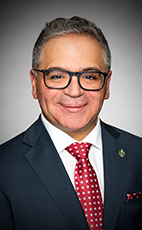
House of Commons photo

Crucial Fact

  • His favourite word was tax.

Last in Parliament April 2025, as Liberal MP for Vaughan—Woodbridge (Ontario)

Lost his last election, in 2025, with 38% of the vote.

Statements in the House

Online Streaming Act May 11th, 2022

Madam Speaker, I thank my colleague from Beauport—Limoilou for the question.

Discoverability in reference to language minorities across Canada, and how that situation may prevail, is something that I find very important. Enhancing accessibility to French-speaking programs across the country is also very important, in my humble opinion.

Online Streaming Act May 11th, 2022

Madam Speaker, I will try my best to answer the query from the hon. member, if I understood it correctly.

I grew up in northern British Columbia at a time when there was no Internet, and we listened to CHTK, which was a local radio station, and a local TV station, so I know how important local radio and local TV are to rural communities from coast to coast to coast. What I will say is that it is comparing apples to oranges when we compare the Internet to radio and the transmission of radio waves in the process.

The bill we are debating tonight is a modernization of part of the Broadcasting Act. It is well needed. It would level the playing field, in terms of bringing the online streamers into the act and under regulation.

Online Streaming Act May 11th, 2022

Madam Speaker, good evening to all my hon. colleagues this evening as we continue to debate Bill C-11, the online streaming act, which is very important to the modernization and amending of the Broadcasting Act. This evening, I would like to focus my remarks on the bill and what it means for the disability community and accessibility in particular.

So far, our debate on the online streaming act has largely focused on how the bill seeks to expand the legislative and regulatory broadcasting framework to include online broadcasters.

However, we must not forget that it is also about making the broadcasting system more inclusive. Ensuring that the Canadian broadcasting system serves all Canadians is an important goal.

In 2019, our government passed the Accessible Canada Act to make Canada barrier-free by January 1, 2040. This historic legislation allows the Government of Canada to take a proactive approach to the identification, removal and prevention of barriers to accessibility in sectors under federal jurisdiction across Canada, which includes broadcasting. Accessibility is part of our government's progressive digital policy agenda, which aims to create a fairer, safer and more inclusive Internet for all Canadians, including disabled Canadians.

Both the Accessible Canada Act and the Broadcasting Act have a role to play in eliminating barriers to accessibility in the broadcasting sector. They work together to remove the barriers to accessibility that people with disabilities continue to face in society on a daily basis.

With respect to the online streaming act, Bill C‑11 helps make Canada barrier-free by strengthening certain provisions of the Broadcasting Act that are designed to provide rights and protections to people with disabilities.

In this regard, the CRTC already has the power to impose accessibility requirements on traditional broadcasting services. To meet the needs of deaf and hard-of-hearing consumers, broadcasters generally need to caption 100% of their programs and meet various quality standards for captioning, including accuracy. To meet the needs of blind or partially sighted consumers, certain broadcasters are required to provide described video for appropriate programming in prime time.

The CRTC also requires cable companies and satellite services to offer persons with disabilities a trial period of at least 30 days so that they can see if the service and equipment meet their needs.

Lastly, the CRTC requires these same companies to supply their subscribers with set-top boxes and accessible remote controls when available.

The online streaming act updates the key tenets of the Broadcasting Act to strengthen the accessibility of the Canadian broadcasting system. First, it states that the system should include all Canadians, including persons with disabilities.

Second, it states that the Canadian broadcasting system must offer programming that is accessible without barriers to persons with disabilities. I want to make it clear that our bill strengthens this objective by striking “as resources become available” from the Broadcasting Act.

This is so that the availability of financial resources specifically can no longer be used to justify the existence of barriers that prevent the inclusion of persons with disabilities.

Finally, the online streaming act amends the Broadcasting Act to clarify that the CRTC should regulate the Canadian broadcasting system in a manner that “facilitates the provision of programs that are accessible without barriers to persons with disabilities”. The policy direction to the CRTC will reinforce this objective.

In addition to these key principles, our bill gives the CRTC the power to impose conditions of service on traditional broadcasters, such as TVA and CTV, and online broadcasters, such as Netflix and Illico, as well as cable broadcasters, such as Videotron and Rogers, to ensure programming accessibility. The CRTC will have the power to impose conditions of service that relate to the identification, prevention and removal of barriers to programming access.

The bill would also give the CRTC the power to impose monetary penalties on broadcasting services that do not comply with the regulations or orders. Conditions of service would therefore be linked to monetary penalties. As such, the CRTC would be able to impose monetary penalties on broadcasting services that do not comply with the requirement to provide closed captioning or described video.

I said earlier that the Broadcasting Act works hand in hand with the Accessible Canada Act to remove barriers to accessibility in the broadcasting sector.

Under the Accessible Canada Act, broadcasting undertakings would be required to comply with accessibility regulations and prepare and publish accessibility plans describing how they will identify, remove and prevent barriers in their operations. They would also need to prepare and publish progress reports on these plans and establish ongoing feedback processes.

The CRTC and the accessibility commissioner share responsibility for ensuring compliance with and enforcing the Accessible Canada Act in the broadcasting sector. Both bodies can impose financial penalties on broadcasting companies that do not comply with the various provisions of the law.

With the passing of the online streaming act, we have an opportunity to make the Canadian broadcasting system more accessible and inclusive and to better support Canadians who, for too long, have been marginalized because of barriers to accessibility.

To achieve this, our bill will ensure that the Canadian broadcasting system, through its programming and employment opportunities, meets the needs and interests of all Canadians, including those living with disabilities.

I thank my colleagues for their time this evening and for listening to my remarks on Bill C-11. I look forward to questions and comments.

American Idol Contestant May 11th, 2022

Mr. Speaker, those who do not recognize the name Nicolina Bozzo must google her right now. The 18-year-old singer and songwriter from the city of Vaughan took the world by surprise back in February with her rendition of She Used To Be Mine on American Idol.

Of the life that's inside her
Growing stronger each day
'Til it finally reminds her
To fight just a little
To bring back the fire in her eyes

These are the lyrics from Nicolina's audition song, and she brought back the fire in our eyes. Nicolina keeps raising the bar on American Idol week after week, “flawless” being a recurrent word used by the judges to describe her artistry. The journey of her voice is so infectious that it leaves us all at the edge of our seats and wanting more.

Now in the top five, Nicolina could become the first Canadian American Idol. We cannot get enough of her voice. She makes Canada proud. The city of Vaughan and all of Canada are rooting for her, along with her parents Dave and Marcella, her grandparents and her sisters Alessia and Isabella. Go, Nicolina, go.

Business of Supply May 10th, 2022

Madam Speaker, I understand the member's position. In this House, traditions have been maintained for a very long time, and I could put the question in reverse to the member in terms of what they are asking and how they would feel on the opposite side of the House as well.

Business of Supply May 10th, 2022

Madam Speaker, I thank my hon. colleague for his question.

I will say that a moment of prayer is something that I look forward to when I come into the House. If members of Parliament wish to have a moment of reflection, they may choose to do so. I have never had a friend who was an atheist come to me and complain about such an issue here in the House or anywhere, so that is my answer on that front.

With reference to the treatment of minorities abroad, I was answering the question from the member from New Brunswick on how we must stand up for all religious rights around the world, for whatever group or entity is being persecuted by whichever totalitarian government that may be.

Business of Supply May 10th, 2022

Madam Speaker, I will say this. Whether they are Uighur Muslims in China who are being persecuted, or Christians in the Middle East, Chaldeans or Assyrians, who have been persecuted now for many years and who I gather with at church in Toronto, I will always be there to protect the rights of minorities and especially religious minorities, such as Baha'is in Iran who continue to face persecution from that government. We must always stand up for minority religious rights and acts of intolerance and hatred against those groups.

Business of Supply May 10th, 2022

Madam Speaker, as we continue to build a more inclusive Canada, we know that diversity is our strength in this beautiful country we are blessed to live in.

As we move to a more inclusive country and as we continue to do the work, it involves breaking down the barriers, systemic or non-systemic, that we need to face every day. To make it a more inclusive country, and continue that great work I just noted, we need to make sure that we identify problems that exist: racism, discrimination, anti-Semitism and Islamophobia. Any form of racism or discrimination prevents our country and individuals here from reaching our full potential.

When I read this motion that I have in front of me, I think that maybe the Bloc was trying to get to a more inclusive society: a more inclusive House of Commons. Then I take a step back and ask if this is the biggest issue that I am facing as a parliamentarian, whether here in Ottawa or in Parliament, as a person who is a Christian, a person of Catholic faith, whose children are attending Catholic school in the province of Ontario. We will be baptizing my youngest daughter of seven and a half months at the end of May. I ask myself what the most important issues are that we are facing as a family and as a society. I see the Bloc, and I have many dear friends, I would say, in that party. I ask myself if this is the most important issue. Is this how we build a more inclusive society?

I get to the answer quickly, and the answer is no. We build a more inclusive society by having people of all faiths in this country, and it is a beautiful thing. During the break in April, we had Holy Sunday, Easter, Passover and Ramadan all coinciding for the first time in 33 years. It really reminded me and Canadians from coast to coast to coast just how special a country we have when people of all faiths, including the three major or more prominent world religions, could all celebrate our faiths. I believe it is the Sons of Abraham, going back to my teachings from the Bible and religious studies. We could all participate in those faiths freely, peacefully and respectfully.

In my riding of Vaughan—Woodbridge, I hosted an Eid dinner last week with the City of Vaughan and representatives of Muslim organizations and groups in my riding. It was a gathering of approximately 150 people. I have learned a lot from the Muslim community. I have learned a lot from the Jewish community. I continue to learn a lot about my faith, and how we try to live it in our daily lives.

I think about how to make Canada a more inclusive country and how to make it a better place to live. I think it is a pretty great place to live, and all Canadians would agree with that. When I think about that, I would not support this motion. I have already stated that. It would not make us more inclusive. In fact, for a lot of people, it would actually do the opposite. I do not think it reflects the priorities of Canadians.

As I have said, I have never had any individual come to me and say that we needed to change the national anthem and get rid of the reference to God, or that we needed to change the items in the House. This House does have some traditions that need changing to make it more inclusive for women and families: absolutely. At the same time, there are things, from what I have come to understand, that I do not think are important.

My focus, in being here from the riding of Vaughan—Woodbridge, is to always produce and advocate for a stronger economy for my three beautiful children and to make sure they have a bright future. I know you, Madam Speaker, have grandchildren, if I am not mistaken. That is why I ran: to make a stronger economy, because I did not like what I saw under the prior Conservative administration headed by Mr. Harper.

At the same time, I am here to make Canada a more inclusive country. I know our government has worked hard to do that and has put in many policies on the economic front, such as the Canada child benefit and the Canada workers benefit. There are also policies to help communities like the wonderful Black community here in Canada, which numbers over a million people. We have put in place certain policies to break down systemic barriers. That is truly creating an inclusive country, not bringing a motion that I think, more than anything, divides rather than making Canada more inclusive, and fundamentally making this place where we work, day in and day out, more inclusive.

I will stop there. I respect the Bloc and its members. As I said, I have many friends on that side. I am in disagreement with this motion that they have brought forward.

Business of Supply May 10th, 2022

Madam Speaker, you have the latitude regarding whether what I say is appropriate or not. I believe it is. It speaks to particular issues that are relevant here in Canada that we must continue to deal with, and it pertains to the motion at hand.

For many, especially Black and indigenous people, this has been their everyday reality for generations.

These issues are especially felt by people from racialized, religious minority or indigenous backgrounds, and have been exacerbated by the COVID-19 pandemic. Racism and discrimination in our society cause suffering, spread division and contribute to a climate of fear, intolerance and stigmatization that we cannot accept.

According to the 2021 Canadian legal problems survey conducted by Justice Canada and Statistics Canada, more than 38% of the respondents in Canada reported having experienced discrimination in the preceding five years, which includes the first year of the pandemic, in almost every context, from school to the bank to restaurants and more. This is a widespread problem that we cannot ignore.

During the pandemic, race and ethnicity were the most frequently cited factors for discrimination and the only ones that have increased. We should be strongly concerned, for example, that members of the Chinese population were 10 times more likely to face racial or ethnic discrimination than a person who was non-racialized.

Consequently, the number of hate crimes is on the rise. According to Statistics Canada—

Business of Supply May 10th, 2022

Madam Speaker, it is great to see you in the chair this afternoon. I hope you and the rest of our hon. colleagues are having a productive week here on the Hill. It is nice to see the sun shining as well and the nice weather. It always brings hope. The Tulip Festival is happening here in the nation's capital in the coming days, so hopefully we will see Canadians come here from coast to coast to coast to visit our nation's capital.

I do not want to reiterate fully what my colleague from Kingston and the Islands said. I too have been here for three elections and am in the seventh year, if we calculate that numerically, and I do not think I have ever received a query or comment about removing references to God in anything, or anything to that effect, from any individual. I am therefore very surprised with regard to the motion brought forward by the member for Drummond.

I am also a little disappointed. I think we are seized with many issues in the world and in the country. Yes, we can walk and chew gum at the same time with the issues we are seized with, be it inflation, a need in our very strong and growing economy for additional labour supply in this country and for an increase in labour force participation rates or the war in Ukraine, an unprovoked, barbaric instigation of aggression by Putin's regime in Russia. We have issues that we need to grapple with. We need to focus on those issues.

This, to me, seems like an issue that is not, I would say, important. I will state that I am against this motion, full stop. I do not like the spirit of the motion. I also do not like the process by which it was brought forward. I am fully against it at this time and will state that at this moment.

I do wish to turn my attention to some prepared remarks I have for the remainder of my time.

Today, I rise to highlight the importance of staying the course in the fight against racism and discrimination in Canada.

Many Canadians believe that because we live in a multicultural society where diversity has become a fundamental element of the Canadian identity, racism and discrimination do not occur in Canada. That is not true.

For many, especially Black and indigenous people—