
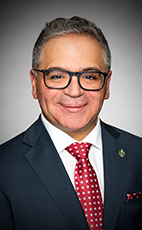
House of Commons photo

Crucial Fact

  • His favourite word was tax.

Last in Parliament April 2025, as Liberal MP for Vaughan—Woodbridge (Ontario)

Lost his last election, in 2025, with 38% of the vote.

Statements in the House

Business of Supply February 10th, 2022

Mr. Speaker, I will be sharing my time with my colleague and friend, the hon. member for Aurora—Oak Ridges—Richmond Hill.

I wish to start off in today's discussion with a very simple statement. I want to start by thanking Canadians. I wish to thank Canadians because we have asked much from Canadians for the last two years, and Canadians have been resilient. They responded.

What have we asked from Canadians for the last two years? We have asked Canadians to wear a mask. We have asked them to socially distance. We have asked them to reinforce their hygiene standards and wash their hands more frequently. We have asked them to refrain from being with family on the holiest of holy days, whatever their religion, and not to be with family members. We have asked them to remain, as our family has done, among one or two families. We have asked businesses owned by Canadians to stay shut down. Obviously, our government stepped up and had their backs, whether it was workers, seniors or entrepreneurs, and helped them during this time.

Why have we asked this of Canadians? We asked it because we are in a pandemic. Canadians provided us the time to receive the vaccines, which we received. They provided us the time to protect our health care system, because we needed to do so, and I wish to thank Canadians for their resiliency, because that is what this debate is about. That is why we were elected to serve as 338 parliamentarians. It was not to be in the weeds, but to look at the big picture.

We are making much progress. Ninety per cent of the residents of York Region are vaccinated. The number of boosters being given continues to rise. Our hospitalizations are down. Surgeries, many of which had been cancelled, are being rescheduled. A new normal is returning, but it is due in part to the sacrifices of Canadians, to Canadians' following not the government's advice but the advice of our public health officials. We cannot lose sight of that fact.

Many lives have been delayed. Many lives have been disrupted. Many Canadians have passed away from this pandemic. We cannot lose sight of the big picture. We are going the right way. We are making progress as a country, not individually but together.

As a parliamentarian, I believe in doing what is right and communicating to my constituents the public health advisories on what we should do to protect our families and loved ones so we can get to a better day. It is coming, absolutely. We are seeing changes on restrictions, especially at the provincial level, and that is the right thing to do. Ninety per cent of Canadians are vaccinated with their double dose. That is wonderful. We should be proud. We should be proud that we are protecting our health care system. We should thank the frontline workers for what they have sacrificed for the last two years. That is what we should be doing.

We should continue, yes, to re-evaluate the science. We cannot put an arbitrary date on when we can lift this or lift that. That does not work. We have seen that. We have seen it in province after province. If they lifted prematurely, their hospital system became overwhelmed, their ICU capacity became overwhelmed, their supply chain became disrupted and they were back at square one. Let us go 10 steps forward at a time and maybe one step back, instead of four steps forward and 20 steps back. That is what our government is doing. We are there to assist Canadians and we will continue to do so.

As I stated at the beginning before going to my formal remarks, I want to thank Canadians today. I wish to thank them for doing the right thing, for getting us through this pandemic as we continue to go forward. Yes, I believe the light is at the end of the tunnel. I completely have confidence in that. Why? It is because of vaccines, because of the science of vaccines, because we have done the right thing and because Canadians have been resilient.

I understand that the official opposition has come on side now, although kind of late, to say that the blockades should stop. We should not be interrupting the lives of auto workers, farmers or our agri-food business. Many of the opposition members represent rural ridings that have a lot of farmers. I do not think it is very impressive that we are blocking borders so that we cannot ship our farm products to the United States. I do not think it is very impressive that auto workers are being forced to stay home because of blockades, which up until three days ago the Conservative Party was in favour of. That is not reasonable leadership; I would call it otherwise. We need to do what is right for Canadians day in and day out. We are in a pandemic, a once-in-a-hundred-years event. It requires maturity and it requires leadership.

It has been more than two years since our border measures were put in place to help keep Canadians safe and protected. As the most serious public health crisis in the last century unfolded, the Government of Canada acted quickly to put in place emergency border measures to reduce the risk of the importation and transmission of COVID-19 and new variants into Canada through international travel. The border measures that have been implemented are informed by data and available scientific evidence, not just by pulling dates out of thin air. They also come from monitoring the epidemiological situation in Canada and in other countries. Measures are adjusted as required to respond to the evidence while continuing to protect the health of everyone in Canada.

Starting in January 2020, enhanced screening measures were put in place for passengers who were arriving from areas where the COVID-19 virus was rampant. As the virus spread to other countries and became more of a danger, these screening measures were further enhanced with additional questions and referrals of incoming passengers to the Public Health Agency of Canada. Eventually stronger measures had to be put in place to protect our country and its citizens, such as the ban on the entry of foreign nationals into Canada. Canada was not alone in closing its borders for discretionary travel at that time. Many other countries also put in place severe restrictions on travel, including other G7 countries and our neighbour to the south, our largest trading partner.

As the pandemic wore on, the Government of Canada never lost its focus on the health and safety of all Canadians. Decisions around protocols and measures were taken to reduce the effects of COVID-19 on our citizens and on our economy so that our Canadian economy could quickly recover, and it was great to see that our output is larger than it was prepandemic. It is great to see that employment levels are above where they were prepandemic. Why? It is because we did what was right for Canadians. We had their backs, we put in place proper measures that we all know about and we invested in Canadians. It was the right thing to do.

In June 2021, the government announced the first phase of its approach to easing border measures for travellers entering Canada, and the Government of Canada continues to make cautious adjustments to its border approach by using the latest scientific evidence and data. These changes are possible thanks to our vaccine adoption rate and our adherence to existing public health measures. The overwhelming majority of Canadians adhered to protocols and measures and got vaccinated not only once but twice, and for many there was even a third booster. They have shown courage, resilience and compassion, and, yes, they have sacrificed. I thank them, as their actions have been crucial in giving us, the Government of Canada, the leeway to reduce and even remove some of the measures that were put in place at the beginning.

Earlier measures have been adjusted. In August and September 2021, the government continued to reopen Canada's borders, allowing fully vaccinated leisure travellers from the U.S. to enter Canada starting on August 9, followed by fully vaccinated travellers on non-essential trips from all other countries on September 7. The government also eliminated the requirement to stay in government-authorized accommodation upon arrival.

As I quickly conclude my remarks, I want all parliamentarians to take a step back and look at the big picture of where we are and where we have been and see that we are is in a much better place. There is work to be done and progress to continue to be made, but we must follow the science.

I do ask, and I have asked this on national television, that the blockade stop and that the protesters outside, with the utmost respect to those individuals protesting, go home and allow the citizens of Ottawa to regain their normal lives.

Business of Supply February 8th, 2022

Mr. Speaker, we have a wonderful Minister of Intergovernmental Affairs, Minister of Environment and Minister of Finance, and our bar is very high on reducing greenhouse gases across Canada and transitioning to a low-carbon economy. If the Province of Saskatchewan meets that bar, then it would implement its own carbon pricing model, but until it does, the federal government's model will be the one in place.

Business of Supply February 8th, 2022

Mr. Speaker, I thank the hon. member for Winnipeg North for all the work he does in the House.

This is the right thing to do. Canadians sent us here to work collaboratively with all members of this House to get things done. This is, yes, long overdue. It will provide for a fairer taxation system for the Province of Saskatchewan and for the residents of Saskatchewan, and we will work with the Province of Saskatchewan to get this completed.

Business of Supply February 8th, 2022

Mr. Speaker, I thank my hon. colleague for his question.

I want to comment on the importance of the French language for me and my family. Since I was elected in 2015, I have taken it upon myself to learn French as well as possible, but more importantly, both of my daughters are in French immersion.

French is very important to me and my family. My daughters are studying the language so that they can speak it proficiently.

Speaking French is quite difficult for me.

I hope it will be easy for my daughters to learn French and be fully bilingual. I will be very proud at that moment.

Business of Supply February 8th, 2022

Mr. Speaker, when we are looking at an amendment to the Canadian Constitution and the Saskatchewan Act, it is the right thing to do to work with the provinces.

A collaborative fiscal federation, which Canada is, requires responsible leadership. That is what our government has demonstrated on this file by working with the Province of Saskatchewan and the official opposition and ensuring that the province's requests are listened to and acted upon. This is the right thing to do for the Province of Saskatchewan and all the wonderful people who currently reside in that province.

Business of Supply February 8th, 2022

Mr. Speaker, it is great to resume the debate today on the opposition motion and see unanimity between the government and the official opposition party.

I was talking earlier about our support for the Province of Saskatchewan throughout COVID. Some of the numbers I announced or detailed earlier are that more than 240,000 Saskatchewan residents received support through the Canada emergency benefit at some point. That is approximately 20% of the population. In addition, Saskatchewan is receiving $1.3 billion through the Canada health transfer and nearly $500 million this fiscal year through the Canada social transfer.

Canada works best when governments work collaboratively and in the interests of Canadians. In this regard, I would like to point out that the land of the living skies is one of the jurisdictions the federal government has entered into an agreement with to build a Canada-wide early learning and child care system.

I want to point out the fact that during the election in 2021, the Conservatives campaigned against this early learning child care system. In fact, they would have scrapped it had they won. However, they did not win, and we are proceeding forward, with all provinces and territories having signed, except for the Province of Ontario. I encourage the Province of Ontario to come to an agreement with our government. I have a great respect for all the ministers involved, who are working judiciously and diligently, and I know that at a certain point in time we will get there.

I would like to announce that all Canadians will be covered, hopefully sooner than later, with a national early learning and day care plan. That is not only good for the economy, which I talk about quite a bit in this place, but is great for families, including my own. With a four-month-old at home, I hope to take advantage and have the opportunity to utilize lower day care fees, especially in the area of York Region, where fees can be anywhere from $1,000 to $2,000 a month in after-tax dollars. By the end of this year, Saskatchewan families will see a 50% reduction in average parent fees for children under the age of six in regulated child care. That is real progress with respect to affordability for Canadian families, in this case Saskatchewan families.

In addition to significantly reducing the costs of child care, federal funding of close to $1.1 billion over the next five years will also lead to the creation of 28,000 new regulated early learning and child care spaces in that beautiful province.

Providing services to the public requires an ongoing commitment on the part of governments to ensure that everyone pays their fair share. This is something we need to keep in mind as we look at the provincial government's request. I support the province's request to amend the Saskatchewan Act. This amendment would be made under section 43 of the Constitution Act of 1982, because this change affects only one province.

This amending formula has been used before. For example, it allowed enshrining the equality of New Brunswick's English and French linguistic communities in the Canadian Constitution. It allowed for the construction of the Confederation Bridge to replace the requirement for a ferry service to Prince Edward Island. It allowed Quebec to abolish its Catholic and Protestant school boards and replace them with an education system organized along linguistic lines. It allowed for the name of the Province of Newfoundland to be changed to the Province of Newfoundland and Labrador. In all these cases, the provincial legislatures adopted the change, and the House of Commons and the Senate did the same after considering the matter judiciously, as we are doing today.

These changes reflect what Canada is today, and so does Saskatchewan's request. The amendment would strengthen the fairness of Canada's tax framework, as our government has done and has continued to do since 2015, when in our first mandate we raised taxes on the wealthiest 1% of Canadians because it was the right thing to do. We also brought in two middle-class tax cuts, one in 2015 and one in 2019, which have returned literally billions of dollars to middle-class Canadians from coast to coast to coast.

Saskatchewan is one of our partners in Confederation, and it can be sure that the federal government is there to support it, not only in this matter but also in getting through the pandemic.

Those are my remarks this afternoon. I look forward to entertaining questions and comments from my hon. colleagues.

Business of Supply February 8th, 2022

Madam Speaker, it is great to be here with all my colleagues, both physically here in the House and virtually. I am honoured to take part in this debate, as a westerner by birth and someone who lives in Ontario now. It is always great to support my colleagues in the beautiful province of Saskatchewan.

Today we are considering a request from Saskatchewan to amend a part of the Canadian Constitution. It is a small part, it is true, but such a request deserves our immediate attention because it is long overdue. Parliamentarians who wish to do so should have a say. We are having this debate because on November 29 of last year, the Legislative Assembly of Saskatchewan unanimously passed a resolution to repeal a section of the Saskatchewan Act.

History buffs, and I know there are many in the House, will know this act received royal assent in 1905. It is best known for having created the Province of Saskatchewan, and it was adopted at the same time as the Alberta Act, creating the Province of Alberta. Both were created from parts of the Northwest Territories. Alberta and Saskatchewan became the eight and ninth provinces of Canada on September 1, 1905. Both acts were enshrined in the Canadian Constitution in 1982, and this why the change requested by Saskatchewan requires an amendment to the Canadian Constitution.

The resolution passed by the Legislative Assembly of Saskatchewan specifically calls for the repeal of section 24 of the Saskatchewan Act. This section relates to the clause of a contract signed in 1880 between the Government of Canada and the founders of the Canadian Pacific Railway company.

I want to note that I will be sharing my time with the hon. member for Winnipeg South Centre.

At the time, Saskatchewan was not yet a province and Sir John A. Macdonald was the Prime Minister. In a nutshell, the clause exempted the CPR from certain federal, provincial and municipal taxes.

As noted in Saskatchewan's resolution, a large corporation should not be exempt from paying provincial taxes. I agree with this assessment. Our government has been very clear that everyone should pay their fair share of taxes, and that certainly includes corporations.

We are focused on strengthening the middle class and building an economy that works for everyone. To do that, Canadians need a tax system that is fair and equitable. It is why we cut taxes for the middle class and asked the wealthiest 1% to pay a little more. It is also why we want to make sure companies, including large digital corporations, pay their fair share of tax in Canada.

Corporations need to pay a fair share of tax in the jurisdiction where their users and customers are located. Whatever the historical context, there is no reason in this day and age the CPR should get the benefit of a tax exemption that no on else receives. It is not consistent with Canada's current tax policies, nor with its fiscal policies.

If the Government of Saskatchewan wants to make the tax system fair, it will wholeheartedly find support on this side of the House. It is great to see collaboration among the parties. It is what Canadians sent us here for: to work for their interests and make this country a better place.

The COVID-19 pandemic has shed new light on the importance of delivering services to Canadians in a timely and efficient manner. Our economic response plan has helped Canadians and businesses weather the storm, including the wonderful and kind people of Saskatchewan. Let me share some of the specifics with the House.

Thus far, the federal government has allocated more than three million doses of COVID vaccines to Saskatchewan. Several million rapid tests have also been shipped to the province. All of that was free of charge.

The Canada emergency wage subsidy has protected more than 100,000 jobs in Saskatchewan. About 30,000 loans totalling $1.6 billion have been made to Saskatchewan businesses through the Canada emergency business account. More than 240,000 Saskatchewan residents received support through the Canada emergency response benefit at some point. Out of a population of 1.1 million, that is more than one in five people, or over 20%. In addition to this, in 2021-22, Saskatchewan is receiving $1.3 billion through the Canada health transfer and an additional $478 million through the Canada social transfer.

Canada works best when governments work collaboratively in the interest of Canadians. In this regard, I would like to point out that the “land of living skies” is one of the jurisdictions with which the federal government has entered into an agreement to build a Canada-wide early learning and child care system.

COVID-19 Protests February 7th, 2022

Madam Speaker, the lines of communication between the federal government and the City of Ottawa and the Ottawa Police Service have been constantly open, and they have been constantly there.

We are collaborating. We are assisting them with resources, from RCMP officers to intelligence gathering. Anything they need, we are obviously there. We do not direct the policy force to do anything or to undertake any sort of activity. They are independent, and there is a reason for that, of course.

I would say to my hon. colleague that we are in constant contact with the City of Ottawa, their mayor and the Ottawa Police Service for the resources they require in this situation.

COVID-19 Protests February 7th, 2022

Madam Speaker, I would like my Bloc Québécois colleague to know that leadership is very important for us.

We have shown leadership in working with the Ottawa Police Service and the City of Ottawa, in collaborating with them and sending them resources from the beginning of the convoy up to date. We have shown leadership in providing the resources they require.

Again, I wish to reiterate, how can we go and negotiate with individuals who want to overthrow the democratically elected government that Canadians voted for in the last election? To me, that is preposterous and it is wrong. We cannot go and negotiate with entities that want everything for themselves and have no desire to co-operate, and, in fact, are not following public health guidelines so that we could finally exit this pandemic.

COVID-19 Protests February 7th, 2022

Madam Speaker, our government put in place a measure to help protect Canadians, including, in this instance, truckers.

I spoke with a president of a trucking company in the region I represent, with 1,300 employees and 3,000 trailers, and 95% of his truckers are vaccinated. He operates in York Region and in the Midwest, in Chicago. He said to me, “Francesco, it is the right thing to do. All my employees who cross that border are vaccinated.”

That is what I believe in. We gave the industry a long runway to prepare for this measure. We spoke with the Canadian Trucking Alliance and they support us. They support this stance. That is what we need to do.