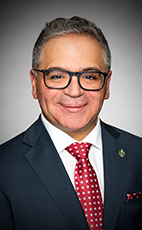
House of Commons photo

Crucial Fact

  • His favourite word was tax.

Last in Parliament April 2025, as Liberal MP for Vaughan—Woodbridge (Ontario)

Lost his last election, in 2025, with 38% of the vote.

Statements in the House

Business of Supply January 28th, 2020

Mr. Speaker, I have great respect for the Auditor General for the work it has done over the decades for Canadian taxpayers. That is a focus in my riding and for my constituents. They know that we have invested in 4,800 projects since the start of our plan with over $57 billion invested. We will continue to work with our partners at the regional, municipal and provincial levels to ensure those dollars flow out the door and into vital infrastructure, whether it is fighting climate change or investing in public transportation and so on.

Business of Supply January 28th, 2020

Mr. Speaker, this morning I read one of the PBO reports that says 900,000 Canadians are going to be taken off the tax rolls with our increase to the basic personal exemption amount and 21 million Canadians will receive a tax break, that is, more tax dollars in their pockets.

I look forward to the PBO undertaking more analysis of our government proposals and plans to invest in Canada and Canadians to keep growing our economy, creating jobs and lifting people out of poverty, because that is what we ran on in 2015 and that is what we ran on in 2019. I look forward to the PBO undertaking further analysis.

Business of Supply January 28th, 2020

Mr. Speaker, I hear some of my colleagues on the other side agreeing with what I said. I thank them for those comments, and I look forward to their questions afterwards.

What I will say is we have worked. We have signed bilateral agreements with provinces and territories from coast to coast to coast. We have been working with the cities. We have worked with the FCM. There has been no better relationship for representatives at the table for stakeholders, whether it is mayors, chairs of regional areas or premiers. We have worked in tandem. The door to our government has been open to ensure that projects that are identified by the cities as key projects, and we know it goes bottom up, are paramount for investment.

Looking at the government record, we can see that 4,800 projects have been started and are in different stages of construction, and we can see the $57 billion that has been approved. We are working well with our partners. This is a much different story than what happened in the past. That was not a story we could tell in this chamber that we are privileged to sit in, representing our constituents.

With that, I would like to focus my remarks today on the essential importance of partnerships and the partnerships we have seen through the green municipal fund. The green municipal fund is currently a $1.5-billion revolving fund administered by the Federation of Canadian Municipalities to help support municipal sustainability, innovation, across the country.

It was under a previous Liberal government that the GMF was created as an important policy instrument for gaining experience in the development and execution of sustainability projects. Working together, in collaboration with all levels of government across this beautiful country that we live in, we are continuing to execute the building of necessary infrastructure that we all need for a successful, productive and prosperous country that we call home.

Working together, we have established and are sharing best practices and lessons learned, and improving the overall environmental performance of municipal installations.

Federal government involvement with the Federation of Canadian Municipalities green municipal fund is a reminder of how well the federal government can work with funding organizations and other key stakeholders to support the efforts of municipalities in achieving their environmental sustainability goals.

We know how important climate change is. It was great to announce, in York region, funds allocated to the disaster mitigation fund. It was great to announce, in York region, funds dedicated to waste and waste-water treatment facilities. Those types of dedicated funding sources improve quality of life and productivity in our region. That is what we will continue to do as a federal government, working with the regional authorities, our municipalities and the Province of Ontario.

I want to state that I will be sharing my time with my friend and hon. colleague, the member for Ottawa Centre.

How can these goals be achieved? Our government is in strong partnership with the green municipal fund, which provides financial support to municipalities with environmental projects related to brownfields, energy, water, transportation and integrated community plans.

Since 2000, the GMF has supported more than 1,200 municipal sustainability initiatives through its unique mix of training, resources and funding. Of the initiatives funded to date, 199 have been capital projects that involved retrofitting, construction, replacement, expansion or purchase and installation of fixed assets or infrastructure.

These capital projects have cumulatively helped to reduce greenhouse gas emissions by over two million tonnes, improve the quality of about 700,000 cubic metres of soil, treat more than 240,000 cubic metres of wastewater per year, make about 80 hectares of previously contaminated land available for use, reduce water consumption by almost 310,000 cubic metres per year, and divert 170,000 tonnes of waste from landfill per year.

Again, we are making progress in our plan to invest in Canada and in Canadians through our $180-billion-plus infrastructure plan. It is transformational. It answers the call of climate change and it answers the call of a growing population and the need to replace aging infrastructure.

We know what the deficit is. We know the deficit was less. We are chipping away at it. We are working well with FCM. We are working well with our big city mayors. We are working well with the provinces. We are at the table. We are signing those bilateral agreements and, most important, we are listening to the cities and to their priorities.

The GMF is delivered by the FCM on behalf of Environment and Climate Change Canada, Natural Resources Canada and Infrastructure Canada. Our job as the government is to provide oversight of GMF operations through the GMF council and the peer review committee.

For the record, the GMF council is made up of 15 members, five of which are federal. The council advises the FCM on the management of GMF. The council is made up of federal representatives from Environment and Climate Change Canada, Natural Resources Canada and Infrastructure Canada; municipal officials; and external members representing the public, private, academic and environmental sectors.

The peer review committee comprises 75 members, 20 being federal. This committee provides the GMF and the federal council members with expert environmental science as well as clean technology advice, analysis of funding proposals and the evaluation of the environmental outcomes of the projects that are funded.

In 2000, the Government of Canada created two complementary GMF funds, the first being the green municipal enabling fund and the second being the green municipal investment fund, where program delivery was delegated to the Federation of Canadian Municipalities. They know best.

Whether in rural Canada or urban Canada, in whatever jurisdiction and whatever province we may call home, the mayors and the local city councillors know best the needs of their cities. Whether it is housing being built, investments in sidewalks or investments in local soccer fields for kids to play on safely, they know and we are listening to them and partnering with them. For more than four years, there has been no better partner for the cities in Canada than this government, and this will continue.

Over the course of 2000-2005, the Government of Canada endowed the Federation of Canadian Municipalities with $550 million to establish the GMF. This amount comprised an initial endowment of $125 million in budget 2000, a subsequent endowment of $125 million in 2001, and $300 million in 2005. In 2005, a new funding agreement was signed, merging the green municipal enabling fund and the green municipal investment fund into a single green municipal fund.

Moving forward, when we brought in budget 2016, the Government of Canada committed an additional $125 million to the GMF as part of Infrastructure Canada's investing in Canada plan.

We know the investing in Canada plan is making a difference in the daily lives of commuters and in the daily lives of citizens across this country, whether they take public transportation or need their own vehicle to commute to work or take their kids to a soccer field, an ice hockey rink, baseball field or to get some STEM lessons, which we know are so important in tomorrow's economy.

This subsequently brought the total endowment to $625 million. To manage this additional funding from budget 2016, a new funding agreement was signed in 2018 by Environment and Climate Change Canada, Natural Resources Canada, Infrastructure Canada and FCM. Again, we are partnering with the partners that know best where these dollars need to flow to and need to be invested.

Budget 2019, I am proud to say, provided an additional $950 million for the GMF transfer through NRCan. The $950 million will support three new program streams, planned for launch in late spring or early 2020. They are focused on increasing energy efficiency. The programs are low-carbon cities Canada, sustainable affordable housing and innovation, and community eco-efficiency acceleration.

To date, the Government of Canada has invested a total of $1.5 billion in the GMF, of which the FCM is to hold over $1 billion in perpetuity. It is in an annuity, in terms of being able to invest continually without seeing a sunset clause of when those funds will not be there. Long-term strategic investments can be made in what is best for the cities and towns that we call home across this country.

This additional funding will help accelerate the government's climate change objectives, specifically financing investments at the municipal level and energy efficiency in residential, commercial and multi-unit buildings. FCM anticipates the end of the five-year current plan for the GMF in 2023.

Business of Supply January 28th, 2020

Mr. Speaker, it is great to be here to speak on an important topic that impacts Canadians from coast to coast to coast. The region I live in, York region, will see over a quarter of the population growth in Ontario settle there in the coming years. With that, the need for new modern infrastructure investments will be even greater.

Economic activity in York region is second to none. We are an area of almost 1.3 million people. There are leading technology, auto parts, auto manufacturers and tech companies in York region. Modern infrastructure is necessary to get our families and kids home safely in the evenings. It is necessary to have the resources for Internet in rural areas in Canada, including the northern areas in York region.

Before I begin speaking specifically about some of the actions we have taken and specific funds, I want to say that our government is committed to investing in infrastructure across Canada. We are committed in our plan.

When we talk about deficits, we know the prior government left a number of deficits. It left an infrastructure deficit, a social deficit, a green deficit and a cultural deficit. It did that because it had no plan to invest in Canadians.

Veterans December 11th, 2019

Mr. Speaker, Take two minutes, would you mind? It’s a pittance of time
For the boys and the girls who went over
...
...may we never forget...
It’s a pittance of time

This year marks the 75th anniversary of the Italian campaign. I had the honour to be a part of the delegation following the path of our 93,000 courageous Canadian soldiers who helped liberate Italy from Fascist occupation. Each row of crosses I saw in each of the war cemeteries visited and the appreciation expressed by the Italian citizens brought me immense feelings of pride and gratitude for our Canadian soldiers.

Nearly 6,000 Canadian soldiers paid the ultimate sacrifice during the Italian campaign for the value of freedom we hold so dear. As we travelled down these Italian roads with our 15 World War II veterans, we finished our song:

But two minutes I will bide. It’s a pittance of time
...
In peace may they rest,
may we never forget why they died.
It’s a pittance of time

Lest we forget.

Resumption of Debate on Address in Reply December 9th, 2019

Mr. Speaker, our economy can only grow and only benefit all Canadians with what is called inclusive growth. We need to target policies that benefit middle-class Canadians. We did it with the first tax cut, benefiting nine million Canadians.

This tax cut would actually take 700,000 people from our tax rolls. That would be 700,000 people across Canada not paying federal tax anymore. That is real change, but it is also giving money back to Canadians who will spend it. What we call in economics the marginal propensity to consume and spend is actually very high. It will benefit those Canadians and benefit the economy the most.

We can only move forward as a country if all Canadians benefit from economic growth, and Canadians benefit from tax reductions.

Resumption of Debate on Address in Reply December 9th, 2019

Mr. Speaker, I thank my colleague for his question.

I am in full agreement with the member from Quebec. In my comments on the throne speech, I said that I fundamentally believed in equality of opportunity for all Canadians to succeed. We need to ensure that Canadians living in rural Canada, in the beautiful parts of our country, are connected to the Internet. The Internet is very equivalent to the telephone of 20 or 30 years ago. Every person in Canada needs to be connected to the Internet to undertake the actions he or she needs to succeed. We need to ensure that. In the prior session, the government invested hundreds of millions of dollars into this and formed partnerships with telecom companies across Canada. We need to ensure that rural Canada is as connected as urban Canada. There cannot be two standards; there has to be just one.

Resumption of Debate on Address in Reply December 9th, 2019

Mr. Speaker, as an economist and someone who follows the numbers in Canada quite closely, what is behind those numbers are stories of Canadians from coast to coast to coast. We have seen net full-time employment rise in the country by over 1.1 million, if not more, in the last five years. We have seen our government take action with the accelerated investment incentive put in place in the prior budget to encourage manufacturers to invest, which is what they are doing. We have seen a resilient economy, and that is backed by resilient Canadians investing in our country.

I would love to sit with the member for Sarnia—Lambton to explain some of the nuances with our foreign direct investment numbers. We are actually seeing an increase in our FDI numbers, especially in the province of Ontario, which has become a leader in financial technology and innovation. Montreal and Waterloo have become leaders in artificial intelligence. Canada has a lot of good things happening.

Resumption of Debate on Address in Reply December 9th, 2019

Mr. Speaker, through you, I wish to congratulate the member for Nipissing—Timiskaming on his election as Speaker. I am very happy for the member and I know he will do a wonderful job for everyone in the House.

I am pleased to speak during the opening days of the 43rd Parliament to respond to the government's Speech from the Throne.

I would like to begin this speech with a big thank you.

I thank the residents of Vaughan—Woodbridge for placing their faith and trust in me for a second term. The citizens in my riding humbled me with a strong vote of confidence in my ability to represent them, tripling the margin of victory and achieving over 50% of the votes cast that evening. It is a wonderful vote of confidence and I wish to thank them.

The results speak to a lot of hard work and an unwavering commitment to my constituents that I always will represent them to the best of my capability and will always be their strong voice in Ottawa. Whether it is through visiting residents in their homes and listening to their concerns and issues, or always being available to our wonderful seniors, whom I love dearly, or listening to the opinions of the dynamic, entrepreneurial and very successful business community, which over the last five years has created over 60,000 new full-time jobs in the city of Vaughan, I will ensure their voices are always heard.

My team of volunteers, those individuals who canvassed, put up signs, sent positive vibes and made the phone calls that count are an inspiration to me. I say a gracious thanks, merci beaucoup, grazie mille.

My wife, Rose, and my children, Natalia and Eliana, are watching today. I love them so much and thank them every day for much patience and love while I do this remarkable job here in Ottawa.

The Speech from the Throne, in my view, is analogous to a blueprint, a blueprint for a more prosperous and inclusive Canada for all Canadians, a blueprint to move the country forward and ensure that we are facing not only the challenges today, but as important, preparing for the ones that may come tomorrow to this beautiful country we call home.

As MPs we have many duties and fiscal responsibilities to fulfill. I believe the most important responsibility we have as members of Parliament is to advocate for policies to provide Canadians with what I call equality of opportunity. Let me elaborate.

It is the utmost responsibility for every single MP to ensure that every Canadian, every citizen, has the opportunity to fulfill their capacity as individuals. That can only be achieved through one thing and one thing only. We ourselves need to demonstrate leadership, but leadership only comes from when we serve. Every single member of Parliament is a servant. As noted by Martin Luther King, Jr., life's most important question is: What are we doing for others? Writer and businessman Max De Pree said:

The first responsibility of a leader is to define reality. The last is to say thank you. In between the two, the leader must become a servant and a debtor.

It is time for all 338 MPs in this wonderful House in the 43rd session of Parliament to be servants, to listen, to act with humility and to ensure that we build a stronger, more inclusive country for all Canadians from coast to coast to coast, one that leaves a healthy environment as well as a prosperous and optimistic future for our children and all the children across this wonderful country.

The throne speech laid out a number of themes that our government will focus on together working with all parties. These include fighting climate change, reconciliation, making life more affordable while we continue to strengthen the middle class, all much important work. I would like to focus my remaining time on the last theme, about the middle class and strengthening our economy.

Capitalism in the 20th and 21st centuries created enormous wealth across this world. It lifted billions of people out of poverty across this globe and allowed innovation, an exponential increase in agricultural yields, advances in technology, medicine and social innovation to occur. The world is more connected than we ever knew it and who knows what will happen in the years to come, but it is a very exciting future.

We as a government will continue to ensure that our policies are based on the values that we fundamentally believe in and care about in this country and are in place to grow the Canadian economy and create good jobs and an optimistic future for Canadians.

Continuing from our first mandate, we will encourage competition, encourage risk-taking and investment by entrepreneurs. We will give Canadians the skills to respond and adapt to an ever-changing global marketplace. We will provide for tax fairness to put more money in the pockets of Canadian families with that goal that we as a government continue to strengthen the middle class, create a more optimistic future and remain the envy of the world.

We saw the results over the first four years with over one million jobs created, primarily full time in where I like to see them, the private sector. Over 800,000 Canadians were lifted out of poverty including over 200,000 to 300,000 children. Those are real stories across Canada. We can pick a province or pick a city and we will see there are Canadians who benefited directly from the policies that we put in place in our first session.

As we did in 2015, our government will again provide tax relief for millions of Canadians. We did it once and we are going to do it again. A promise made will be a promise kept, with a tax cut aimed at those Canadians who need it the most. All Canadians who earn income, whether it is income earned at work, pension income or even investment income, will see a rise in the basic personal exemption amount. This is something that I argued be put in our platform and it is great to see it there. The amount we earn before paying federal taxes will be increased quicker than would happen naturally, from $12,000 to $15,000, while remaining to be indexed. For taxpayers in Canada who earn approximately $15,000, that will mean $300 more in their pockets to spend on the things they deem to be important. Whether they are saving for their kids' future or paying for everyday necessities, it is their money and we are going to give it back to them. This tax cut will provide over $5 billion annually in tax relief to Canadians.

I am proud to be part of a government that is focused on lowering taxes for middle-class Canadians. I am proud to be part of a government that will provide tax relief to Canadians from coast to coast to coast. The first time, nine million Canadians benefited from our tax reduction of approximately $20 billion over five years. Over the next two to three years, we will see $15 billion to $20 billion of tax relief dedicated to those families who need it the most, not the wealthiest 1%, not those earning over $200,000 or $300,000. Average middle-class families in Canada earning $70,000 or $75,000 will see over $600 more in their pockets. That to me is great news.

I am blessed to represent a riding that is defined by dynamic entrepreneurial spirit and a can-do attitude. It is an attitude I see every day in the nearly 12,000 small businesses that are located in the city of Vaughan and the approximately 4,000 that are located in my riding. It is a spirit of asking what they can do for this country rather than the opposite. It is a spirit of hiring and growing our economy, a spirit of getting to work and making things happen. These business owners and entrepreneurs have my utmost respect. Their success is not due to luck but due to hard work and perseverance.

Some of the most successful entrepreneurs and private enterprises in this country are in my riding. I know first-hand that we must focus on policies that encourage investment, but also provide for what I call inclusive growth, which is when growth occurs, all Canadians benefit.

That has been the focus of our government from the beginning. It is a focus on returning money to Canadians through our middle-class tax cuts, a focus on the Canada child benefit, where eight or nine out of 10 families in Canada were made better off. In my riding, every month, $5 million arrives tax-free to the families in my riding, helping almost 18,000 children and over 10,000 families. That is real change. That is the change that Canadians elected us on in our first mandate.

In this session, I am glad to see in our platform further adjustments to the Canada child benefit that will help families not just in my riding but, more importantly, from coast to coast to coast. We will continue lifting children out of poverty. We will continue creating those good, full-time jobs in the private sector that we saw in our first four years. In fact, for the last 12 months, starting in November 2018 to today, almost 300,000 new full-time jobs have been created in Canada. We still have one of the lowest unemployment rates in the world, depending on how we want to use the measurements. However, if we compare apples to apples, we are among the lowest.

I spent over two decades working in global financial markets. I grew up in a small town and worked at a pulp mill, a grain elevator and McDonald's, which was one of my first jobs. I know the value of hard work. Hard work is what defines this country. It is what defines the constituents in my riding. That is why we as a government will continue to listen to the hard-working Canadians from coast to coast to coast. We will continue to put in place policies that grow our economy.

I see some of my colleagues from the opposition parties who reside in the beautiful province of Alberta. We will make sure the TMX pipeline gets built. It is being built. This will bring our resources to new markets and make sure we are capturing that full price and lower the differential between oil prices that has hampered the economy of Alberta for the last several years. We need to make sure we get full price for our products and our resources.

I look forward to working with all my colleagues from all parties, in the 43rd Parliament.

One of my hallmarks of the 42nd Parliament was to reach out to individuals from other parties, to say hi, to become friends with them and get to know them. If many of us in this House do that, we will see a much more congenial place and a nicer attitude. I see some smiles across the aisle.

Mr. Speaker, through you, I would like to say good morning and bonjour à tous. I would also like to say a special good morning to my kids, and tell them to stay strong, that daddy loves them and he will see them soon.

With that, I look forward to questions and comments.
Business of Supply June 18th, 2019

Mr. Speaker, I listened to my colleague intently, who I have the pleasure of sitting on the finance committee with, to see if he would offer up some new ideas or policies instead of regurgitating talking points that I constantly hear.

He did speak about small businesses, so I will comment on that. He did not mention the small business tax rate that we reduced from 11% to 9% that benefits over 11,000 businesses in the city of Vaughan. He did not talk about the accelerated investment incentive that allows businesses across Canada, from coast to coast to coast, to fully write off their investments in a full year. He did not speak to the EI rates that are now the lowest in a generation that are benefiting businesses across the country. He did not talk about the Canada pension plan that is going to benefit hard-working Canadians, who go to work every day and save for their futures, which is portable, indexed and the model for the entire world. He did not reference those things. Then, when he should have been speaking about climate change, he did not even speak about whether he believes in climate change or we should act.

I would ask the member across the aisle what he thinks we should do about climate change and how we should reduce emissions going forward. We have a plan. Where is your plan?
