
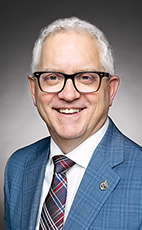
House of Commons photo

Crucial Fact

  • His favourite word was saskatchewan.

Last in Parliament April 2025, as Conservative MP for Desnethé—Missinippi—Churchill River (Saskatchewan)

Won his last election, in 2021, with 49% of the vote.

Statements in the House

Criminal Code March 30th, 2022

Madam Speaker, when I spoke to the first iteration of this bill back in April 2021, I remarked at the time on how out of touch the Liberal government had become. If anyone from the new NDP-Liberal coalition actually took time to come and speak to mayors, chiefs and councillors, or the RCMP members in northern Saskatchewan, they would know that bills like this do far more to hurt communities than to help them.

When I speak to elected leaders, I constantly hear that there are violent offenders they do not want in their communities. In fact, they are searching for ways to keep them out. They wonder why these repeat offenders cannot remain in custody and why they are allowed to keep returning to victimize their communities. They are frustrated. They realize that when certain people are removed, they seem to have a time of peace and quiet. This bill would add to the frustration.

Bill C-5 would eliminate mandatory minimums for offences such as robbery with a firearm, extortion with a firearm, weapons trafficking, importing or exporting knowing a firearm is unauthorized, and discharging a firearm with intent. The list goes on. The Minister of Justice, just this afternoon, told us that he believes these are just minor offences. I do not believe these are minor offences.

Police officers, judges, prosecutors and many others in the communities already do everything they can for non-violent offenders to ensure they have every opportunity to stay out of prison. Sometimes the peace of mind that comes with mandatory minimums is essential to ensure our communities feel safe and are safe.

In northern Saskatchewan, there is a concerning trend of witness intimidation, as well as increasing recruitment of young people into gangs and the drug trade. Mandatory minimums assist the police and prosecutors to ensure the safety of witnesses. By keeping violent offenders off the street, greater opportunity is provided to engage in early intervention and prevent criminal gang recruitment.

March 17, just last week, Meadow Lake's RCMP Staff Sergeant Ryan How wrote an article in Saskatchewan Today. It reads:

From October 1, 2020, to March 15, 2021, Meadow Lake RCMP responded to 66 firearms complaints. In the same time frame in 2021 to 2022 RCMP have received 30 firearms complaints. Any level of gun violence is unacceptable and the Meadow Lake RCMP Detachment is unfortunately still busy dealing with violent occurrences, while at the same time noting that this reduction in gun calls is welcome progress.

A focused formal enforcement project led by North Battleford Provincial GIS was put in place in early 2021 to dismantle one of the gangs involved in the violence and has resulted in the following convictions....

He goes on to list the names, the offences they are charged with and the sentences of several violent gang members. It is shocking that the charges include one that is being proposed to no longer have minimum sentences under this bill. The Government of Canada ought to be supporting more initiatives like the one Staff Sergeant How talks about and supporting enforcement officers like him who are investing time and energy in building relationships in the communities they serve, rather than basing Criminal Code policy on political ideology.

I am neither an RCMP officer nor a crown prosecutor, like some of my colleagues, but when I hear from experts on the ground that getting rid of mandatory minimums like those proposed in Bill C-5 would put our communities in greater danger, I tend to believe them. We need to be equipping law enforcement to carry out their duties and keep our communities safe, not neutering their abilities to keep violent offenders off the streets.

One of the questions that keeps coming up around this bill is regarding judicial discretion. While I agree that judges should have some discretion when it comes to sentencing, this is also the role of Parliament. Parliament, in the past, has assigned not only maximum sentences, which impact judges' discretion, but also minimum sentences. This has been done with Parliament's wisdom. It is up to us and within our power to change that, but it has always been the case that Parliament sets out the parameters whereby judges sentence people.

We are the ones who decide, through the Criminal Code, what is a criminal act, and we set out the parameters for sentencing. That is part of our job, and it is not partisan.

Many of the minimums being eliminated by this Liberal government were in fact introduced by previous Liberal governments. This is about ensuring there is an appropriate sentence for someone who commits a very serious crime. Again, as I said previously, Bill C-5 is not about minor and insignificant offences. It deals with what I would conclude are very serious offences, such as robbery with a firearm and extortion with a firearm. I have not even begun to discuss the sections in the bill dedicated to drug-related offences.

Bill C-5 would also eliminate mandatory prison time for trafficking or possession for the purposes of trafficking, importing and exporting or possession for the purpose of exporting and production of a substance under schedule I or II. Examples of those are heroin, cocaine, fentanyl and crystal meth. When I read the legislation, it seems clear to me that no one from the Liberal-NDP coalition has ever sat across the table from a chief and elders pleading to get and keep these drug dealers out of their communities.

When I first spoke to Bill C-22 in the last Parliament, I shared a story from a local paper. The story was about a judge's decision, arguments by the Crown prosecutor and the victim impact statements of some RCMP officers. Today I am going to take a few minutes of my time to share that story again, one of the victim impact statements of one of the officers. I truly hope today that all members in this House, even if they ignore everything else I say today, will listen to this story.

The statement said:

When I encountered the gold truck you were in north of Loon Lake the only emotion I felt was sadness.

I knew right away how this was going to end. It’s always the same, just a varying degree of tragedy. When I saw your co-accused run from the Equinox and point what may have been a gun at me, I just felt tired and defeated....

I knew what you would do when you came up to the road block. And you did the same thing every other desperate criminal does—you accelerated and swerved towards the police.

As you did that, I took off my seatbelt and accelerated my truck directly at you. I wanted to be able to at least have the chance to manoeuver in the cab if you and your fellow gang members started shooting at me. As I lined up my truck to yours head-on I fully expected to be shot but I tried to make sure my truck would stay on a straight path and hit you even if I couldn’t steer because you needed to be stopped.... Even after all of this, after hours of chasing after you, hours of being frustrated, angry, and tired, [I] was required to be of calm mind and use sound tactics as I drew my gun on you and the people with you.... At that moment I was furious that it had come to this. I was furious that your stupidity was causing me to miss an important family event going on right at that moment I had you in my gun sights. I was furious that I might have to shoot and kill you.... I didn’t shoot you...My coworkers didn’t shoot you, even though we were taunted and dared to do it by the people in the truck with you. Even though your actions caused one of my coworkers to almost be run over and killed. We made sure you were safe. It was a joke and a game to you. It was life and death for me, for my partners, and the public. I’m telling you that on January 17, 2019, you were lucky to be arrested by some of the most capable and experienced police officers in the country. They showed incredible restraint and professionalism to make sure you lived to be here today.

I had the opportunity to speak to Sergeant How after this and he shared with me how these events had become almost routine in his world. I am asking members to imagine this becoming part of the daily routine. I remember having to fight back the emotion.

Finally, this bill would allow for greater use of conditional sentence orders for a number of offences. Allowing criminals who commit violent acts to serve their sentences on house arrest puts communities in my riding at risk.

In closing—

Saskatchewan Volunteer March 30th, 2022

Mr. Speaker, Joyce Willick, who turns 85 years young next month, has been named one of nine recipients of Saskatchewan's volunteer medals. She has driven the Zamboni at the arena for over 30 years and is being recognized for her dedication and commitment to her community of Spiritwood.

In addition to her duties at the arena, Joyce is also an honorary life member of the Spiritwood Skating Club, has been involved in both minor hockey and softball, is very active with the local seniors group, has helped the Spiritwood tourist booth and is an active member of her church.

Feeling overwhelmed by the honour, she said, “It’s not something you set out to do and it just blew me away. I thought it was a scam.” When congratulated on the recognition recently—at the rink, of course—she replied, “There are so many people more deserving.”

A sign of a true volunteer is that they enjoy what they are doing; therefore, it does not feel much like work.

Joyce's energy and enthusiasm are inspiring and make her a perfect role model. I ask all members to join me today in recognizing a very special volunteer, Joyce Willick.

Telecommunications March 29th, 2022

Mr. Speaker, the Hanson Lake road in northeastern Saskatchewan is a 324-kilometre stretch of highway connecting Creighton, Denare Beach, Flin Flon and many first nations to the rest of the province. Unfortunately, there is no cell or broadband service. Not only is this extremely dangerous, but it restricts the much-needed economic growth opportunities in the region. I have written and talked to the minister on several occasions with no response.

When will the government approve Saskatchewan’s application to the CRTC and give these communities what they need for both safety and success?

World Tuberculosis Day March 24th, 2022

Mr. Speaker, today is World Tuberculosis Day. More than 4,000 people die every day from TB. Today we stand in solidarity with people who suffer from TB and the millions who have lost their lives. Before COVID-19, TB was the deadliest infectious disease, claiming the lives of 1.4 million people every year despite being both preventable and curable.

Over the past several months, the communities of Black Lake, Fond du Lac and Pelican Narrows in my riding have announced TB outbreaks. We have dozens of outbreaks, over 100 cases and many of them are children. These outbreaks underscore the need for the government to step up and act on its previous commitments to TB elimination.

Indigenous Services Canada admitted that the development of a TB reduction action plan for first nations was not completed as promised. Canada must reaffirm its commitment to address the health inequities that allow TB to persist in northern Saskatchewan and all of Canada.

Petitions March 21st, 2022

Mr. Speaker, it is an honour today to rise and present a petition on behalf of over 850 residents of Saskatchewan.

Last week, Saskatchewan's Premier Moe started a petition asking the federal government to classify rail workers as an essential service in light of what was a looming CP Rail strike at the time. This disruption will have a catastrophic effect on the supply chain in Saskatchewan, affecting many sectors such as agriculture, mining and forestry. The petition asks the federal government to start working on back-to-work legislation and begin working on legislation to make rail service an essential service, which would preclude any future disruptions.

The rail sector is a vital service not only for Saskatchewan's economy, but for Canada's economy.

Carbon Pricing March 21st, 2022

Mr. Speaker, in northern Saskatchewan, every product on every shelf has a significant freight cost. Transport companies I met with last week have been forced to raise their fuel surcharges just to survive. That increase must be passed on, and the cycle of inflation spirals out of control. Life gets more expensive every single day. The government ignores this fact, but my constituents do not have that luxury.

Where is the Prime Minister's plan for rising fuel prices? Will he, at the very least, cancel the scheduled increase to the carbon tax on April 1?

Emergencies Act February 20th, 2022

Madam Speaker, I would go back to my initial comments I made in my speech and the work that my team and I have done in our riding. It is a slogan and everyone will say it is just a slogan, but building authentic relationships with people actually works. It actually works. We have to become active listeners. We have to engage people at the appropriate level, and we have to dialogue with people.

We have to get to the place where we can have what I call adult conversations with people, even though we might not agree with their philosophy. Maybe we do not agree with their ideology. If we have adult conversations, respectful conversations, sometimes it is appropriate for us to agree to disagree, but we can do that respectfully.

Emergencies Act February 20th, 2022

Madam Speaker, like I said in my comments, the first step to resolving this was to actually listen to people and to have dialogue with people. That is the root of any conflict resolution mechanism. It was known for weeks that these people were coming to Ottawa, yet no one went to talk to them. The Prime Minister claimed in his comments that he has supported and met with all levels of government and all people involved in this, and that he was very in tune with what was going on, yet the Liberals did nothing until they brought out the Emergencies Act.

I will go back to my “sledgehammer and a peanut” argument. We went from zero to a hundred overnight and this was never necessary, as taking initial steps to dialogue with these people and hearing the concerns of these, very frankly, frustrated people would have gone a long way to resolving this issue a long time ago.

Emergencies Act February 20th, 2022

Madam Speaker, I have worked together with my hon. colleague on the Standing Committee on Indigenous and Northern Affairs and we have a mutual respect.

What I and every single Conservative colleague would say is that we are 100% against any white supremacy, bigotry and any kind of racism. The member knows that very well and he knows my record on the Standing Committee on Indigenous and Northern Affairs. If he looked at the work I have done advocating for first nations people and for Métis people in my riding, for indigenous people across this country, he knows that to be true. If he looked at the work I have done coaching minor league hockey in my riding, coaching kids from across the riding and from first nations and Métis communities, he knows the work I have done and he knows my record.

I am happy to stand by that record.

Emergencies Act February 20th, 2022

Madam Speaker, it is without pleasure that I rise today to speak on the government's invocation of the Emergencies Act.

Following my election as the member of Parliament for Desnethé—Missinippi—Churchill River in 2019, we put signs throughout the riding with the slogan “building authentic relationships”. I realize this probably is not the catchiest slogan ever, but it demonstrates how my team and I have operated since.

Throughout the pandemic, my team and I have consistently and strategically attempted to be a voice that brings calm and reason to a very tumultuous environment. Personally, I believe that is what leaders should do. The failure of the Prime Minister to show even a shred of grace or compassion for people who are clearly frustrated is frankly unbecoming.

Some may ask why I start here. I start here because of what I have observed since entering federal politics just over three years ago. The Prime Minister and the federal government have shown absolutely no interest in building relationships with anyone, other than those who vote for them.

It is my belief that the moment the leader of the Liberal Party of Canada became the Prime Minister, he no longer had the option of only representing Liberal voters. It became his job to represent all Canadians. However, not only have the Prime Minister and his government shown no interest in representing all Canadians, but they have time and again shown disdain, contempt and disrespect for Canadians who do not agree with them.

Before I address my opinion on the government’s use of the Emergencies Act, it is important that we consider what actions, or inactions, have led to us being here today. As confirmed by our Liberal colleague for Louis-Hébert last week, during the last election campaign, the Liberals saw an opportunity to wedge, divide and stigmatize Canadians over vaccines and vaccine mandates. They did this to get re-elected, and they were successful, but at what cost?

A poll taken just after the election showed that 77% of Canadians felt the country was more fractured than ever. I am fearful of what that number might be today. The politicization of vaccines and vaccine mandates by our Prime Minister has led to deep divisions in our communities, our provinces and across our country.

By treating Canadians with impunity, the Prime Minister laid the foundation for what happened just outside these walls in Ottawa and across our great nation. He called Canadians racists and misogynists. We have even heard Liberal members in the House this weekend call them terrorists. This is not acceptable. Might I add that this was before making any attempt whatsoever to meet or speak with them.

In my past life experience, in any kind of conflict resolution mechanism there was always one thing in common: dialogue. They all require some sort of dialogue and active listening. I was raised to believe that respect begets respect. I am, and will always be, willing to meet with Canadians, especially my constituents, regardless of their political leanings. The only limit I impose on them is that they must be willing to be respectful and have what I call “adult conversations”.

I believe that, had the Prime Minister and his government operated in this manner, we would not be having this debate tonight. In fact, I believe that not only would the protesters have left, but they would likely have never come here in the first place. Unfortunately, because of the government’s offensive rhetoric, several blocks surrounding Parliament Hill were indeed gridlocked and people had to forcefully be removed.

I have consistently said that when individuals cross lines of acceptable and legal behaviour, they should be called out and individually held accountable for their actions, but we cannot paint everyone with the same brush.

Let me share something I read from a blog last night. The writer explains that he lives in downtown Ottawa and defines it as “absolute ground zero”. The truckers are literally camped out below his bedroom window. He read a lot about what his new neighbours, he calls them, are supposed to be like, mostly from reporters. He decided to go for a walk to find out who these people actually were. He stated the following:

As I finally made my way back home, after talking to dozens of truckers into the night, I realized I met someone from every province except P.E.I. They all have a deep love for this country. They believe in it. They believe in Canadians.... Last night I learned my new neighbours are not a monstrous faceless occupying mob.

He concludes a long blog with the following statement:

...what we should have never forgotten: We are not a country that makes an untouchable class out of our citizens.

This brings me to the second part of my speech, and that is how I believe the current situation in Ottawa does not fit the requirements outlined in the Emergencies Act.

During the introduction of the Emergencies Act in 1988, the minister responsible, the Hon. Perrin Beatty, said this in his remarks:

The legislation for second reading which I am proposing today will provide the necessary flexibility to respond to national crises without invoking the War Measures Act. It applies only to national emergencies and distinguishes between four types.

In broad terms they are these: First, situations affecting public welfare and caused by an accident such as a massive chemical spill or by natural disasters such as earthquakes, floods or tornadoes that are of such magnitude as to exceed the capacity of the affected province to respond and to require special powers for an effective federal response; second, public order disturbances that threaten the security of Canada and which are so serious as to be national emergencies; third, international emergencies requiring Canada to take special preparatory measures in concert with our allies; fourth, and finally, war itself.

The order in council released by the government authorizes the government to impose “other temporary measures authorized under section 19 of the Emergencies Act that are not yet known.”

The Prime Minister is essentially asking the House to hand him unlimited authority. We have seen this movie before. Do people remember March 2020, when the Liberals introduced an unprecedented bill to give their government unlimited powers to tax Canadians and spend public money without parliamentary approval for 21 months? Do people remember the documents from the Winnipeg lab, and how the Prime Minister's actions showed he has little or no respect for parliamentary oversight? Let us not forget how the SNC-Lavalin scandal demonstrated that he has little respect for the independence of our justice system.

More recently, on Monday, when the Prime Minister announced he was invoking the Emergencies Act, he said the following:

I want to be clear. The scope of these measures will be time-limited, geographically targeted, as well as reasonable and proportionate to the threats they are meant to address.

Since then, the Deputy Prime Minister and finance minister has stated that she is looking to make some of these provisions permanent.

The justice minister admitted that the Liberals were looking to use the act to punish political opponents. The Parliamentary Secretary to the Minister of Justice said that the Emergencies Act provisions technically apply to all of Canada. Why should Canadians trust this Prime Minister now and grant this open-ended request to limit the civil liberties of all Canadians?

Today, I join with the premiers of Quebec, Alberta, Manitoba and Prince Edward Island, as well as with Premier Scott Moe from my province of Saskatchewan, along with many legal experts, civil liberties associations and millions of regular Canadians across the country saying that while the situation in Ottawa has been very difficult for many people, and I have a great amount of compassion for them, it did not meet the standard of a national emergency. Thankfully, there was no widespread violence and no loss of life.

The Prime Minister said, in his remarks at the opening of this debate, “the situation could not be dealt with under any other law in Canada.” I do not believe this to be true, and for the Prime Minister to say this in the House of Commons leads to the degradation of our democratic systems and erodes the already low level of trust in government. The precedent that this sets is leaving many people in my riding with grave concerns for the future of our country.

Far be it from me to quote an NDP MP, but tonight I am going to because the Hon. Tommy Douglas was from Saskatchewan. In describing Pierre Elliott Trudeau's use of the War Measures Act during the October Crisis, he said it was “like using a sledgehammer to crack a peanut”. I am sure that my colleagues from all parties would agree that what happened outside these walls pales in comparison with what took place in 1970. I implore my NDP colleagues to consider their roots and consider what the great Tommy Douglas would do if he were here in the House at this moment in time.

In closing, there is no easy way to put this. The division that has resulted from this pandemic has been heartbreaking. I have seen it divide our country, provinces, communities, workplaces, social clubs, churches, friendships and even our families. I am afraid that the Prime Minister's use of these heavy-handed measures will only further divide our country.

Thus, I am asking all members in the House to search very long and very hard when they decide how they are going to vote on this motion tomorrow night. Let us work together to start healing the brokenness that is so evident across this great country.