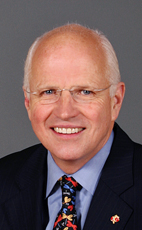
House of Commons photo

Crucial Fact

  • His favourite word was veterans.

Last in Parliament March 2011, as Conservative MP for New Brunswick Southwest (New Brunswick)

Won his last election, in 2008, with 58% of the vote.

Statements in the House

Canada Student Loans May 5th, 1998

Mr. Speaker, I want to pick up where my counterpart from the NDP left off. It is on the hepatitis C question. We have spent the day on this issue and I think we will spend many more days on this issue because it is not resolved satisfactorily in the eyes of the Canadian people. Up to now it has not been resolved because we do have a number of victims left outside the compensation package. That is the point I am going to make tonight.

Obviously what the government has done is come up with a compensation package that covers only those victims within the time frame of 1986 to 1990. That is a flawed position simply because it leaves people outside the package. The question then becomes what happens if someone was infected on December 31, 1985. They would be left out. But if it happens to be a day later, January 1, 1986, they would be compensated under the plan as it now exists. That is absolutely wrong. There is no logic to it.

The government is telling us that a test did not exist. We have heard that numerous times from the Minister of Health, from the parliamentary secretary and from the Prime Minister. But that is flawed logic. That is not the case. A test did exist and was being exercised and conducted in the United States and Germany as two examples of jurisdictions that did use the test which would test for what is now known as hepatitis C. Let us not forget that. That is the logic that the government falls back on. It is flawed logic. A test did exist and we have said that over and over in the House.

The Government of Canada did not ascribe to that test until 1986, but the test was available. The test was fairly accurate. The test would have alleviated a lot of hardship on the part of a lot of Canadians who are now infected by hepatitis C if the government had used that test.

The other difficulty I have with the government's position, and this again is flawed logic, is it is saying it cannot compensate the victims outside of this package of 1986 to 1990 because there are too many of them. The minister suggests that it would actually bankrupt the Canada health system, the medicare system as we now know it. In other words, the government could not possibly pay for this many people.

In the Globe and Mail today a figure has been proposed, as has been suggested by hepatitis C groups for a long time, that the real numbers are not 60,000 victims but a mere 6,000 and possibly 10,000.

The point is the government can afford to compensate all victims.

Hepatitis C May 5th, 1998

Mr. Speaker, given the outrageous and extreme positions taken by the health minister— and I guess we know what those are—unless he is willing to swallow himself whole, what moral and intellectual leadership can the minister possibly bring to the table when he convenes with the health ministers from across this country to re-examine the hepatitis C issue?

Supply May 5th, 1998

Mr. Speaker, I want to ask the member what moral and intellectual leadership the present Minister of Health can bring to the table if and when the health ministers meet. I think they have some positions which are completely untenable. He has made some outrageous statements in the House, for example stating that the package could not be reopened because if it was it would bankrupt our treasuries. In other words it would jeopardize health care in the country because we simply could not afford that package.

Given that point of view, and the minister continues to support that point of view, what could constructively happen out of the meeting that is planned for the health ministers in the near future?

Supply May 5th, 1998

Mr. Speaker, we will certainly vote with our hearts in the right place with regard to this motion. I hope members on the other side can do that. There were a lot of them squirming in their seats just a week ago when they had to vote to deny compensation for those innocent victims.

I hope the Prime Minister allows his people to vote with their hearts today. I am sure that if the parliamentary secretary and even the minister spoke with their hearts, and just a bit with their minds, they would have voted with us on this side of the House, as I am sure Mr. Speaker would have done as well if you were in that position.

This motion before us today is good and we have to continue debating this issue. I believe at the end of the day this House will overwhelmingly, at least on this side of the House, support that motion. I know we certainly will.

Supply May 5th, 1998

Mr. Speaker, I cannot believe what I am hearing from this parliamentary secretary. They are sticking to that line which is a complete failure. The member is talking about going back to the table and still sticking to this date, which is absolutely and totally artificial.

If that is the basis on which the government is going to go into this argument, I go right back to the point that I made previously. Nothing is going to change.

Has the government not learned anything in the last four weeks in this House? The only people who support that position are government members. If they continue that line of logic, the poor victims will gain absolutely nothing.

After four weeks in this House I would think that the parliamentary secretary to the minister would have learned something. This indicates that nothing has been accomplished in terms of the ability of government members to absorb information. On that, I rest my case.

Supply May 5th, 1998

It is a shame. It becomes so ridiculous that for example a person infected on December 31, 1985 would be outside the package and a person lucky enough to be infected on January 1, 1986 would be in the package. From any reasonable point of view it does not make a bit of sense. That was the strategy the government decided to pursue. It was the one the government attempted to defend and it has not done a very good job of it.

Yesterday there was a move, I guess it could be called a crack in the armour. Premier Harris of Ontario announced that he is willing to put $200 million into a compensation package for those people outside the frame or box of convenience, the years 1986 to 1990. That is heartening for many of us but it is not the end of the debate.

The debate falls right back into the lap of the federal government because the question then becomes, can all provinces afford to do that? The answer is no they cannot. Where will it leave the poorer provinces? We do not know where it is going to leave them. Some are suggesting it is still going to leave them out in the cold so to speak because many of them cannot afford to do more.

That is why we on this side of the House have consistently stressed the importance of the federal government acting unilaterally to do the right thing. When the federal health minister meets with his counterparts the provincial ministers, we are hoping that will be addressed by the federal minister. We hope they will say “Yes, we do have to take the leadership in this”.

The generosity being expressed by other provinces is important and I hope that file continues to move. I hope the other provinces can come up with something. But at the end of the day it still will be the federal minister who will have to lead on this file. I do not believe he has done that in the past number of weeks.

What I think has been happening on the government front benches is that it has been a battle between the finance minister and the health minister. I do not think any of us in this House would stand and say that the health minister of this country would actually deny compensation to victims. I think he has been a victim of internal politics within his own government. The finance minister with a big Cheshire cat grin on his face day in and day out as the health minister is besieged and attacked refuses to move, refuses to budge. That is one of the problems we see being played out on the front benches of the government.

What has changed in the equation? I do not think a heck of a lot has changed. I think the health minister has caved in to the power of the finance minister. At the end of the day there will still not be any money for innocent victims left outside the original package. I do not think that is right.

We are going back to square one again. What I think the government has to consider is the box it put itself in and the difficulty the health minister will have moving off some of the statements he made in this House.

Some of the things he stated are pretty outrageous. In the past, he indicated this could bankrupt the Canada health care system as we know it if compensation were extended to victims outside the original package.

I do not know how he can retract those words. I do not know how he can go into cabinet and wage a convincing fight if he still takes that position. I do not know what will happen when he meets with the provincial ministers if he still holds on to that point of view.

I do not think it will be particularly healthy and I do not think it is going to lead to any kind of package that we in this House could support.

What I am saying is that there may be a need for a change in the leadership of this file on the federal level. I will not go beyond that because only the Prime Minister can decide. I think the health minister is boxed into a position that will be very difficult for him to negotiate from, basically a position of weakness. I do not think that is healthy.

The motion today speaks to the inclusion of hepatitis C victims in these negotiations. I think it is only fair that that happens because I do not think these people are asking for anything other than what is reasonable and what is fair. I think their point of view has to be at the table.

The other thing that we have lost sight of in this House, which the member for Macleod spoke on, is the real number of victims left outside the package.

If members have been following this file they will find that the number is absolutely exaggerated. The health minister sat over there day in and day out telling us the victims are in excess of 40,000. He routinely mentioned 60,000 victims.

He is saying this for a reason. He wants the Canadian public to believe that the health care system would be bankrupt because of the number of victims who have yet to be compensated.

That has to be corrected. Again, I do not know how he can go back in good faith to the bargaining table and disconnect himself from some of the previous statements he made. That is one of the reasons why the victims have to be there. I think they can talk intelligently about what those real numbers might be.

In the Globe and Mail today, Mr. Picard is suggesting that the number could be as low as 6,000 victims, 10,000 victims or maybe 15,000 victims. We do not know. I think that is one of the things to be established from day one.

I do not think they can come up with the kind of package that means anything until there are real numbers to work around. That is why these people have to be at the negotiations, so some of the honesty in terms of numbers and what they are looking for is actually expressed at that table.

We will continue our pressure on the government, particularly on the health minister. I hope at the end of the day the Prime Minister and the Minister of Health do the right thing. I hope these victims are compensated and the real story comes out.

Supply May 5th, 1998

Mr. Speaker, I want to thank the New Democratic Party for putting forward this motion. It is an important debate and I thank the members for their support. I believe I speak for all members on this side of the House.

The position taken by the federal government in regard to the compensation of the hepatitis C victims was certainly untenable from the start. When that package was announced it included only the victims between the years 1986 and 1990. The question was how could it establish that date. There was no reason for it. Basically it was a position that no one could defend and certainly not the government. It came up with what I call an artificial date or box of convenience. It was based on when testing was available.

I guess from the government's point of view if one were a lawyer it could be argued that way. That was the position the government could best defend in a court of law, that is, in any lawsuits or civil cases that may come before the courts from the victims prior to 1986. That in itself was also a very shallow argument.

As members of this side of the House have said repeatedly over the years there was a test available which was being exercised routinely in West Germany prior to 1986 and going back certainly to 1981. What is now commonly referred to as hepatitis C was routinely being tested for in that jurisdiction and many others before that time period.

The government's position is completely untenable. It leaves thousands of Canadians outside a compensation package.

Supply May 5th, 1998

Mr. Speaker, I thank the member for his good speech and for the work he has put into this file, as have all members on this side of the House.

One of the questions I have for him regarding yesterday's announcement from Ontario is what will fundamentally change? Obviously in this country, unfortunately and regrettably we have rich provinces and poor provinces. At the end of the day I still believe it is going to take a great deal of leadership by the federal government to put a package together that will include all victims of hepatitis C.

Many of the provinces are under financial restraint. Unless the federal government takes a leadership role in this when they get back to the table, what is going to change unless the health minister stands up with the support of the Prime Minister and says that all victims are going to be compensated?

Questions On The Order Paper April 30th, 1998

Why did the government leave out key recommendations contained in the draft report of the Review of Section 14 of the Patent Act Amendment 1992 (Chapter 2, Statutes of Canada 1993) submitted to the Ministries of Health and Industry by the Standing Committee on Industry in April 1997 and why, in particular, was recommendation N concerning the repeal of the linkage regulations left out?

Supply April 23rd, 1998

Mr. Speaker, I support entirely what the member for Macleod said. The minister is attempting to use a legal argument to get rid of this so his responsibility will disappear. At the end of the day it falls at the doorstep of the Minister of Health. There is only one national Canadian Minister of Health and he is dodging the bullet. He prefers to put the blame on someone else. However, at the end of the day he is charged with the safety of the Canadian blood supply system. It is as simple as that. He cannot dodge that bullet.

I hope that members on the other side of the House will ignore the threat or the stick being held over them, or, as the member said, the whip that is being applied to them to bow in and vote with the government on Tuesday night. The minister is being surrounded by a ragtag assortment of supporters; just simply a handful. There are 150 empty seats over there and they do not support the minister on this issue.