
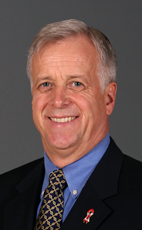
House of Commons photo

Crucial Fact

  • His favourite word was debate.

Last in Parliament October 2010, as Conservative MP for Prince George—Peace River (B.C.)

Won his last election, in 2008, with 64% of the vote.

Statements in the House

Witness Protection Program Act November 26th, 1999

moved that Bill C-223, an act to amend the Witness Protection Program Act and to make a related and consequential amendment to another act (protection of spouses whose life is in danger), be read the second time and referred to a committee.

Mr. Speaker, I will begin my remarks today by stating that this is an exciting day for me. Although I have submitted private members' bills many times in the past six years, this is my first bill to be deemed votable.

Bill C-223, an act to amend the Witness Protection Program Act or the new identities act, as I have called it, attempts to accomplish one thing, to save lives.

In my remarks today I will address the problem of domestic violence in our society, the inadequacies of our present laws, the current new identities program and explain the initiatives proposed in Bill C-223.

Domestic violence is one of the most horrendous problems facing our society. It is my opinion, and that of the hundreds of women who have responded to this issue, that domestic violence is indeed a national problem deserving increased attention from parliament. I do not believe that we as parliamentarians have done enough to address the violence that all too often occurs behind closed doors. This is an issue that requires us to put aside our partisan ways and address the true needs of those in danger.

Just listen to these statistics. In 1996, 21,901 cases of spousal assault were recorded in a sample of 154 police departments across the country. In 1996, approximately 80% of victims of criminal harassment or stalking were women. Over half of all female victims of criminal harassment were harassed by ex-spouses or other intimate partners.

Between 1977 and 1996, there were 2,048 spousal killings in Canada. In over 56% of spousal homicides, investigating police officers had knowledge of previous domestic violence between victims and the suspects.

The process of eradicating domestic violence is not easy and I am fully aware that process will take some time. In the meantime, there are women and children in our country who live in fear for their lives. When I began to research this issue I was shocked by the lack of laws focused on preventing domestic violence and spousal abuse. Aside from anti-stalking laws and restraining orders, there are few remedies available. Most of the laws focus on punishment for crimes committed and are often too late for victims.

Such was the case for Mary-Lynne Miller from Dawson Creek in my riding. In February 1997 Brad Neuman, Miller's former common-law spouse while on probation beat her into a coma in her own apartment. Mary-Lynne suffered on the floor with severe head injuries for over 21 hours before getting medical attention. She remains in a coma to this very day.

One of Neuman's probation conditions was that he was to have no contact with Mary-Lynne Miller. Other than go into hiding, Mary-Lynne could not ensure her own safety and paid a heavy price. It was this case that really opened my eyes to the tragedy of domestic violence. Sadly, there have been thousands of others equally tragic.

In January of this year I was reading the Vancouver Province on my flight from Vancouver to Ottawa where I came across an article. The story detailed a maverick program run by bureaucrats in the Department of Revenue Canada, in conjunction with Human Resources Development Canada, to provide new identities for those people who find themselves in life threatening situations. It allows them to change their names and social insurance numbers in order to hide from an abusive spouse or former spouse.

The woman featured in the article had endured beatings, death threats and emotional torture. The new identities program helped her to relocate and get new documents. Unfortunately, her academic credentials were not transferable to her new identity nor was her resume. This meant finding any job she could in order to support herself and her child. When her husband caught her trail again she would have to run and start the same panicked process of self-preservation over again.

After reading this article I felt frustrated and motivated to do something. That is when I began to research this issue to seek out a solution. The result is the bill before the House today. Originally numbered C-494 in the first session of this parliament, I sent copies of this bill and background material to over 500 women's shelters and transition houses across Canada seeking feedback and their input.

What I got in return were letters of support; tragic, horrifying personal stories and petitions signed by hundreds of people in support of the bill. It was reassuring to know that those who deal with the brutality of spousal abuse on a daily basis endorse the principles contained in this bill.

This summer a woman contacted me after hearing about the bill. She came into my office in disguise to tell me firsthand the story of her abuse. She has been on the run from her former husband for over 10 years. She and her son live in a constant state of readiness to move. Just this fall her husband, through a private investigator, found them again. The threat of violence is so severe that her son's school was put on lock down to assure his safety.

She has been harassed, stalked, beaten, permanently disfigured and threatened with death. It is hard to believe that these are Canadian citizens living in such fear in this very country.

Without a new identify, this woman is positive that her former husband will kill her. Even though he has had several restraining orders filed against him there, is little that can be done until he decides to strike again.

As I mentioned earlier in my remarks, the new identities program is an ad hoc program providing assistance to those in need. However, the program is not well known and operates without a mandate or formal funding.

I would like to take this opportunity to recognize the tremendous service that the bureaucrats in these departments have undertaken. These individuals went far and beyond their job descriptions to help those in need. They exemplify the true meaning of the term “public servants”.

I believe that the witness protection program is the natural home for new identities. Women brought into the program will benefit from the expertise and knowledge of the RCMP who already relocate crown witnesses. All law enforcement agencies across the country are connected electronically, granting access to this program from the most remote reaches of Canada.

By bringing the new identities program under the Witness Protection Act, I believe we can do more for these women and their children. The Witness Protection Act defines protection as including relocation, accommodation and change of identity, as well as counselling and financial support.

This program is not for everyone. In fact the exact opposite is the reality. The new identities program is an escape of last resort for those who the law has failed and are in fear for their lives and the lives of their children.

I listed earlier the tremendous sacrifices undertaken to change one's identity. However, there are some in our society who would try to use such a program for ulterior motives. To ensure this does not happen there is a list of factors or criteria to be considered for admission into this program: the nature of the risk to the security of the person would be assessed; alternative methods of protecting the person without admission into this program would be considered; the nature of the injuries suffered by the person or the severe psychological damage inflicted by the spouse and any criminal history; the circumstances that cause the spouse to believe that their life is in danger would obviously be assessed; and, such other factors that the commissioner of the RCMP would deem relevant. I believe that the criteria are fair and will ensure that those who truly need the program will have access to it.

Canada is supposed to be the best country in the world in which to live. But for women living in fear from abusive spouses, it is a hell on earth.

I fully realize that according to the standing orders I can speak for 20 minutes when moving a votable bill. Certainly this is such a tragically vital bill I could not do the subject proper justice if I spoke all day. However, I believe in my heart that this issue is non-partisan and is of such a nature that I will limit my remarks in order to allow more members to participate in this important debate.

In closing, I call on all members to support this bill. It is but a first small step that we can take to provide protection to those most needing our help.

Divorce Act November 26th, 1999

Mr. Speaker, I rise on a point of order. I respect the fact that all members have the advantage of having the order paper to look at to see what it is you are referring to, but we have an enormous following that watches the proceedings through the television camera. They do not have the advantage of that and they are trying to follow, with I am sure rapt attention, what you are doing and saying. I think they would be having the same difficulty.

Hockey November 26th, 1999

Mr. Speaker, the member for Nepean—Carleton said in the House that the hockey game last night would “establish the bragging rights to parliamentary hockey supremacy in Canada once and for all”.

Well, it certainly did, but it is the United Opposition and not the government that now reigns supreme.

In a hotly contested battle, the true united alternative to the overconfident, boastful Liberals came out on top. With a team consisting of six Reform MPs, a single MP from the Bloc, the NDP and the Tories, a Reform staffer goalie and two opposition CTV members of the media, Team Opposition coasted to a six-four victory. What a treat for the sell-out crowd in the Corel Centre to witness the humbled, downcast Team Liberal and the overjoyed exuberance of the United Opposition.

Following the game, the opposition MPs enjoyed hot wings and beer while the members for Renfrew—Nipissing—Pembroke and Mississauga West ate crow. In hockey, unlike federal elections, the Liberals cannot claim victory from tallying only 40% of the points.

Supply November 22nd, 1999

Mr. Speaker, as my hon. colleague has quite rightly pointed out, there were grassroots native people present who would have liked to have had a chance at the microphone. They were excluded and that was noted in the local paper. It was not only non-aboriginals.

There is a final point I would briefly like to make. A referendum would not only give non-native or non-aboriginal people the right to vote on this. Very clearly it is not just the Nisga'a who deserve a vote, but also the Gitksan, the Gitanyow, other tribes and other Indian bands in the province. They deserve a vote as well. The referendum, were it to be supported by the House and put to the people of British Columbia, would accomplish exactly that.

Supply November 22nd, 1999

Mr. Speaker, we could debate all day whether it would have been apropos for me to make an apology. I was not the one who made those comments. I would never make those types of comments. The fact of the matter is as I have said, that I think people were expressing their deep frustration.

The hon. member for South Shore was part of a process of sucking up to the Liberal government during the hearings. That is the reality. I cannot speak about the other four hearings as I was not there, but everyone who was present at the hearing in Prince George saw the type of opposition member that the member for South Shore is. People were quite appalled by the fact that he supported the Liberal government in excluding people from Prince George who had taken time from work, had gone to that hearing and wanted to be heard. He supported the Liberal government in excluding those people and in denying them their democratic right to be heard. It has been pointed out that the committee incurred expenses with taxpayers' money to travel to British Columbia supposedly to listen to British Columbians on this important issue.

Imagine the extent of their frustration and anger. They had taken time off work to put their points of view forward. While sitting there they learned that the committee chair and the committee, supported by members like the member for South Shore, were going to deny them their right to be heard by the committee, yet their tax dollars had been used to fly in an author from Vancouver because he was the only person the committee could find who would support the Nisga'a treaty. It could not find local people so it had to fly in somebody from Vancouver at taxpayers' expense. This author was representing only himself. He was not representing a group. He admitted that during his testimony.

Sadly that frustration bubbled over and some very unkind things were said. As I already said I think the individuals who would have said those things, once they had calmed down, would apologize.

Supply November 22nd, 1999

Mr. Speaker, I would like to begin by notifying the Chair that I am pleased to split my time with my hon. colleague from Esquimalt—Juan de Fuca.

The hon. member across the way who just delivered his speech made some very serious allegations that I found quite disturbing, obviously since they were directed at me, at my party and at my colleagues.

I would like to start by noting that despite the claims to the contrary the reality is that the Liberal government in Ottawa shut down debate in the House of Commons on this piece of legislation after allowing the official opposition only four hours and 12 minutes of debate.

Why do I single out the official opposition other than the fact that obviously I am a member of it? The reality is that in this debate we have the absurd situation where three of the opposition parties are in total agreement with the government. They are not opposing it at all, even though there are things I am sure they could find wrong with the legislation and the treaty. They have to find something that they would oppose. Yet to listen to them in debate, one would think that it was perfect, that the whole situation has been supposedly resolved, that it is a perfect piece of legislation and they have little to do other than to support the government.

In reality, while we have had more debate than that, what is the point of debate or should we even call it debate, if speaker after speaker from the New Democratic Party, the Bloc Quebecois, and the Progressive Conservative Party are basically the mouthpieces for the Liberal government on the bill? How is that a debate? I think the people of Canada realize that it is not a debate.

The only true debate taking place is by the official opposition in the points it is raising. I pointed out to the viewing public that only four hours and 12 minutes so far have been allocated to members of the official opposition to bring forward these points of how the treaty, once implemented, is going to change the landscape of Canada for all time.

The thing that saddens me the most and which was really reinforced when the committee travelled last week to my home province of British Columbia is that democracy plays little or no role in this process. In fact, if democracy was ever a part of our political system in Canada, it is certainly nowhere to be found in the debate on the Nisga'a treaty.

I challenge the members, as did my leader when he made his remarks earlier today, that this debate is not so much about the specifics of the treaty. We have had the limited debate the government has allowed on that particular aspect contained in the treaty itself, the pros and cons. Obviously, the government is not listening to the points being brought forward about some of the dire consequences once it is rammed through parliament. The debate today is about the process of holding a referendum on the issue and giving all British Columbians the opportunity to vote either to support or to reject the Nisga'a treaty.

Let us look at the process that took place until now. Hon. members from across the way, and I believe from some of the other so-called opposition parties, have stated that it was Reform that forced the Standing Committee on Aboriginal Affairs and Northern Development to travel to British Columbia. Contrary to the points of view put forward by some of the members across the way, it was not to try and orchestrate some huge protest or to try to demean individuals and their parties. We were hoping against hope that once the committee was in British Columbia it would actually listen to British Columbians about this legislation and treaty. Unfortunately, that did not happen. Unfortunately, the committee chose not to listen. Unfortunately, it chose to prevent people from making presentations.

We tried to get the committee to spend more time in British Columbia. We tried to get it to go to more locations than just the five: Monday in Terrace; Tuesday in Smithers; Wednesday in Prince George; Thursday in Victoria; and Friday in Vancouver. We tried to get the committee into Kamloops but there was no movement by the government. It was opposed to letting the people of Kamloops come forward.

Let us review what took place at the meeting I attended. It is the one I have firsthand knowledge of because I was there. I was in the city of Prince George for that hearing. We started out with seven, possibly eight witnesses. A couple of possible or probable witnesses to appear were listed. All but one were from out of the area, from the lower mainland, from Vancouver, Vancouver Island. As time progressed, people dropped off for various reasons.

It came to the attention of the hon. member for Prince George—Bulkley Valley and myself that we were left with four witnesses that would appear that day. Three were from Vancouver or Vancouver Island. Only one was from Prince George itself.

When the hearings began, my colleague from Prince George—Bulkley Valley and I attempted to raise a point of order with the committee chair. We asked her, that since we had people who had dropped off the witness list and that since there were people who had taken time off work to attend that hearing that day who represented groups of local people in Prince George, if the committee in its wisdom could not decide to hear them. We all know that a committee is the master of its own destiny. It can make these decisions. It can change the format. It can change the witnesses if it so decides.

The chairman of the committee ruled that we were not even allowed to put forward that point of order. The government did not want to hear the people from Prince George who had taken time off work to go to that hearing. They were sitting in the audience, prepared to step up to the microphone and put forward their point of view on the treaty.

One group wanted to speak out in favour of a referendum. It has a very special interest in holding a referendum. It was the organization that had spearheaded a local plebiscite in Prince George. It was a voluntary plebiscite in which over 9,000 people participated. Some 9,000 people in northern British Columbia came forward voluntarily to participate even though it had no mandate and even though they knew their vote would probably fall on deaf ears. Nevertheless they came forward. People took the time to come from work or home to cast their ballot and 94% voted against the treaty.

That group, called B.C. in Focus is a non-partisan group. They are not Reformers. Certainly some of them are. Both the hon. member for Prince George—Bulkley Valley and I are here as testament that we have pretty solid support in the city of Prince George so obviously some of those people who belong to B.C. in Focus, that lobby group and citizens group, are obviously reformers. It is not some conspiracy concocted by the Reform Party of Canada. It is an independent group. It was refused the opportunity to put forward its point of view.

The other group was the Central Interior Logging Association. A gentleman whom I know reasonably well, Roy Nagel, is the general manager. That group came with a brief to put forward to the committee. The group asked for permission to do that and was turned away.

Some very unfortunate comments were made, I would agree with my hon. colleague from across the way. On behalf of the citizens and people of Prince George, I would apologize to anyone. The hon. member for Nunavut is present today, and I offer that unconditionally.

I think we have to look beyond the fact that those types of comments were made and look to why they were made. It is the extreme frustration the people of British Columbia are feeling about this process and the treaty. That is the problem. It has been a closed door process from the very beginning. People were shut out yet again when this group came to Prince George. Unfortunately some people voiced their frustration in ways that were not very kind.

Obviously we have to turn a corner here. I call upon all members of all parties to exercise their right to vote in favour of this motion and give the people of British Columbia a referendum on this treaty.

Supply November 22nd, 1999

Mr. Speaker, I ask the hon. member through you—and obviously the viewing public will make this judgment—if that sounds like someone who went out to British Columbia for those five hearings on five consecutive days with the intent of listening to British Columbians with an open mind.

Is that the type of comment that could be attributed to someone who went out there to listen with an open mind? I think not and I think the actions of the hon. member and some of his colleagues clearly demonstrated that during the hearings.

Supply November 22nd, 1999

Madam Speaker, when the hon. member opposite talks about what is sad, I think it is sad when an hon. member of the House would get up to make all those types of accusations as he just did in his remarks and not have absolutely any evidence to back them up.

He made statements such as that he was appalled the Reform Party would stoop so low to these kinds of tactics. He went on at one point to brag about the five minutes he gave up to my hon. colleague, the member for Prince George—Bulkley Valley, during the hearing in Prince George so that my colleague could address a certain witness who was appearing before the committee at a bit more length. He is quite right. My hon. colleague did thank him for that.

What I find appalling is that he obviously stooped to those types of tactics just so he could come into this place, stand before the television cameras and brag about how he gave up five minutes of his time.

I was present as well at the hearing held in Prince George because part of the beautiful city of Prince George is in my riding as well as in the riding of the member for Prince George—Bulkley Valley. I had the good fortune, or the misfortune I guess is more closer to the truth, to attend that particular hearing. I have a distinctly different view of what transpired and I will go into that in some length when I have the opportunity to speak and set the record straight during my remarks later today.

The hon. member was quoted in the very first hearing held on the Monday of last week in the city of Terrace as saying “We are only in B.C. because of a tactic by the Reform Party to hijack parliament. This little dance and song is costing $500 directly by the Reform Party”.

Mr. Speaker, I would ask you and ask the viewing public at home—

Aboriginal Affairs November 19th, 1999

Mr. Speaker, why would the government spend hundreds of thousands of dollars to fly the committee to northern British Columbia and not hear from people from that area directly affected by this treaty?

In fact, taxpayer money was spent to fly an author from Vancouver to speak, yet the people from Prince George, the people who took time off from work to attend those committee meetings, were denied the right to be heard.

Does the government agree with the recently deposed premier of B.C., Glen Clark, that the reason for denying a referendum to the people of British Columbia is because the government knows that it will fail?

Aboriginal Affairs November 19th, 1999

Mr. Speaker, the reality is that the Liberal majority on the committee decided who the witnesses were going to be.

In Prince George on Wednesday the committee only heard from four witnesses all day, three of which were from southern British Columbia. Even though three other organizations backed out at the last minute, the committee chair denied representatives from B.C. in Focus and the Central Interior Logging Association an opportunity to speak.

Only the Nisga'a have had a direct vote on this treaty. Other affected Indian bands have not been granted the same right.

Before it rams the Nisga'a treaty through this House, will the government conduct a referendum so that all British Columbians, aboriginal and non-aboriginal alike, can have a direct vote on the Nisga'a treaty?