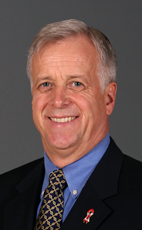
House of Commons photo

Crucial Fact

  • His favourite word was debate.

Last in Parliament October 2010, as Conservative MP for Prince George—Peace River (B.C.)

Won his last election, in 2008, with 64% of the vote.

Statements in the House

Sponsorship Program February 4th, 2005

Mr. Speaker, once upon a time this Prime Minister told Canadians that he wanted to get to the bottom of ad scam. Thanks to Alfonso Gagliano's testimony at the Gomery inquiry it is now obvious to everyone, to all Canadians, that the ethics of the Liberal Party of Canada and this government have indeed hit rock bottom.

Now that the truth is finally getting out, why will the Prime Minister not keep his promise to Canadians and repay the public money used to finance Liberal Party campaign expenses?

Business of the House February 3rd, 2005

Mr. Speaker, would the government House leader care to inform the House of Commons what the government's legislative agenda will be for the remainder of this week and into next week?

Furthermore, if he knows it, when does the government intend to have the debate on the same sex marriage legislation?

Supply February 3rd, 2005

Mr. Speaker, I would like to commend the minister for sticking through the debate today and for recognizing the experience that not only my colleague from Lethbridge has but a lot of our colleagues have who have farm backgrounds, and people like myself who farmed for 19 years, a grain farm of some 3,000 acres. Indeed, my brother still operates that grain farm. We do have a wealth of experience on this side of the chamber, particularly in the official opposition when it comes to agriculture.

I want to pick up on a comment that my colleague from Lethbridge made at the end because that is the fundamental issue that we need to deal with today, and it is the sense of urgency. I hear it all the time from the agricultural industry in Prince George—Peace River. If we do not do something, and I implore the government and the Minister of Agriculture today, for these people who are the backbone of rural Canada, we will not have an agricultural industry in the very near future. I wonder if my colleague from Lethbridge shares that sense of urgency.

Supply February 3rd, 2005

Madam Speaker, I rise on a point of order. Just for the record, I wonder if you would check the seating plan for the House because I believe the rules of the House state very clearly that the member must be in his own seat when he is addressing the chamber. I think he is in default of the rules of the House of Commons.

Supply February 3rd, 2005

Mr. Speaker, there have been consultations among the parties and I believe you would find unanimous consent for the following motion. I move:

That the time provided for the first speaker on the supply motion before us today be divided between the member for Haldimand--Norfolk and the Leader of the Opposition, and that the Leader of the Opposition be permitted to speak first.

Finance February 1st, 2005

Mr. Speaker, if the hon. member's question were not so comical it would warrant probably a more serious response.

He has a very selective memory. I am not that old. I have only been a member for 11 years, but I know why I became involved in politics. It was not just because of my concern about the debt that was growing, as he states, under the Progressive Conservative government that preceded the three terms of fiscal terror by Jean Chrétien. I was concerned well beyond that. I think most Canadians were concerned about who actually started deficit spending in this country and who saw it balloon to unbelievable proportions. That was the successive administrations of Pierre Trudeau.

The member selectively pulls out one part of history and says that we cannot see that happen again. I would like to say that we cannot see a lot of things happen that happened in the past.

I would also like to remind the member of something else. I remember this because I ran in the 1988 election. I was not successful; I lost. That election was known as the free trade election. I well remember the hon. member's leader at the time, John Turner, railing against free trade and how it would be the end of Canada.

Now the Liberal government over the past 11 years has been the net beneficiary of the policies of the Progressive Conservative government, of the free trade vision of that Progressive Conservative government, the very policies that the Liberals ranted and railed and fought against so vehemently. The Liberals said that free trade would be the destruction of Canada. Now the government is benefiting. Now we do not hear the Liberals saying that. Now, all of a sudden, they are proponents of free trade. The Liberals have seen the light; they have had this epiphany.

As well, the Liberals fought against the GST. I am not a great proponent of the GST. I think it has its problems. Where does the government get its money? Where does the government get the overtaxation from?

Canadians out in the real world are not fooled. They understand quite well that it is overtaxation. Maybe the member does not want to admit that the government has taken billions of dollars more in the last few years than it could possibly squander. Canadians know about that.

Canadians know to whom the surplus belongs. That was the point of my speech, to point out that we in the Conservative Party of Canada understand that that money rightfully belongs to Canadian taxpayers and it should be returned to them. I look forward to the budget in two or three weeks' time. I hope that the Liberal government will honour the commitment in the throne speech of last October and we will see the substantive tax cuts that will result in a net pay increase. We often hear the Liberals talk about all these billions of dollars in tax cuts that the Liberals have initiated, but no one out in the real world has seen them on his or her paycheque.

Finance February 1st, 2005

Mr. Speaker, it was with great anticipation that I prepared for this opportunity to speak today on the upcoming federal budget.

As the federal representative for Prince George—Peace River it is incumbent upon me to advocate that tax dollars are utilized by the government wisely, fairly and in accordance with the wishes of my constituents. While this duty is carried out each and every day in some form or another, today is the opportunity for me to state on the record in the House how the residents of Prince George—Peace River want their government to prioritize and manage their money. And it is their money, despite the government's tendency to boast of its annual surpluses. A surplus is built upon the backs of the Canadian taxpayers. A surplus simply means that the government has overtaxed Canadians.

I often remark that there is a fundamental difference between a Liberal and a Conservative. A Liberal looks at a surplus and asks, “How can we devise new programs to spend the money?” A Conservative looks at a surplus and says, “We have overtaxed Canadians and we should return it to them because it is their money”.

This year it means that the federal government will have taken close to $11 billion more from taxpayers than it was committed to spend. Are taxpayers going to get some of their money back? If the Prime Minister and his government were to stick to the commitment they made last October, just over three months ago, Canadians would get some of that $11 billion back in the form of tax relief, or as I prefer to call it, a pay increase.

Specifically the throne speech amendments, which government MPs voted to support, called for tax cuts for hard-working Canadians. If the government intends to honour this three month old pledge, we should expect to see substantive tax cuts in the upcoming budget.

In Mackenzie, B.C. for example, a small community in my riding, a remote northern town where the cost of living is considerably higher than most other communities, residents might expect to see at long last the reinstatement of their northern residents tax deduction. No one in the federal government has been able to justify why the deduction was taken from Mackenzie in the first place, but in the upcoming budget there is an opportunity to correct the oversight while simultaneously complying with the throne speech amendment to cut taxes.

During the election campaign the federal Liberals ridiculed calls from the Conservative Party of Canada for substantive tax cuts. They ridiculed our calls to increase funding for health care, for education and for our armed forces. The Liberals said that these proposals to cut taxes and at the same time invest in Canadians' security and well-being were preposterous because the money simply was not there. The government projected a surplus at that time of just $1.9 billion. We know that was underestimated by roughly $9 billion. We are also well aware that the money certainly is there.

What about the $1 billion plus that has been spent on the dysfunctional gun registry? What about the millions wasted on the federal sponsorship program? In fact, with an ounce of fiscal responsibility and fiscal management, there is ample room for tax cuts as well as funding for critical areas of our country's social and economic health.

In Prince George—Peace River, like most of Canada, there is grave concern about the state of our health care system. Some have told me bluntly that although they are not pleased that the government is set to amass an $11 billion surplus this fiscal year, they do not want it back. Some of my constituents do not want those surplus dollars if, and it is an important if, the government can assure them that they will actually be able to find a family doctor, not just more talk about health accords and complex and cantankerous federal-provincial negotiations, not more idle rhetoric about shortening the waiting lines, but a living, breathing medical professional whom they can access when they or their loved ones are in need of care.

The doctor shortage in my riding is critical. Whenever a doctor retires in one of our communities, the pressure intensifies on the already overburdened local medical services. Recent examples include Tumbler Ridge and Fort Nelson where residents have relatively few options for medical care. There is also an urgent need for additional palliative care, and homes and resources for the elderly.

It is not just health care that has been neglected. A recent report shows that Canadian workers have seen barely any growth in their real take home pay, and I repeat that this is their take home pay, throughout the past 15 years while government spending has grown at record rates. I can assure everyone that there has not been a corresponding improvement in infrastructure and government services in Prince George—Peace River.

As one notable demonstration of this decay in infrastructure in the city of Prince George, known as B.C.'s northern capital, two major transportation corridors, Highway 97 and Highway 16, and two major rivers, the Fraser and the Nechako, converge to form an economic hub that is critical to the economy of the entire region. Yet a significant number of the logging trucks, heavy equipment for the oil and gas industry, and other industrial traffic that passes through the city must cross an old single lane wooden bridge dating back to the 1930s.

Mr. Speaker, I will be splitting my time. I was mistaken in not stating that at the outset of my speech.

It is not unrealistic for the residents of Prince George and area, who have heard the Prime Minister's promises for a new infrastructure deal for Canadian cities and who have seen their paycheques shrink due to taxes, to expect that the upcoming budget will address their need for a replacement for the Nechako River bridge.

Similarly, airports in Prince George, Fort St. John, Fort Nelson and Dawson Creek are vital to the transportation infrastructure of northern B.C. where ground transportation is not always a feasible or cost effective option. Yet since the federal government has off-loaded these airports to local airport authorities, it has taken a hands-off approach to ensure their ongoing safety and viability.

The airport capital assistance program, or ACAP as it is known, which is supposed to assist these airports, had $6.9 million left over in the last fiscal year. This is money the program was allocated but did not spend. It is money that those airports and many other small rural airports across the country need for new terminals and runways and to ensure safe operation. In Prince George the airport cannot even get an answer from the minister responsible for the Canada Border Services Agency as to whether it can get more customs officers to meet the growing demand for international cargo services.

This federal neglect is felt all the way to the farm gate as well. Farmers in the Peace region have been hit hard by the BSE crisis, low commodity prices and drought in recent years, followed by snow and wet fields at harvest time this past fall. It is incumbent upon the federal government to take measures in the upcoming budget to help our family farms pull themselves back from the brink of bankruptcy.

After all, it is the same government that just a couple of months ago found another $96 million to spare for the federal firearms registry. In fact, it is when my constituents imagine what the $1 billion plus the Liberals have spent on the gun registry could have meant in terms of tax relief and real priorities that they get angry.

To my constituents real priorities are the ongoing softwood lumber dispute with the United States and the mountain pine beetle epidemic that has devastated the forest industry throughout the past decade. Yet the federal government has allocated a grand total of just $8 million to fight the pine beetle infestation, this for an industry that drives 25% of B.C.'s economy and from a government that had no problem wasting millions in the sponsorship program.

Ultimately, I am very proud of Prince George—Peace River. I am proud of the innovation, the perseverance and hard work of its residents. Through economic crises and what often seems like outright neglect from Ottawa, the citizens, businesses and municipal representatives have demonstrated the initiative and ability to grow and to improve our quality of life in Prince George—Peace River.

As the Prime Minister and finance minister put the finishing touches on their upcoming budget, I would like to remind them that the constituents in Prince George—Peace River are not looking for handouts or more mammoth government programs. They want fiscal responsibility and accountability. They want to know that the tax dollars they worked hard to earn are working hard for them. They want to know that their government in Ottawa respects them and respects their tax dollars.

Finance February 1st, 2005

Mr. Speaker, this week as MPs deliberate the upcoming federal budget, I am urging the government, on behalf of the 72,000 citizens of Prince George, B.C., to remember some of its election promises.

If the government were to keep its promise for a new fair infrastructure deal for Canadian municipalities, Prince George could get the funding it requires to construct the new Nechako River industrial crossing.

If the government were to keep its promise to boost the size of Canada's military reserve forces by 3,000 personnel, Prince George could get a 120 member army reserve unit.

If the federal Liberal government were to keep its promise to consider the needs of western Canada, it would properly address the mountain pine beetle epidemic and the softwood lumber dispute.

This could be the budget that stops blowing tax dollars on the useless gun registry, government advertising and corporate welfare, and instead implements tax relief for low and middle income Canadian families that they could actually take to the bank.

Finance January 31st, 2005

Mr. Speaker, I listened attentively to the comments made by my colleague from Newfoundland in this prebudget debate.

It struck me that well past the eleventh hour and we might say that at midnight the clock struck and the Prime Minister decided to quit dithering for a moment, sit down with the premiers of Newfoundland and Labrador and Nova Scotia and actually work through a deal. Now he wants to be applauded and credited with driving home this bargain deal that he wants to talk about.

It strikes me, and I think my colleague was referring to this, that two things are abundantly clear. One is that a near crisis could have been averted if last fall the Prime Minister had simply honoured the commitment he made last June and said, “I made a commitment to Newfoundland and Labrador and Nova Scotia and I am going to honour that and proceed on that basis”, but he did not. The second thing I want to make clear is that if it was not for a minority government, I do not think we would have seen the Prime Minister actually held accountable for the promise that he made.

Has my colleague from Newfoundland and Labrador heard similar sentiments expressed by the people of that great province? Do they recognize that it was through his efforts as well as those of many other colleagues and our leader that really held the government's feet to the fire and made the Prime Minister own up to his commitment and finally put his money where his mouth is?

Forestry December 13th, 2004

Madam Chair, could you just get control of the Minister of Natural Resources because I am concerned that maybe he does not have as strong a heart as he thinks he does. I do not want to see him keel over here tonight because he is so worked up about this.

My colleague from Cariboo—Prince George, my colleague from Kamloops, and myself, who represent most of the northern half of British Columbia, have written letters to the ministers and indeed to that minister himself. We have risen on statements in the House and we have asked questions in question period. For the minister to suggest in one breath that somehow he is unaware of the problem and then in another breath say that he has been working diligently and has been beavering away with the provincial government trying to work out a solution, and yet turn around in the next breath and suggest there is no plan, it is very discouraging for British Columbia but it is also typical of the Liberal government.