
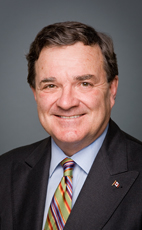
House of Commons photo

Crucial Fact

  • His favourite word was budget.

Last in Parliament April 2014, as Conservative MP for Whitby—Oshawa (Ontario)

Won his last election, in 2011, with 58% of the vote.

Statements in the House

The Budget June 9th, 2011

Mr. Speaker, I congratulate the member opposite on his election.

I commend to him the budget that was presented in the House on Monday this week. It is an important document, as has been said by other members. It not only reflects fiscal matters, but it reflects the general policy of the Government of Canada.

I commend to him the measures to support job creation that are listed on page 15 of the budget. Perhaps the member would like to read that over the weekend.

I commend to him the fact that as set out at page 58 of the budget, that Canada has the best job creation among the industrialized nations in the world, since the great recession.

I commend to him also the graph on page 30 that sets out the quality of the jobs created in Canada, the majority of them being high paid jobs, and of course the fundamental facts set out page 14, that more than 540,000 new jobs have been created in Canada since the great recession ended in July 2009 which is, of course, a record in the industrialized nation.

For the new member to suggest with any seriousness that Canada has not done a very good job in job creation is an error.

The Budget June 9th, 2011

Mr. Speaker, I congratulate the hon. member on her election to the House of Commons. I regret that it means we do not have with us any more our dear friend Gary Lunn. I do not know what the member opposite has against munchkins but I am a member of that brotherhood.

We like this budget so much we introduced it twice. I can assure the hon. member that the budget implementation act will, of course, reflect items from the budget that are referenced in the budget.

The GIS payments for seniors, in particular, are very important. We want to get those cheques out in July.

Personal Debt June 9th, 2011

As I said, Mr. Speaker, the code of conduct that we developed was done together with small business and consumer groups. It was welcomed by small business and consumer groups.

Unfortunately, the opposition NDP voted against the code, but I gather from the question that I have just heard from the learned member of the NDP that this position will be changing and that he will be supporting our policy on the code of conduct.

Personal Debt June 9th, 2011

Mr. Speaker, for some years now we have heard the concerns expressed, and we have certainly expressed them, with respect to the level of consumer debt. That is why we have taken several steps. Three times we have intervened with respect to the insured residential mortgage market, including this year.

We also created the code of conduct in co-operation with small business in Canada and small retailers. They have praised that code of conduct with respect to credit cards because it is working.

Tax Harmonization June 8th, 2011

Not only does the government get it, Mr. Speaker, but the voters of Canada got it on May 2, based on a very strong mandate. The voters of Canada made a choice between a high tax plan and big spending programs of the NDP, and a low tax plan, jobs, growth, creative Canada, education, skills training and encouraging small business and larger businesses in Canada to create jobs.

It is a strong mandate from the people of Canada. They made their choice.

Tax Harmonization June 8th, 2011

Mr. Speaker, as I am sure the member opposite realizes, provincial sales tax is a matter of provincial responsibility. It is not a matter of federal responsibility. It is a decision for the Government of British Columbia and the people of British Columbia, as it has been in the past in Ontario and in the provinces in Atlantic Canada that chose to harmonize over time. This is not a decision for the Government of Canada.

The Budget June 8th, 2011

Mr. Speaker, the process to be undertaken will commence soon. Chaired by my colleague, the President of the Treasury Board, a special committee of cabinet will do a careful review. The committee will not slash and burn, as the Liberal government did in 1995-96 with the provinces, the territories and individuals in Canada. We will maintain the transfer payments to the provinces and territories. We will maintain the transfer payments to individuals in Canada, to seniors, to persons with disabilities. However, we will look carefully at the cost of delivering government services and productivity in government at the operating--

The Budget June 8th, 2011

Mr. Speaker, if the member has an opportunity, he should read pages 182 and 183 of the budget document that was tabled on Monday, which outline the process for the strategic and operating review, looking at the operating expenses of government and the Government of Canada, a large organization.

A review of the operating expenses has not been done in more than 15 years. It is high time it was accomplished in order to cut out some of the fat and unnecessary spending in government.

The Budget June 6th, 2011

Much better, Mr. Speaker. Our debt to GDP ratio is about 2.4%. Compare that with the United States, the United Kingdom and other countries which are up 10% and more. This is not a matter with which any of us certainly on this side of the House can be complacent. There are difficulties in the world economy. We are pleased that our country is recovering better than some other places. We also wish them well, of course, because this is an integrated economy, a global economy, and Canada is not an island.

We will maintain our course, in response to the hon. member, to ensure that on the deficit and debt we get back to a balanced budget, and then get back to the position where we can pay down public debt. We paid down almost $40 billion of public debt before the great recession happened, and it happened from outside Canada and came into this country, but it put Canada in a position where we could take the kind of action we did in the economic action plan.

The Budget June 6th, 2011

Mr. Speaker, the third party in this place now is an expert in cutting. This was the party that in the mid-1990s cut transfers to the provinces. What were those transfers for? They were for health care, education and social services. Liberals did it without notice. They did it without negotiation. It resulted in the closing of schools. It resulted in the closing of hospitals, in the laying off of nurses. These are the experts who well deserve to be sitting where they are in this chamber today.