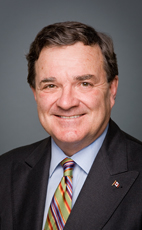
House of Commons photo

Crucial Fact

  • His favourite word was budget.

Last in Parliament April 2014, as Conservative MP for Whitby—Oshawa (Ontario)

Won his last election, in 2011, with 58% of the vote.

Statements in the House

National Defence November 24th, 2010

Mr. Speaker, no one knows how to spend like Liberals. How do I know this? I know this because it has confirmation from the finance critic, the member for Kings—Hants.

Here is what he thinks of Liberal spending. He says that neither the Liberal caucus nor the Liberal Party “has ever encountered a problem that they did not believe to be best solved by throwing copious quantities of taxpayers' money at. They are tax and spend-aholics”. He would know.

Finance November 24th, 2010

Mr. Speaker, none of that is accurate, of course.

Our government will not reduce the transfer payments for health and social services to the provinces.

I was there in Ontario when the member's government back then cut the transfer payments. We had to close hospitals. Nurses were laid off. We could not educate doctors properly. Teachers were laid off. Schools were closed. It was all because of the Liberal government.

Finance November 24th, 2010

Mr. Speaker, we have the lowest deficits in the G7 and the best overall fiscal position.

Our deficit this year is lower than originally forecast. As we have said all along, once our recovery is assured we will return to a balanced budget.

The stimulus package was necessary to protect Canada and protect Canadians, and that meant running a deficit for a short period of time.

I know it was the right idea, because the member for Kings—Hants, my critic, said, “The Canadian stimulus package undoubtedly created economic activity and jobs”.

Securities Industry November 24th, 2010

Mr. Speaker, the proposal with respect to a Canadian securities regulator is purely voluntary and purely optional. I am pleased that 10 provinces and territories are working with the Government of Canada on the initiative.

As the member knows, the Government of Quebec referred the matter to the Quebec Court of Appeal. We have referred the draft legislation, which was tabled in this House, to the Supreme Court of Canada for the opinion of the court on the jurisdiction of Parliament to legislate in this area. We anticipate hearing from the court next year.

Securities Industry November 24th, 2010

Mr. Speaker, this initiative is optional and voluntary for the provinces. We are respecting provincial jurisdiction in this area.

Pensions November 23rd, 2010

Madam Chair, I will comment on the remarks of the member for Hamilton East—Stoney Creek.

There is this assumption made by Liberal members, and by the NDP member, that somehow we have two classes of people in our country: people who employ people and people who work for other people. It is just nonsense.

If they actually knew what was going on in the country, they would know that the biggest producers of jobs in are ordinary Canadians who run small and medium-sized businesses. They would know that if they paid attention in their own ridings, they would stop this false nonsense talk against employers and they would stop their nonsense talk saying that we should not reduce taxes on employers.

Of course we should. Why? It is the fastest way to create more jobs in Canada. We know that small and medium-sized businesses are the job generators. They are the job generators in the riding of the Liberal member for York West. They are the job generators in the riding of the member for Hamilton East—Stoney Creek. This is vitally important.

I was appalled earlier to hear the member for York West try to take credit for the working income tax benefit, known as WITB, and the tax-free savings account. The Liberals had 13 years in government and they did neither of those things. We became the government and we implemented both of them, despite the fact that we are in a minority Parliament. That is good public policy for Canada and I would hope the Liberal member opposite would acknowledge that.

Pensions November 23rd, 2010

Mr. Speaker, we are all committed to ensuring adequate pension retirement income for Canadians. As we know, the federal government is responsible for only about 10% of the pension plans in Canada. We have had very constructive, progressive discussions with our provincial and territorial partners. I look forward to continuing them when we meet again as finance ministers in Alberta in about a month.

Questions on the Order Paper November 19th, 2010

Mr. Speaker, in response to (a), under Canada’s economic action plan, the government has committed nearly $5.6 billion in federal funding toward over 7,000 provincial, territorial and municipal infrastructure projects.

In response to (b), please be advised only the national recreation trails initiative was subject to a March 31, 2010 deadline for project completion. All projects were completed by the deadline.

In response to (c), the government is monitoring progress on projects on an ongoing basis, but has not been provided with a listing of individual projects at risk as of October 5, 2010.

Questions on the Order Paper November 18th, 2010

Mr. Speaker, the Canada pension plan, CPP, is a jointly managed federal-provincial-territorial plan. The federal government cannot unilaterally change the CPP. To come into effect, a change needs formal approval of at least two-thirds of the provinces with two-thirds of the population of Canada.

The reforms referenced were unanimously agreed to by all federal, provincial and territorial finance ministers on May 25, 2009 and followed the conclusion of the mandated 2007-2009 triennial review of the CPP. For more information, please visit http://www.fin.gc.ca/n08/09-051-eng.asp.

Collectively, the ministers unanimously agreed to modernize the CPP to better reflect the way Canadians live, work and retire. The alterations were intended to increase flexibility, modestly expand CPP coverage, and treat workers fairly regardless of the age they take their pension or how they choose to retire.

Once fully approved, the changes will come into effect starting in 2011 and 2012, and many of them will be implemented gradually, over a number of years. Specifically, the proposed changes include: removal of the work cessation test in 2012; an increase in the general low earnings dropout provision; a requirement, starting in 2012, for those who take their CPP before age 65 and work, as well as their employers, to contribute to the CPP; and gradual restoration of pension adjustments for early, between ages 60 and 64, and late, between ages 66 and 70, take-up of the CPP to their actuarially fair levels.

Under the reforms, access to a CPP pension as early as age 60 will not change. Rather, they will gradually restore adjustments to pensions taken before or after age 65 to their actuarially fair values. This change reflects that in most cases those taking up the CPP before age 65 will receive it for a longer period than someone taking it after 65, even though they paid contributions for a shorter time. Additionally, this change also reflects that in most cases someone taking up the CPP after 65 will receive it for a shorter period than someone taking it before 65, although they have paid contributions for a longer period.

Federal, provincial and territorial ministers of finance agreed to move these adjustments gradually, over a number of years, to their actuarially fair values. When fully implemented in 2016, the early pension will be adjusted downward by 0.6% per month for each month that the pension is taken before an individual’s 65th birthday. As a result, beginning in 2016, if an individual chooses to take up the CPP pension on his or her 60th birthday, he or she will receive 64% of the amount he or she would have received at age 65, compared to 70% currently.

The adjustment for pensions taken after turning 65 years of age will be fully implemented earlier, in 2013. When fully implemented in 2013, the late pension will be increased by 0.7% per month for each month that the pension is taken after age 65 up to the age of 70. As a result, if an individual chooses to take the pension at age 70, he or she will receive 142% of the amount he or she would have received at age 65, compared to 130% currently.

This change will not affect current CPP beneficiaries who took their pensions before or after age 65, nor will it affect those who apply for the CPP in 2010, unless those individuals return to work in 2012 or later. In that case, only the portion of CPP benefits based on earnings after 2012 will be affected by the new pension adjustments.

As required by the legislation, the Office of the Chief Actuary at the Office of the Superintendent of Financial Institutions prepared the 24th Actuarial Report on the CPP to show the effects of the aforementioned reforms on the long-term financial status of the CPP. For more information, please visit http://www.osfi-bsif.gc.ca/app/DocRepository/1/eng/oca/reports/CPP/cpp24_e.pdf. According to the aforementioned report, the reforms were deemed affordable within the current CPP contribution rate of 9.9% on earnings up to average wages.

Additionally, third party independent observers have reviewed and applauded the reforms as well. For example, an Edmonton Journal editorial noted the “welcome changes…will allow Canadians of a certain age to draw on their Canada Pension Plan benefits and still be allowed to work … the prospect that thousands will be able to discern a horizon when they can not only choose to be gainfully employed but also collect on a pension they paid into for years must come as some relief”. Finn Poschmann of the C.D. Howe Institute has remarked that the “adjustments mark an important sea change in government pension policy's approach to dealing with population aging and, in particular, making it easier for those people who want to work later in life to do so”.

Securities Industry November 17th, 2010

Mr. Speaker, as I have always said, participation in this initiative is voluntary for Quebec and the other provinces.

The Supreme Court of Canada will deal with the jurisdictional issue in April of next year and then we will have confirmation with respect to the legislative authority of Parliament on this subject.