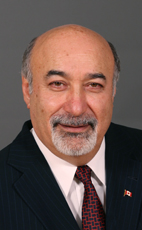
House of Commons photo

Crucial Fact

  • His favourite word was billion.

Last in Parliament March 2011, as Liberal MP for Scarborough Centre (Ontario)

Lost his last election, in 2011, with 32% of the vote.

Statements in the House

Business of Supply March 10th, 2008

Mr. Speaker, I have a question for the hon. parliamentary secretary, who touched on a few things in his statement.

Before I ask my question, I will note that as the parliamentary secretary opened his statement, to which I listened to very carefully, at one point he said “critical” but was just this short of saying “crooked”, because it is really one of the problems that we are facing there.

In order to deal with the problem, we have to deal with the reality of a crooked administration. I am referring not to President Karzai but to anything beneath that level. Does the member have any suggestions for how we could address the crookedness, if I may use that word again, that is going on in that country?

Second, he touched upon what is so vital and that is the training. He talked about 46 people. I do not know if he knows, but the information I got as the former chair of the committee is that we have only about seven or eight policemen who train, and the rest might be trainers for other services, which I believe are important. Could he confirm that? If so, does he think that seven or eight policemen are adequate to do the work that vitally needs to be done?

Last, does he feel that the additional 1,000 soldiers that we are hoping to get there over the next two years are going to be sufficient to do the work that needs to be done?

The Budget February 27th, 2008

Mr. Speaker, the parliamentary secretary talked about balanced budgets, et cetera. I think he was a bit unfair because the current Minister of Finance was in the provincial government for nine years and that government did not balance one budget. For the record, I want to clarify that he left Ontario with a deficit of almost $6 billion.

Nevertheless, I want to ask the member why his government has been so unfair to the city of Toronto. Toronto is having to raise property taxes, and levies for hockey arenas, community centres and garbage because Toronto is being starved.

I was happy that he said that the Conservatives are extending the gas tax. In essence he is confirming that the Liberal government started the gas tax and the Conservatives now see the light to extend it.

Why are the Conservatives starving Toronto? What have they got against Toronto? I know the Minister of Finance says that they are not in the pothole repair business, but that is part of Canada, too. Why are they being so unfair to Toronto?

The Budget February 27th, 2008

The budget was 2005. You betrayed Canadians.

The Budget February 27th, 2008

Mr. Speaker, I listened very carefully to the member for Parkdale—High Park. I remind the member that she went to the election in 2005 saying one thing, “Look what we got you. Lend us your vote and we will get you more”. People were unable to see through the smoke and mirrors at that time.

It struck a chord with me when she said that we had betrayed the seniors, the students, infrastructure money and so on. This might not be a good budget, and it is not, but there is some money in there for infrastructure for my city of Toronto. There is some money in there for education. It is not what it should be, but at least there is some money.

The Liberal Party will not betray Canadians, even if there is just a teeny bit in the budget, the way the NDP betrayed Canadians. Before the last election, there was $1.6 billion for housing. There was money for education, for seniors, for international obligations and for the environment. The money was in place through the recommendations of the NDP. Then that party did an about-face and brought down the government prematurely.

What will the member for Parkdale—High Park say to her constituents when she goes to the polls? Is she going to tell them to lend the NDP their votes because it will lose them some more? That is what the NDP did in the last election. If anybody should be ashamed, it is the members of the NDP.

Afghanistan February 26th, 2008

Mr. Speaker, first of all, there is no question that we and all Canadians have stood behind our men and women in the military and will continue to stand behind our men and women in the military.

The member talked about the Manley report not being brought to committee. Does he think it is fair that the report of the defence committee, which he now sits on and which laboured for months and months, was not even looked at by his leader, the Prime Minister? He talked about not being fair. Even the recommendations in that report are part of what put it together.

The member talked about a NATO coalition. Does he think it is fair that only Canada and maybe another nation are in the difficult zone? Why does the rest of the NATO family not participate equally?

With respect to children going to school, when President Karzai was here, he said there were 200,000 fewer students going to school than there were the year before. We do not have the actual numbers, but let us call spade a spade.

Afghanistan February 25th, 2008

Mr. Speaker, what we have done is the Liberal Party under its leader has managed to refocus the mission to where it should be, which is development, defence and diplomacy. We want to help build schools, roads, security, a civil service and a society where the citizens of that country can grow and prosper in peace and harmony. I am supporting this motion because now the new Conservative Party is seeing it in the Liberal way.

Afghanistan February 25th, 2008

Mr. Speaker, the member has asked several questions. First, when Canada went to Afghanistan we went in under the three D policy, development, diplomacy and defence. That was a decision we made given the circumstances. We learned along the way. We had a debate that was forced by the opposition at the time. Today it is more elaborate. As time goes by the debate actually improves.

I have heard military people, most recently the head of the U.S. defence command, say that a thousand troops are not going to do it. He is talking about 400. We are really fooling ourselves when we say that an additional thousand troops is going to solve this problem in answer to that question.

Second, I must say that we had a constructive exchange in committee and that is why we will move positively forward. That is also why I am a bit upset. When in opposition, the current Prime Minister said, “I am going to use committees. I am going to use the parliamentary process”. Committees brought the report in. He was part of it.What did the Prime Minister do? This is not a low blow, but he threw it out. It did not matter. He went through independent channels.

That being the case, we should all sit at home and not bother going to committee. We should not bother listening to witnesses. Instead, we should hire independent people to do all the work for us. What can I say.

Afghanistan February 25th, 2008

Mr. Speaker, let me thank my colleague from Esquimalt—Juan de Fuca for sharing his time with me to give me the opportunity to add my voice to this most important debate.

I am pleased that the member also mentioned the shortage of time when this debate first started a couple of years ago. At that time, as members will recall, we were in a minority government and in such a short period of time were not able to take out some of the bugs and bring forward something better. Today again it is a minority government and here we are asking for the time to discuss this. Why? Because we are asking our men and women in uniform to go into harm's way and, we hope, bring some peace, security and development to this most unfortunate region of Kandahar, Afghanistan.

I followed the debate throughout the day and was saddened in many ways by some of the comments that were made.

I want to say first and foremost that I think I speak on behalf of every member in this House when I say that when we stand to speak, we are not here to pit our military against party A or party B. It has nothing to do with politics and everything to do with doing the right thing, making the right decision. That is why I am going to start by reminding each and every Canadian of some words that the Prime Minister has used in the past. In essence he used George Bush's words when he said, “We're not going to cut and run”. It is not a matter of cutting and running. The government has not said so, no member has said so, no Canadian has said so, and our men and women in uniform have not said so. We are simply trying to set the terms of engagement for a successful outcome. I just wanted to clarify that for the record.

In the last Parliament I had the privilege of chairing the Standing Committee on National Defence and Veterans Affairs. Today I am vice-chair. I have had the opportunity, unlike most other members who I am sure would have appreciated the opportunity, to listen to various witnesses who came before our committee, including people who were formerly in the military, academics, recognized organizations, NGOs, people currently in the military, and the previous minister of defence as well. We were able to hear all their comments.

Members also listen to their constituents. This past Friday, I met with an Afghanistan group, who said, “You guys don't really know what is going on over there”. I heard some other comments, which I will bring forth today.

Some good things have been said in the Manley report. Through this debate I also want to inform Canadians that the committee on national defence committee worked very hard to put a report together which was tabled last June, with 12 recommendations. There was a 13th recommendation which unfortunately we could not put in the report, and I will explain why. It concerned something which everyone is talking about, and that is training, training, training.

We recommended that we get more involved and make sure that the Afghanis are trained properly to provide security, policing and whatnot. The researchers came back to us and said, “There is no evidence to support the recommendation as stated. The current ANP training program is the responsibility of the U.S. and Germany, at a cost of $1 billion”.

So, what are we talking about? We are talking about training, training, training. If we are going to address an issue, we have to deal with reality. The Canadian forces provide only about seven or eight policemen to help with training the military police, local ANP, only in the area of Kandahar. I mention that to clarify it for people who are very interested in this most important issue.

The Minister of National Defence went to the recent meeting and he was promised by the French that they would send 700 troops. That was an empty promise. There is no delivery.

The concern I have with respect to the Manley report is the 1,000 additional troops. I am hoping it does not include the 2,500 troops the United States of America is to send in for a period of seven or eight months. One of their senior military people said a couple of weeks ago in a press conference in the United States that 400,000 troops are needed.

We have been told by witnesses that until now approximately 50,000 to 51,000 troops are there and we have trained approximately 49,000 to 50,000. The problem we have with that is what my colleague pointed out earlier in terms of the poppy growing areas.

Mr. Siddiqui wrote in the Toronto Star a couple of weeks ago that that is where the problem lies. The organizations pay a farmer, or a security guard, or a police officer $50, $60 or $100 a month and the drug lords pay them $300, $500 or $600 a month. During the day they are acting as police officers and during the night they are pushing drugs. They bring in hundreds of millions of dollars which they then use to support their insurgent activities. We are cutting off our nose to spite our face. We are not making any headway.

My colleague from Esquimalt—Juan de Fuca hit the nail on the head. We know where the problem is. Why are we not focusing on those poppy growing areas? He talked about a feudal system. We understand it. How do we get them to move away from that system? By engaging them, by providing security, by providing development, but security especially, so that the farmer's life is not in jeopardy.

I have another concern in terms of the borders. I read a headline, “Taliban calls truce with Pakistan”. As far as I am concerned, the president of Pakistan, Mr. Musharraf, needs to be put in his place. He should either shape up or ship out. On one hand I remember when the Conservatives were in opposition they said they would not deal with those guys. Today we do not want to deal with them, but the guys we are trying to protect are in essence dealing with them behind our backs while our men and women are in harm's way. I do not find that acceptable and I am sure every Canadian does not find it acceptable either.

Witnesses tell us what is going on in Afghanistan. In a recent article, Lieutenant-General Michel Gauthier said that we are making progress, that insurgent ambushes have fallen in four of Kandahar's 17 districts. However, further on the article states that Major-General Marc Lessard, the new commander of the North Atlantic Treaty Organization, says that violent incidents are up by 50%. Who can we really believe?

Let me summarize. With respect to NATO, I would ask the minister when he goes to Bucharest to pull up his socks and let Canada be counted. We had before our committee the chairman of the military committee of the North Atlantic Treaty Organization, General Henault, former chief of the defence staff for Canada. My question to him is on record. I asked him if he was preparing for 2009 knowing that that was the date. It took me three questions. I finally got out of him that they were preparing.

We do not buy this argument that if we give them short notice, we cannot replace the troops. That is hogwash. I want everyone to know that NATO does not respond overnight. It does sometimes in an emergency situation, but it knew that we would be leaving in 2009 and it was planning for it.

I close by saying to all the NATO partners that if they are going to be members of NATO, then they should participate equally. The Korean conflict was mentioned earlier. Let us share in this together. It should not just be Canadians taking the hit. Let us rotate. If a country is going to be a member of the club, then it should take up the responsibilities.

Tackling Violent Crime Legislation February 11th, 2008

Mr. Speaker, because I was so intrigued, I want the member for Notre-Dame-de-Grâce—Lachine to finish what she was about to say. Would she be so kind, for the benefit of my constituents, to finish what she was about to say?

Privilege January 30th, 2008

Mr. Speaker, I rise on a point of privilege predicated by the type of answers that the Prime Minister gave to some of the questions he was asked.

The Minister of Health is shaking his head, but when he faces the Greek Canadian community in the future, I will remind him.

I do not want to be interrupted. I have served five terms in this honourable House. I have had the honour and the privilege of representing my country Canada abroad and proudly see, as I look around this honourable chamber, the diversity that makes this great country of ours.

The Prime Minister in his response today put a black mark on the over half a million Greek Canadians who played even a small role in the development of this great country.

The Prime Minister insulted the entire Greek community. I want to get to the bottom of it. When answering questions that he was asked, why was it necessary for the Prime Minister and others to continually refer to these two people, Housakos and Soudas who works in his office, who supposedly acted improperly lobbying him, as Greek Canadians? I do not see how that ties together.

Mr. Speaker, we have all faced difficult issues, dealt with difficult problems, but never before in my tenure in the last five parliaments or before, have I ever experienced this.

I would ask the Prime Minister on behalf of over half a million Greek Canadians, some of whom even supported that party, to send them a card like he has done in the past and apologize. I demand that he stand in the House and apologize publicly to each and every Greek Canadian.

In closing, permit me if you will, Mr. Speaker, to say that this is a dark day for the Greek Canadian community and each and every Canadian of Greek origin. They came to do things differently as the Reform Party. They proved--