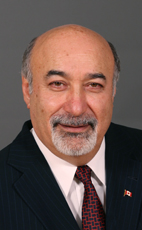
House of Commons photo

Crucial Fact

  • His favourite word was billion.

Last in Parliament March 2011, as Liberal MP for Scarborough Centre (Ontario)

Lost his last election, in 2011, with 32% of the vote.

Statements in the House

Science And Technology June 8th, 2001

Mr. Speaker, in the recommendations that will come forward, good points have been made by the hon. member and every member on the committee.

Right now we are going to continue with this agenda. We are reviewing it. The committee is summarizing it. He and every Canadian can be assured that we will continue to make Canada the most connected and innovative country in the world.

Science And Technology June 8th, 2001

Mr. Speaker, when the member uses the word spend, he is wrong. The government is investing in Canada. We heard from the astronomers and listened when they brought forward their points.

Let me tell the member, who is a very active participant on the industry committee, that if he thinks investing in Genome Canada is wrong, then let him say so. If he is thinks investing in and connecting our country is wrong, then let him say so. If he is talking about investing in research and development in our universities, then let him say so. That is where our investments are going.

Questions On The Order Paper June 6th, 2001

Industry Canada: Strategis is a website intended to provide business and consumer information. It is assumed to be the most popular website of Industry Canada. Its users are primarily Canadians who consult the site to obtain information or transact business with the department.

Parts ( a ) and ( b ): Strategis uses web server log file analysis software to record the Internet protocol, IP, address of computers that have contacted the website: Strategis makes no attempt to associate particular IP addresses used in contacting the website to individuals. Strategis also occasionally uses a technology known as “cookies” to identify that a particular computer has returned to access the Strategis website more than once. Finally, Strategis occasionally invites users to provide views and opinions in the form of voluntary surveys. In no circumstance is any attempt made to link information obtained by these technologies to specific individuals.

However, from time to time, personal information such as name, phone number, e-mail or conventional address is required in order to respond to a particular client's question or to register in a secure area of Strategis where transactions are conducted. This information is supplied by the client on a voluntary basis or may be required by law. This information is retained as appropriate to circumstances.

Part ( c ): Strategis includes standard statements as required by the Privacy Act. These statements clearly describe the nature and extent of personal information being collected and ensure the rights of the individual are set forth. A web Privacy Statement summarizing the privacy and policy practices of the Strategis site is also available on every page of Strategis.

Question No. 41—

National Agriculture Industry Relief Coordination Act June 5th, 2001

Mr. Speaker, I rise on a point of order. I beg your indulgence. I stayed here because I had an interest to hear, but I am not really hearing what this debate is all about. If we could get back to the subject matter I would like to hear it.

National Agriculture Industry Relief Coordination Act June 5th, 2001

Blame the Alberta government.

Patent Act June 5th, 2001

Madam Speaker, I am pleased to rise today to begin third reading of Bill S-17, an act to amend the Patent Act. Bill S-17 is the end result of two separate World Trade Organization challenges, one by the European Union and one by the United States, against different aspects of Canada's drug patent regime.

As a result of these challenges the WTO ruled that certain aspects of our drug patent regime, namely stockpiling and our old act patent term, were inconsistent with our international obligations under the WTO agreement on trade related aspects of intellectual property rights, also known as TRIPS.

On a more positive note, Canada won an important aspect of the challenges when the WTO validated our early working exception that accelerates the market entry of generic drugs by a period of three to six and a half years.

Overall these rulings neither undermine nor threaten the underlying balance of Canada's patent regime. They do, however, mean the Patent Act needs to be amended to comply with our obligations under TRIPS.

The bill before us deals exclusively with issues of patent term and stockpiling. Its primary objective is to bring Canada's Patent Act into compliance with the WTO ruling. It is very important therefore that we proceed expeditiously with the amendments before us because the WTO has imposed an August 12 deadline for compliance with the patent term ruling.

The amendments in the bill have deliberately been kept as simple and straightforward as possible to help meet the deadline. If we do not respect the deadline we could face retaliatory trade sanctions. To avoid such a result requires that the bill be passed by parliament and given royal assent before the summer recess.

Some would say that Bill S-17 would alter the balance of Canada's drug patent regime. That is not the case. We have demonstrated that the amendments would not increase the price of drugs. They would affect only a small percentage of drugs on the market, less than 1%, and would not affect the speed at which generic drugs enter the market.

This demonstrates that the amendments would not undermine the balance of Canada's drug patent regime, a balance that rewards innovation and guarantees access to affordable drugs for all Canadians.

Because some have expressed concerns about how a change in the terms of patent protection would affect drug costs, I will go into the issue in more detail. We heard in committee that the number of commercially significant drugs that would benefit from patent term extension is approximately 30. That number is relatively insignificant when compared to the 5,200 patent and non-patent prescription drugs available to Canadians. The average term extension for patents on the 30 drugs I mentioned is less than six months.

The proposed amendments would not increase the overall price of drugs. Rather, they could delay by a few months the potential savings offered by generic alternatives. Even under the most generous of assumptions, the forgone savings would amount to less than one-tenth of 1% of drug sales over the next eight years.

Our current patent regime serves Canadians well. According to the latest report from the Patented Medicine Prices Review Board, prices in Canada are 11% below the median foreign price and Canadians pay 40% less for patent drugs than do Americans. The amendments contained in Bill S-17 would not hinder the PMPRB's role of ensuring that Canadians do not pay excessive prices for drug prescriptions.

Bill S-17 has undergone scrutiny by committees in both houses of parliament. The Senate Standing Committee on Banking, Trade and Commerce held hearings in March and April. As a result of the hearings I understand that committee members developed a common understanding that Bill S-17 was necessary to comply with WTO rulings.

On the more divisive issue of NOC linkage regulations, there was a general recognition from the Senate committee that they fell outside the scope of Bill S-17 and that now was not the time to address broader intellectual property rights.

The House of Commons Standing Committee on Industry, Science and Technology held hearings in May. I would venture to say that there was a general recognition by most members of the committee that meeting our international obligations was important and that the passage of Bill S-17 was necessary to do so.

On the issue of the NOC linkage regulations, we heard that the early working exception and the NOC regulations, taken together, were an important part of our balanced approach. For the most part, members of the committee agree that it was a matter for another time. The immediate priority is the passage of Bill S-17 before the summer recess.

Bill S-17 contains the amendments necessary to bring the Patent Act into compliance with the WTO rulings. Neither the WTO rulings nor the proposed amendments would undermine the structure of the Canadian patent regime as it currently exists.

It is very important that innovation continue and be rewarded and that Canadians continue to have access to affordable drugs. The government's objective is to build a world class leading economy driven by innovation, ideas and talent. We need a strong and modern intellectual property framework to do so. The amendments contained in Bill S-17 would help maintain Canada's leadership in the global knowledge based economy.

I urge all members on both sides of the House to work together and move expeditiously to support the bill.

The Act Of Incorporation Of The Conference Of Mennonites In Canada June 4th, 2001

Mr. Speaker, I too am very pleased to participate in this debate today on Bill S-25, sponsored by the member for Winnipeg South. Let me also add my comments, after hearing the member for Elk Island give us an historical perspective. It gives everybody the opportunity to maybe appreciate why we are doing this. It is such a unique experience, as we begin a Monday in this House, to see such tremendous co-operation among members. It is amazing what can be accomplished when everybody comes together and rises above political stripes.

I will also point out, as the parliamentary secretary, that the bill is very straightforward. None of the changes proposed in the bill are unusual or revolutionary in any way, as the House heard from other members. Rather the changes are designed to ensure clarity of operation for the Mennonite church.

The bill was requested by the Conference of Mennonites of Canada and was sponsored in the other place by Senator Kroft to start with. Senator Carstairs then sponsored the private bill in the last parliament, but unfortunately it died on the order paper. So here we are today.

I would like to point out that even though the bill is routine and non-controversial, it speaks to the larger issue that builds on the foundations of Canada's economy. That issue is important for the framework of legislation affecting corporations as well.

Whether these corporations are aimed at making a profit in the global economy, or whether they are co-operatives aimed at advancing the interest of their members, or whether they are not for profit corporations, or in this case churches as was mentioned earlier, any corporation must have its rules and regulations built upon a solid base of framework law.

Over the past years the government has worked to modernize its corporate framework legislation as we all know. A sound corporate governance structure is a fundamental requirement for healthy investment, innovation, trade and economic growth. In recent weeks we have debated Bill S-11 which amends the Canada Business Corporations Act and the Canada Cooperatives Act.

These are the framework laws that establish basic rules for corporate governance in these kinds of bodies. For example, they set out the rights and obligations of directors, officers, shareholders and co-operative members. Part of the objectives of Bill S-11 are to eliminate duplication and reduce costs of compliance. Let me emphasize, we want to allow business corporations and co-operatives the flexibility to organize their affairs within a sound legislative structure.

We place a high priority on this kind of co-operative framework legislation because it helps Canada compete in the global economy. We amend these pieces of legislation to position Canadian businesses, investors, shareholders and co-operative members to respond quickly and creatively to rapid developments in the marketplace.

This brings me to the bill before us today, Bill S-25. At first it may seem that there is very little in common between the corporate framework law affecting companies and co-operatives and that which affects the Mennonite church.

After all, the House will see in subclause 3(4) that the first objective of the corporation in question is:

—to promote the spiritual welfare and the unity of spirit of the members of the Corporation and, by mutual assistance, to foster, diffuse, encourage, advance and strengthen the work of the kingdom of God;

We rarely find these objectives as part of the corporate goals of the business covered under Bill S-11.

The next object listed for the corporation is:

—to build Christian communities in the Mennonite tradition;

That tradition has existed in Canada since the 18th century when the first Mennonites came to Canada from the United States following the American revolution. It was clearly pointed out by the member for Elk Island. I appreciate him providing the history, because it gave everyone the opportunity in the House and across our country to understand fully what the bill all about.

Let me point out that another wave of immigrants came from Russia, as I mentioned earlier, in the 19th century following the Russian revolution. More recently Mennonites from many different backgrounds have made Canada their home, including Chinese, Vietnamese, Laotian, Cambodian, Taiwanese, French and Spanish, as well as German.

Over the centuries the tradition has produced a unique socio-religious culture based on self-sufficiency within tight communities. It is a culture that emphasizes peace and relief projects.

Since its incorporation in 1947, the needs of the Conference of Mennonites in Canada have changed. Corporate governance laws in Canada have also changed. This is why, even though the aims and objectives of the Mennonite conference are different from the kinds of corporations covered in Bill S-11, there is a unity of purpose in the need to provide framework law that meets today's needs.

Bill S-25 would give the Mennonite church in Canada greater flexibility to carry on its affairs and makes its incorporation status consistent with modern corporate legislation. The bill would remove the factors that limit the corporation from operating internationally. In this way we can see a commonality of spirit between the bill affecting a church and our corporate framework legislation designed to make industrial corporations competitive internationally.

This is a routine piece of legislation. I am sure and know, as we have heard, that my colleagues unanimously support this effort. At the same time, the bill reminds us all of our importance to work together in the House co-operatively.

In closing, I personally want to thank everyone here for this co-operation. I know that as we move forward we will do the right thing.

Trade May 29th, 2001

Mr. Speaker, let me thank the member for Brampton Centre for his question and acknowledge his interest in the issue.

Over the years the government has been a strong advocate of reducing interprovincial trade barriers. Let me point out the agreement that was signed on international trade with the provinces, the territories and Yukon in 1994.

Let me also point out that there was a meeting in April of all ministers. They put forth an agenda which will culminate in a meeting of all ministers on May 31 to June 1, basically to work on reducing trade barriers within our country.

Points Of Order May 28th, 2001

Mr. Speaker, just for the sake of clarification on a question the member for Richmond asked during question period. The RCMP was requested to do an investigation. It looked into the matter and concluded that no investigation was necessary. I just wanted to state that for the record.

Auberge Grand-Mère May 28th, 2001

Mr. Speaker, I do not know how clear I can be. Perhaps there is confusion in the hon. member's party.

I just clarified that the RCMP was asked formally to conduct an inquiry. It did that. It came back. The member accepted the findings of the RCMP. I think the member is just as confused as his party is.