
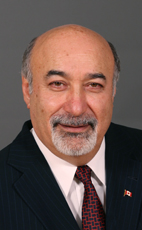
House of Commons photo

Crucial Fact

  • His favourite word was billion.

Last in Parliament March 2011, as Liberal MP for Scarborough Centre (Ontario)

Lost his last election, in 2011, with 32% of the vote.

Statements in the House

Shipbuilding Industry February 8th, 2000

Madam Speaker, I thank you for your clarification. Let me get to the essence of the whole debate here tonight.

I remind the House that last November and December the Standing Committee on Industry had already begun reviewing Canada's productivity and competitiveness with respect to shipbuilding. I want to make it crystal clear that the member's motion comes a little bit too late, as I said earlier. Let me emphasize the valuable work already done by the Standing Committee on Industry.

Before taking a few moments to review the testimony provided during the hearings, I want to once again remind all members that there is a national shipbuilding policy in Canada and it includes the following support. They said there is no shipbuilding industry. There is an accelerated capital cost allowance for Canadian built ships; a 25% tariff on most non-NAFTA ship imports; domestic procurement by the federal government in the hundreds of millions of dollars; Export Development Corporation financing for commercially viable transactions; and a very favourable research and development tax credit system.

These are the very elements that the industry committee has examined. On November 16, the first day, the committee heard from several government officials. Committee members were provided with a global portrait of the shipbuilding industry. We have to look at it in that context, one in which most shipbuilding today is done in Asia, Japan, South Korea and increasingly I might point out in China. These governments heavily subsidize the sector.

The Japanese have built a strong niche in the construction of large vessels and have managed to hold on to that niche. The newly developed countries see shipbuilding as an outlet for their steel production and steel production is a key to their industrial development. Other countries, including the United States, have non-tariff barriers to buying foreign built ships.

Officials also maintain that overcapacity has been a problem for Canada's shipbuilding industry today. For some time now the industry has been undergoing rationalization. Officials have suggested that the industry itself acknowledges that rationalization has improved its competitiveness.

On a more positive note, officials pointed out in committee that the Canadian manufacturers are on a par with just about everyone in the world when it comes to designing innovative products, manufacturing them efficiently and marketing them to the world. They said that there are niche opportunities for the Canadian shipbuilding industry. Ice-breaking vessels, ferries, offshore equipment and self-unloading vessels are areas in which we have a great international reputation. We are also well regarded as builders of military frigates. Unfortunately there is not that big of a market for them.

Officials from the Export Development Corporation also appeared before the committee. They reported that EDC has concluded 17 transactions with the shipbuilding industry for a total of $247 million worth in business. Here is one government program which indeed is showing a positive result.

Finance officials also explained how Canada's tax system supports shipbuilding, including giving the industry a higher capital cost allowance and noted that Canada has the most generous R and D regime in the G-7.

During the hearings the hon. member for Fundy—Royal referred to the financing available in the United States under the title XI program. I remind the hon. member for Fundy—Royal of his exchange with the finance officials concerning his suggestion that Canada should provide a combination of lease financing and accelerated depreciation. The hon. member also may believe that in providing these incentives the government would end up increasing federal revenues because there would be more economic activity. Finance officials clearly pointed out in their reply that rarely does the government's return on such incentives amount to more than a fraction of the amount of taxpayer moneys committed.

These are some of the points raised in the first day of the standing committee's hearings on shipbuilding. As you can tell, Madam Speaker, we had a vigorous and exciting debate during that session.

The standing committee went on to hear testimony from labour organizations including the Canadian auto workers, the Marine Workers' Federation of the CAW and the ship workers union of Lauzon. We were presented with a document entitled “The Shipbuilding Strategy for Canada” which talked about the need for a level playing field, emphasizing the role of the Jones Act in the United States in closing its markets to Canadian built ships. They offered suggestions including financing terms that would be similar to what the Americans have with their title XI program. Once again the committee had a very probing, thought provoking exchange with the shipbuilding industry.

On December 14 the standing committee met for a third time on the topic of shipbuilding to hear from industry representatives. The Shipbuilding Association of Canada spoke of the impact of subsidies on the market and the need for competitive financing arrangements. He referred specifically to the title XI financing of the American shipbuilding industry. The Chamber of Maritime Commerce spoke also about the advantages that labour practices and low labour rates give the shipbuilding industry in newly developed countries.

I would like to close by thanking the member for bringing forward the motion and giving us the opportunity to debate this issue in the House and the opportunity for the government to put some of the data on the floor.

Shipbuilding Industry February 8th, 2000

Madam Speaker, that is not what I said. I was saying we should compliment, congratulate and support people who support us.

I am pleased to respond to this motion brought forward by the hon. member for Fundy—Royal that the Standing Committee on Industry review policies currently in place that affect the Canadian shipbuilding industry.

We on this side of the House are very open to the idea of a parliamentary review of the shipbuilding industry, but this motion seems to be caught in a time warp. I understand where the members from the Bloc, the Conservatives and the NDP are coming from. I understand the regions. I understand the members have to address a specific industry in their ridings and be so passionate.

What is the point of standing up and bringing something forward that has already been addressed? Is it showcasing? If it is, I congratulate the member. I think he is doing a great job. Tomorrow he can send a press release to his local newspaper saying “Look, here is what your member for Fundy—Royal has done”. But we have a responsibility when we come to this House.

Shipbuilding Industry February 8th, 2000

Madam Speaker, I was going to start with the text of my prepared notes but I will not. I am going to take this opportunity to respond to the emotional and passionate presentations I have just heard from the Conservative member who brought the motion forward, the Bloc Quebecois member and my good friend from the NDP. What I heard took me away from what I really wanted to say about the good work that was done in committee and how extensively the committee looked into this matter.

I have heard comments which have shocked me. Instead of focusing on constructive comments of what we can do about the shipbuilding industry, I heard about the farmers and I heard about HRDC. I heard everything but constructive input. I find that shameful. They were referring to ministers and their businesses which are in trust. That is shameful. That is not what we are supposed to be doing here tonight. We are here to discuss shipbuilding and to bring some constructive points forward.

I am going to take this opportunity to refer to my notes and talk about how enthusiastically and aggressively the committee addressed this issue.

The member referred to Les Holloway and all the other great people. I am glad he is doing this. He should do it to get their votes if that is what it is going to take to get their votes and if that is what it is going to take to get a contribution to their campaigns. That is fine. I have no objections to that, but I do object when we go totally off the issue.

Churchill Heights February 8th, 2000

Mr. Speaker, I take this opportunity to welcome the students of Churchill Heights to Ottawa today. These students have travelled to Ottawa from my riding of Scarborough Centre in order to visit the impressive Parliament Buildings and to see firsthand how their government functions. This experience will no doubt be an enriching addition to what they have already learned in the classroom and will leave a lasting mark on them for the rest of their lives.

I believe it is important for Canadians of all ages to visit the capital and bear witness to the legislative process at work. As such I extend an invitation to all my constituents to do as the students of Churchill Heights have done by visiting us in Ottawa.

I welcome the students from Churchill Heights to Ottawa and thank them for giving me the opportunity to host them in our country's capital.

Questions On The Order Paper February 8th, 2000

It is not possible for the Social Sciences and Humanities Research Council to respond to this question because the category editorial project is not a separately coded category. Nor is it necessarily supplied by the researchers in the list of key words they give for their projects. The current corporate storage and retrieval system thus cannot provide a reliable and comprehensive report of the funds granted under the category editorial projects. It should be noted that the council awards its grants through a highly selective competitive process which considers the research, intellectual and social significance as well as the overall excellence of the projects submitted.

Question No. 39—

Canadian Tourism Commission December 16th, 1999

Mr. Speaker, pursuant to Standing Order 32(2) I have the honour to table, in both official languages, the Canadian Tourism Commission's annual report for 1998-99 entitled “Transition”.

Nisga'A Final Agreement Act December 6th, 1999

Madam Speaker, the question today is just as confusing as it was last week, simply because the hon. member goes from pricing to competition.

Let me point out that the Competition Act contains all the necessary tools to investigate and prosecute offences in the gasoline industry. I can assure the hon. member that where allegations are made to the bureau that companies or individuals have crossed the line of appropriate business behaviour by fixing prices or engaging in anti-competitive conduct, the Competition Bureau will act appropriately.

When the bureau finds evidence supporting allegations made it will actively pursue these matters through the competition enforcement of the Competition Act. For example, criminal charges were laid in September of this year against a refiner and two retailers of gasoline for price maintenance.

Where the bureau's investigation finds that the allegations are not sustained or do not support the conclusion drawn by the complainant, the bureau will discontinue its investigation. It is important to realize that when an investigation is discontinued due to lack of evidence, it does not mean that the act is deficient or requires amendment. It means that there is no sufficient evidence of anti-competitive activity.

I will also point out to the hon. member that the authority to regulate retail gasoline prices falls within the purview of the provincial government not the federal government. Therefore, the hon. member's suggestion to have the federal government establish an energy price review commission that would have as its mandate to review and regulate gasoline prices, could not be undertaken by the federal government.

If the hon. member, my good friend, wants to achieve this, he should take this case to his colleagues in the Government of Saskatchewan. The hon. member should realize that price regulation usually results in increased costs, higher prices and distorts the normal operations of the markets. Reliance on market forces and not regulations is in the best interest of Canadians.

With respect to hockey, I think Saskatchewan needs a hockey team too.

Canadian Tourism Commission Act December 1st, 1999

Mr. Speaker, I have a quick comment to make. All I heard from the hon. member, aside from of course stating separatist aspirations, was forcing, forcing, forcing. Nobody has forced anybody into this wonderful arrangement upon which we are embarking. All the stakeholders came together, Quebec included, and their representatives.

The member talked about duplication. It is not a matter of creating something. This was already there. We are simply fine tuning it to crown corporation status, which is basically what all the stakeholders asked, including Quebec, which is granted a seat on the board, as are all other representatives, so that collectively we can market not only the beautiful province of Quebec but the entire country.

There is no duplication. The system already exists. We simply want to work much closer with our provincial partners, who will have the opportunity to promote and enhance the tourism industry.

Recognition Of Crimes Against Humanity Act November 30th, 1999

Mr. Speaker, that is our goal. The upcoming negotiations of the WTO, which will be launched in Seattle on November 30, have generated a lot of interest, and rightfully so. These talks are important to Canadians, as they should be.

One of the agreements that will be discussed is the General Agreement on Trade in Services. This is an important agreement for Canada, as we were in 1998 the 10th largest exporter of services in the world. Currently over 60% of our GDP and 12% of our exports are in the service sector and service exports are growing at a rate of over 9% per year.

Our service industries are a critical component of our growing knowledge based economy. As well, with advances in technology, an ever-increasing amount of our goods exported depend on a service component either in the production process, distribution or after sales service.

Globalization is pushing Canada to grow and develop markets outside our borders. This is benefiting Canadians and is an important contributor to job creation. Because we are trading beyond our borders, it is important to have rules to protect our interests. These multilateral rules, agreed to by the 134 member countries of the WTO, helped to create an orderly marketplace. This is why we participate in the World Trade Organization.

Canada has world class service firms in sectors including engineering, telecommunications, environmental, computer, tourism and financial services. In GATS negotiations, we will try to further open foreign markets for Canadian service exports. As in the case for goods, more exports of services means more jobs for Canadians.

At the same time, we are fully aware of domestic sensitivities in certain service sectors such as health, education and social services.

As has been stated already and stressed, in the WTO and under GATS, our universal health care and public education are not subject to any international trade rules unless Canada accepts such rules. This means that we will not be engaging in negotiations in these most important sectors. Canada's position is that our health care and public education system are not negotiable and will not be jeopardized in the current upcoming negotiations.

Canadian Tourism Commission Act November 26th, 1999

Thank you, Mr. Speaker, for respecting the rules of the House. The member who spoke on the bill said that they could not support the bill in its current form. That does not surprise me because they would not support it anyway, no matter what form.

Before I get on to my question, I was disappointed because the member took this opportunity to take the bill in an entirely different direction, which is unfair to the industry, unfair to us, and unfair to the country. For years the member for Broadview—Greenwood has been promoting tourism. I commend him for it. We have been presenting it as a pan-Canadian initiative.

I compliment the member when he talks about the beautiful areas of Quebec. I am very proud to say that my daughter will be teaching French next year. We share its beauty and that of the rest of Canada. On other hand, as the CTC is unfolding I want to clarify for members and the listeners out there that the Canadian Tourism Commission was there, is there and will continue to be there.

It is a partnership agreement where the stakeholders come in and provide financial support along with government appropriations and proper accountability. The sad part I heard while listening, as much as I heard many wonderful things, was the way it was portrayed in terms of marketing Canada or promoting federalism. The word propaganda was there. There is no propaganda when we talk about the beauty of our country from coast to coast to coast, helping small businesses grow, bringing about employment and capturing the market.

Could the member tell me how the CTC, the government or any Canadian, could prevent any French speaking individual from any part of the globe from coming to Canada? That I cannot see.