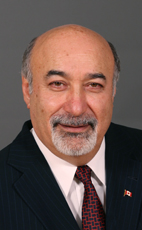
House of Commons photo

Crucial Fact

  • His favourite word was billion.

Last in Parliament March 2011, as Liberal MP for Scarborough Centre (Ontario)

Lost his last election, in 2011, with 32% of the vote.

Statements in the House

Greek Independence Day March 20th, 1997

Mr. Speaker, on March 25 Canadians of Hellenic descent will be celebrating the anniversary of the liberation of their former homeland from the Ottoman Empire. In 1821, after 400 years of oppression from the Turkish regime, the Hellenes, with the help of heroes such as Lord Byron of England, helped restore freedom to Greece, the birthplace of democracy.

It is my hope that as we enter the next millennium the current provocations and tensions in this region will be completely eliminated. It is my suggestion that both nations should now concentrate on infrastructure and economic development.

The energies of their people, particularly their youth, should be focused on creating a peaceful environment which, in turn, will lead to a prosperous future.

As John Lennon of the Beatles once said, please give peace a chance.

The Budget March 18th, 1997

Mr. Speaker, he would have to ask the provincial people. That is where it was from. I want to respond very quickly because I know my time is up.

The member for Capilano-Howe Sound is absolutely correct and I agree with him. Maybe, because I agree with him, that is why he was the first member who applauded our previous budget. As we reduce payroll contributions we could entice employers to hire. That is clearly stated in the budget.

As I mentioned in my presentation in 1993, EI deductions were $3.30 per $100. They are down to $2.90. They are going down to $2.80. As our economy grows our intentions are to reduce those premiums. Hopefully that will motivate employers to hire. He is absolutely correct in saying that. Then hopefully we can take part of those contributions and increase the savings with respect to the Canada pension plan.

The Budget March 18th, 1997

Mr. Speaker, that is a very good question. I thank the hon. member for his comments.

The question does not respond to the figures he gave between the year 1976 and the year 2030. However it is very important for the people to know that the Canada pension program is not strictly a program of the federal government. We did not simply decide that we would do this. The program is administered in co-operation between the provinces and the federal government. We did not arbitrarily say one day what we were going to do. We all know about the negotiations that went on.

We agreed to a 10 per cent increase. The fact remains that the Reform Party wanted to increase it by 14.2 per cent. If he is concerned about the numbers he has given me, in essence he is saying these are the numbers we will have with a 10 per cent increase over the next six years. He is not saying how wide the gap will be with their proposed 14.2 per cent.

Their programs do not provide for any disability phase of the Canada pension plan. As an employer I looked at it as part of the benefit package when it came to hiring staff. It was part of my obligation. When we moved over from health premiums and the employer had to assume that responsibility I was very happy to take it on. I made sure the health program had an infusion of money. It was my responsibility as an employer to make sure that based on the payroll deductions I had to contribute to the health system. That was one way of securing the health system would be there.

In essence the gap would be wider if we had gone with the Reform Party proposal.

The Budget March 18th, 1997

Mr. Speaker, I will continue my presentation. I want to touch on transfer payments and the cuts that have often been mentioned during this debate. Earlier on there were comments about a $7 billion cut in health care. We are being intellectually dishonest when we stand up in this honourable House and make those kinds of statements.

We know very well that it was not $7 billion to health cuts alone. This was $7 billion spread throughout the country. I would like to use Ontario as an example because that is where my riding is situated. Ontario's hit was $1.2 billion. In the election of 1995 before the current government took over in Ontario, the former government headed by Bob Rae just before the election gave out almost $1.6 billion in handouts. I can break down exactly where these handouts were but the question many people had was where the money came from.

I would like to repeat that Ontario's reduction was $1.2 billion. Most recently the Conservative government in Ontario stated that it was going to put back into the health program almost $400 million. It also indicated that the additional $500 million that was slotted to be taken out of the program in 1998 most likely will not be taken out. Therefore, when we take those two figures of close to$900 million that in essence almost adds up to the type of shortfall that Ontario will be receiving.

Let us be very clear about it. The closure, reduction or fine tuning of certain hospitals is not as a direct result of the less money going to specific provinces. That is a political decision of the respective governments, in this case the governments of Ontario and Alberta.

I would like to touch on tax relief. Earlier today we heard the leader of the Conservative Party indicate that he is going to reduce taxes immediately. Where is the money going to come from to try to balance the budget and give a tax break at the same time? The people of Canada know, because economists have spoken about it often enough, that we are on track. The underlying message is that we are headed for a balanced budget and we are very proud to say so.

Once the budget is balanced, what will we do with the surplus that we will hopefully have? The debate then will be, do we start eating away at the debt or do we rebuild some programs?

One big point we have debated over the last while has been the Canada pension plan. In the 1950s and the 1960s it was our responsibility to bring forward these programs. The challenge before us today is to make sure these programs are secure, not just for us and our children, but for generations to come. I believe the approach being used to secure the future of the pension program is the only way to go.

If we look at the alternatives that the Reform Party has put forward, using the example of Chile, today almost 40 per cent of the population of Chile have no benefits, no programs or pensions whatsoever. We can talk about super RRSPs or private pension programs. Most recently we read about the Route Canada program which after so many years is now starting to clear the company pension program.

In response to a question, the Minister of Finance indicated the difference in the Canada pension plan. There is one word I would like to stress and that is secure. Confederation Life unfortunately went into bankruptcy. What happened to the pensions and the savings?

There was an article in the paper not too long ago about the difficulties the retail store Eaton's is going through. It says here:

"Eaton's eyeing pension surpluses". If I had a private pension plan that I had no control over and a large organization is controlling that pension program and something unexpected happens, where is the protection? There may be some protection.

It has been claimed that the Canada pension plan has been exploited in a very extreme way. I would like the opportunity to put my constituents at ease by saying that the Canada pension program is one that now has been put on a solid footing. The money will be invested and reinvested. An independent group will be looking after it and, for example, investing much as teacher's pension funds or the firemen's fund are invested.

I am comfortable responding to questions from my constituents when I tell them they have no worries. The Canada pension plan is there today and will be here tomorrow.

Another important issue which I believe will be before us during the next election is the question of health. The National Forum on Health stated that the problems with the program are not monetary. There is enough money in the programs. What did we do as a Liberal government? We said we would like to go a step further and add an additional $50 million over the next three years.

I recall some comments I heard from my constituents in Scarborough Centre when speaking of the provincial government. I was hearing comments such as: "Why do we have just over10 million living in Ontario and 11 million health cards?" That does not make sense. What we have to do with our health system is spend our money wisely. We do not need four managers for ten staff, for example. That is the restructuring that is going on within the hospital environment.

It has been noted in the past that Reform Party members would like to see us take a much more aggressive approach to reducing the deficit. We know their statistics. We know their numbers. What good will it do to slash and burn from day one only to come back to re-energize? Who will we bring back to life? The dead patient? It is too little, too late.

We have taken a balanced approach, a humanitarian approach to cutting. As a government we have also taken our hits. They have been clearly noted. We are looking at supporting the health program in the best way we know how. I want to tell that to my constituents in Scarborough Centre and to anybody else who is listening.

I also hate it when they talk about the 73 per cent increase. Why do we not take the Canada pension plan and go through it step by step. Today we are paying almost 6 per cent. Next year it will be6 point something. What is odd here is how Reformers combine the employer's share and the employee's share. We know there are also private pension programs within company pension programs. That is not a tax. I do not understand how they term Canada pension contributions as being a tax.

I am not concerned with what the finance department says. I know what I said when I was an employer and hired people. When I hired people, the deciding factor was not how much I paid in UI contributions or Canada pension plan contributions. That was part of the employment package. The bottom line was productivity.

In closing, I would like to put out a challenge to the private sector. We responded to their concerns and put our financial house in order. I put the challenge out to the private sector: We have done our share. It is high time they do their share and recommence hiring.

The Budget March 18th, 1997

I apologize, Mr. Speaker, I neglected to mention at the beginning that I would be sharing my time with the member for Scarborough-Rouge River.

The Budget March 18th, 1997

Mr. Speaker, it is a pleasure for me to be given this opportunity to participate in the debate on our most recent budget. There are many positive details in the budget but will focus on a few issues which are very important to me and to the constituents of Scarborough Centre.

First I will touch on the measures we have taken with respect to supporting small and medium size businesses. I speak from experience when I say that I know the importance of a strong support network which is indeed instrumental in allowing small businesses to grow. Before I entered the political arena I too was a small businessman. I believe the growth of small and medium size businesses is essential to the creation of jobs for all Canadians.

Our government believes that small businesses will remain a key source of continued employment growth in the years to come. The small business sector now accounts for over half of all private sector employment. The impact of this most important initiative is the profound way it will continue to be relied on as our growth and economic initiatives for today and the future. Because of the importance of small business, the government has been working on ways to make life easier for the owners.

One measure that was announced in this year's budget is the quarterly remittance of statements. The joint forum to reduce paper burden on small business identified frequency of remittance as a major irritant and recommended that quarterly remittances be made for small businesses. Monthly remittances impose a great burden on small businesses, as they do not normally have the in house resources that larger companies have.

The budget proposes allowing small businesses with average monthly remittances of less than $1,000 complete with a good record of compliance for payment of income tax and other payroll deductions to be remitted on a quarterly basis as opposed to a monthly basis. This will potentially affect approximately 650,000 businesses, representing 56 per cent of all businesses.

Also announced in this year's budget is the raising of the lending ceiling for small business loans from $12 billion to $14 billion.

Since the Small Business Loans Act is expected to hit its$12 billion ceiling by July 1997, the government has raised it by$2 billion to ensure that loans can continue to be made in both 1997 and 1998.

For any of the other small business organizations, the loan act is something that I believe small business should access and tap into with respect to supporting them when it comes to expansion, to purchasing equipment or expanding the business, fixed assets et cetera. This program has proven to be extremely beneficial to the small and medium size businesses right across the country.

Our government has also lowered the EI premiums which in turn helps employers and employees. In 1993 EI premiums were pegged at $3.30 per $100. Today they are at $2.90. This budget has clearly stated that the premiums will be going to $2.80 by 1998. When we add the entire program that is a combined savings of almost$1.7 billion both for the employers and the employees. I would tend to look at that as a tax deduction as opposed to a tax increase. Although I use the word tax, I have always termed this type of deduction as a premium rather than as taxing.

The new hires program which was introduced in the 1997 budget will also allow up to 900,000 eligible employers to pay virtually no premiums for new jobs created this year. As I mentioned earlier, together these measures will combine to almost $1.8 billion in payroll deductions for both employers and employees.

These measures coupled with the low interest rates, the lowest in almost 35 to 40 years, have generated an environment of confidence and strong growth within the small business sector.

As the statisticians and the economists are stating, this trend most likely will translate into about 300,000 to 350,000 new jobs in 1997. I cannot express how important this sector is not only to my riding of Scarborough Centre but to all communities across Canada.

Large firms have been downsizing consistently, entrepreneurship has become the in thing of today and this is why I speak, as a former entrepreneur and a small business owner, on how important interest rates are. When we look at today's primate rate at 4.75 per cent, an individual whose running and operating line is at an average of $150,000 may be saving 2 per cent or 3 per cent, constituting a considerable amount of money at the end of the day. When we look at their loan payments certainly the less they pay in loan payments, the more they can put back into upgrading their company or hiring new staff.

When we look at mortgage payments and the rates of today which hover around 6.5 per cent for a five year mortgage, maybe 6.75 per cent, for the average individual renewing their mortgage today there is a considerable savings of anywhere from $3,000 to $4,000 on an average $100,000 mortgage. I would like to emphasize this because this is disposable income that these families or small business people never had three or four years ago. This is after tax dollars.

Our small business community has become more sophisticated and globally competitive, particularly in a technology based economy. It is vital we understand that as we move from a resource based economy to an information based economy it is important not only to support these organizations to expand and invest in research and development but that we train our workforce to have the tools and the skill sets needed to compete in today's economy.

Our government has also shown a willingness to support and foster the entrepreneurship spirit that drives the small business community. That is why another measure in our budget is to increase the funds for Canadian tourism. Funding for the CTC will increase $15 million per year over the next three years. Much of this funding will go toward increasing Canada's visibility in foreign markets. The Prime Minister's trade visits across various countries have brought in close to $22 billion in contracts. There are companies in my riding of Scarborough Centre that have benefited directly as a result of those trade missions. We see our trade surpluses today at numbers that we never imagined they would be and with the stability of the dollar this certainly enhances our economic position both locally and abroad.

I want to return to the tourism industry. This industry has huge potential for employment creation and by infusing money within that industry with more funds we can encourage and continue interest in that area. The other dimension in supporting the tourism industry is that it gives us an opportunity as a nation to showcase our country from sea to sea.

I would like to take this opportunity to encourage Canadians to visit other parts of this country. Maybe we could entice Canadians to travel within our country by some form of tax breaks and rebates at the same time.

I congratulate the Minister of Finance on his continued balanced approach to fiscal responsibility. After being elected three and a half years ago our government pledged to get our financial house in order. We have set firm two year rolling targets and this will be the third year in a row we have met and bettered our deficit targets. Our 1996-97 results will be more than $9.5 billion below our deficit a year ago. That is the largest year to year decline. We are clearly on track to meeting our deficit targets for the next two years;$17 billion for 1997-98 and $9 billion for 1998-99. This means Canada will enter the new millennium in a position to eliminate financial borrowing needs. Once again we will be in control of our own country. We will have reduced the deficit to zero and we will be able to say that we are number one in the G-7 countries.

Often the opposition refers to EI and Canada pension plan contributions as payroll taxes. I would like to take this opportunity as a former business owner to say that when I hired an individual, UI deductions or Canada pension contributions were not a deterrent in hiring new employees. I looked at it as part of the benefit package that the company had to offer.

I would also like to take this opportunity to make it clear when talking about Canada pension contributions that opposition members have often used the figure of a 73 per cent increase. It is totally unfair when they say it is a tax. Let it be stated very clearly that Canada pension plan contributions are simply contributions. It is saving today for benefits in the future.

Probably each member in the House drives a car. Every year he or she pays insurance premiums, expecting nothing back. I hope that none of us ever has a car accident because only then would we access the program. Similarly, we pay unemployment insurance hoping that we never lose our jobs, but on the chance we might be laid off or are out of employment we can access that program.

I would also like to comment on earlier debates in the House with respect to the health programs and the slashing that has supposedly gone on. Earlier in the debate-

The Budget March 18th, 1997

Mr. Speaker, I would like to take a few moments to respond to the hon. member's comments.

I will go down the list, but first let me state that I do agree with him that our tax system needs to be looked at and simplified for each and every Canadian.

I am sure the member did not become a medical practitioner by being stupid. The member said that if this government had listened to the Reform plan two and a half years ago we would have been better off. I would like to remind the member that not only did we listen to the people of Canada but even his own members listened to us and applauded us. It was after our previous budget when their own finance critic was the first one to stand up and lead the applause after the budget was presented.

It is so ironic because on two occasions the member for Saanich-Gulf Islands stood up and said that this government had gone too far and had cut too much. On the very same day I recall being in the House when the member for Lethbridge stood up and said that we did not go far enough.

I do not know what the Reform Party actually wants this government to do. We know what we want to do and that is a balanced approach.

I want to take this a step further because he touched on the health care system. I want to use the example of Ontario which most recently has put close to $400 million back into the health system and is saying that the $500 million cut slotted for 1998 most likely will not take place.

The national forum on health not too long ago announced that the problem with the health system is not that we do not have enough money in it but that we have to simply spend the money wiser. Having that feedback, we as a government took it a step further and talked about putting $50 million back into the program for the next three years. We also talked about introducing the pharmacare program. That is why we are going to insist on protecting the program.

When he talks about social conscience, let us recall that in their presentation just a year and a half ago, their approach to taking care of our seniors and the needy was to turn them over to the communities, the social services, the relatives and the charitable organizations.

They say they want to get rid of the GST, scrap the GST, as the member stated a minute ago. In their own platform they state they will hold on to the GST until they balance the budget and then they will address it.

If they were elected would they scrap the GST immediately or not?

Scarborough School Board March 11th, 1997

Mr. Speaker, I rise today to congratulate the Scarborough School Board on a successful program in the schools of the city of Scarborough.

Weapons related violence in Scarborough schools has dropped 61 per cent on a monthly basis since the board introduced a zero tolerance policy three years ago.

Under the Scarborough safe school policy, expulsion hearings are mandatory for a variety of violent weapons offences. School violence has decreased substantially since the policy was introduced.

Perhaps if amalgamation occurs this program could be implemented and used as a benchmark. The students of Scarborough have benefited greatly by the ability of the board to provide programs and services they need, while maintaining the lowest cost per pupil in metro.

I commend the Scarborough school board on taking this initiative to reduce violence and crimes in our schools. Once again, my congratulations to the board, its chair and the trustees.

Supply March 10th, 1997

Madam Speaker, I rise on a point of order. I have been following the debate throughout the day. There has not been a member from either side of the House rise to defend this criminal. They talked about the process and the system and how they unfold.

Supply March 10th, 1997

Nobody believes you any more. Be honest.