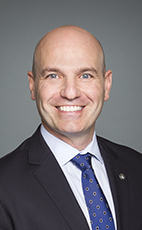
House of Commons photo

Crucial Fact

  • His favourite word was conservatives.

Last in Parliament October 2019, as NDP MP for Skeena—Bulkley Valley (B.C.)

Won his last election, in 2015, with 51% of the vote.

Statements in the House

Ethics October 25th, 2017

The voice of the out of touch 1%, Mr. Speaker.

Has anyone ever tried to change the channel knowing that the batteries are dying in the remote and just been too lazy to get up to fix them? That is what the Liberals were doing yesterday, trying to change the channel. However, Canadians are not buying it. Rather than admit they screwed up and close the Morneau Shepell ethical loopholes, the Liberals actually voted against doing so.

The Prime Minister must believe there are two sets of rules, one for him and his buddies and another set for everyone else.

While Canadians are worried about protecting their pensions, why is the Prime Minister only worried about protecting his finance minister?

Business of Supply October 23rd, 2017

Madam Speaker, I know this is a difficult thing to weigh in on, yet today, in terms of staying on topic, my friend is not even making an attempt. Usually we require some attempt to at some point glance back to the topic at hand. Reciting the government's economic plan has literally nothing to do with the topic we are talking about today. At some point he has to at least reference ethics, the Ethics Commissioner, or Bill C-27.

I know there is a lot of discretion, and we allow a lot of latitude. However, I have listened to the first number of minutes of my friend's speech, and he has not made reference to what we are talking about here today once. It is just hard to say that this is an attempt, even a small attempt, to try to talk to the matter before Parliament today.

Business of Supply October 23rd, 2017

Madam Speaker, it is the smoking gun as it is. A lot of times around ethical conduct, it is very difficult to point the transgression right to the benefit. Oftentimes, in unethical behaviour, there is the bad behaviour but it is sometimes difficult to find out if a person actually benefited from it.

I believe it was October 19, 2016, when the Minister of Finance introduced this pension bill. Within five days, the personal stock that he owned in Morneau Shepell went up 4.8%. From what we know of the stock the minister owned at the time, he would have realized a profit of $2 million, which is far more than most Canadians earn in a lifetime of work. Again, there is that middle-class value coming forward again. “Scratching my back and scratching my back again” is the Liberal way.

Business of Supply October 23rd, 2017

Madam Speaker, did we all watch that attempt, as mightily as he could, to change the channel from the ethical transitions of the Minister of Finance? The facts remain. I omitted a fact, and it is helpful the member intervened to remind me of this. The finance minister did break the ethics act, not just a loophole part. He also forgot a villa in France that he had put into a number company. However, who has not? Most middle-class Canadians and those seeking to join the middle class, from time to time, forget a villa in France that they placed into a numbered company to shelter away from taxes. Therefore, it is a normal transgression of behaviour, so the minister can be forgiven.

All policies are important. We saw the backpedalling from the finance minister last week, again and again. First the Liberals are going to tax employee benefits for somebody working at a coffee shop but then they think it is a stupid idea. Now they are going to make it impossible for people to pass on the family farm, their fishing business, their forestry company, all the businesses I represent in Skeena—Bulkley Valley. However, that was a stupid idea, so the Liberals are backtracking. Yes they are listening, but there is a part of this lack of connection to reality that one starts to wonder about with the government.

Now we have this ethical disjunct where the Liberals do not even seem to see the problem. We have to wonder what is worse: the fact that someone would act in this way, or the fact that after it has been exposed, someone would simply continue to think it is okay.

Business of Supply October 23rd, 2017

moved:

That, given the Minister of Finance:

(a) after being elected to Parliament in 2015, led Canadians to believe that he had placed his shares in Morneau Shepell into a blind trust, while never having done so;

(b) used a loophole in the Conflict of Interest Act to place his shares in a private numbered company instead of divesting them or placing them in a blind trust;

(c) on October 19, 2016, sponsored Bill C-27, An Act to amend the Pension Benefits Standards Act, 1985, a bill that would reasonably be expected to profit Morneau Shepell and the Minister of Finance in light of his continued ownership of shares in Morneau Shepell through a company he controls;

(d) was and remains in charge of regulating the pension industry in which he has had a personal economic interest; and

(e) has failed to live up to the ethical standards set forth by the Prime Minister in his mandate letter to the Minister;

the House call on the Minister of Finance to apologize to the House and to Canadians for breaking their trust, and the House call on the government to immediately close the loopholes in the Conflict of Interest Act as recommended by the Conflict of Interest and Ethics Commissioner, in order to prevent a Minister of the Crown from personally benefiting from their position or creating the perception thereof.

Madam Speaker, I will start by suggesting the brilliant idea that I should split my time with my friend, the member for Rimouski-Neigette—Témiscouata—Les Basques. This is the best idea I may have had all week.

This incredibly important motion the New Democrats are raising today is of the most serious nature. This is what some have referred to as a motion of censure. This is not a task we take lightly and is borne directly out of the respect we have for this place, out of an understanding of the role cabinet ministers play, and the important role they play in the lives of Canadians. In order to play that role, they require the trust of Canadians and must conduct themselves in the highest ethical standard.

The Prime Minister gave an explicit order to his cabinet ministers that they would not just follow the letter of the law when it came to ethical behaviour, but they would go beyond that to fully encompass the spirit of the law of conflict of interest. He also ordered his cabinet ministers to make fully public their personal assets and their controlling interests “to be above and beyond” reproach. This clearly has not been the case.

Let us start with the facts of the matter. It is always important, when setting out an argument, to talk about what we know to be true. In 2015, after being elected to Parliament, the Minister of Finance led Canadians to believe he had placed his shares in Morneau Shepell into a blind trust. He told this to the CBC, he let it be known to his former company, Morneau Shepell, and he indicated that to colleagues in the Liberal Party. Beyond that, for two years, when this mistruth was repeated publicly on social media by Liberals and others, he allowed that mistruth to exist. That is a fact.

The second fact is that the minister exploited a loophole within the Conflict of Interest Act that allowed an individual to place his or shares in a private numbered company, instead of divesting them or placing them into a blind trust. That is now known as a fact. That was only revealed by the media digging and finding out the reality and the truth.

The third fact is that on October 19, 2016, the minister sponsored a bill. The same Minister of Finance, under his name, sponsored Bill C-27, an act to amend the Pension Benefits Standards Act, 1985, work in which Morneau Shepell, his former company, the company he still had shares in and derived benefit from, receiving payment cheques on a monthly basis, almost in excess of his yearly salary as a member of Parliament, would directly benefit. Morneau Shepell had done work in this field of pensions, with a great amount of benefit to the company. This bill, by the way, not parenthetically I suppose, does great harm to the pension security of Canadians by passing the risk from a shared view between the employer and the employee, almost entirely to the employee. He sponsored the bill, a bill that his company, which he still had assets in, and he would have directly benefited from.

The fourth fact is the minister remains to this day in charge of regulating the pension industry in which he has had a personal economic interest, and remains with a personal economic interest. The Prime Minister, as we note in our opposition day motion here, called upon the Minister of Finance to live up to a very high ethical standard, not just the explicit minimum. The Prime Minister explicitly told cabinet ministers they had to divulge, to full public disclosure, their personal assets. That was not done in either case.

We call on two specific things, because we do not just seek to point out the facts of the case, we also seek to make things better.

The first thing is that if the Minister of Finance, and the government, is truly interested in attempting to restore the trust lost between his office, between him and the business community, and the larger Canadian public, it would seem to me that an apology is in order. One of the hardest things in politics may be to say “I'm wrong and I'm sorry. I was wrong to exploit this loophole. I apologize for having done it. I will make amends the following way.”

I was personally surprised, and I have heard this from many Canadians over the weekend, that the Minister of Finance's tone last week was “How wonderful am I. Look at me now, divesting, maybe eventually, my interests in an industry in which I will continue to regulate. How wonderful am I that I allowed this lie to exist for two years in the public, that I never corrected it, and that I will still not apologize for. How wonderful am I that when the media asks for more information, I say I am not accountable to you.”

Ethics October 19th, 2017

Mr. Speaker, for two years the finance minister told the media that he was putting his shares in a blind trust. He told the same thing to his old company. Canadians and even fellow Liberal MPs lived this lie. His response two years later, I guess after making millions, is that now it is time to do the right thing. Talk about Liberal entitlement. Those guys really know how to celebrate an anniversary.

Too many Canadians already think that too many politicians are just in it for themselves, and now this.

Does the finance minister simply not understand that his actions ruin the trust in our institutions? If he really wants to do the right thing, will he apologize for abusing the trust Canadians put in him?

Ethics October 19th, 2017

Mr. Speaker, in the few days after he personally introduced Bill C-27, a bill designed to attack the pensions of Canadians and help firms like Morneau Shepell, the value of Morneau Shepell stocks increased by 4.8%. For the finance minister's personal holdings, that represented a profit of over $2 million in just five days. That is more money than the average Canadian makes in a lifetime of work.

The minister constantly talks about serving the public. How does pocketing millions of dollars from his work as the minister do anything but serve himself?

Business of Supply October 19th, 2017

Mr. Speaker, there are a couple of trigger words that I am starting to get nervous about when I hear them from my Liberal colleagues.

One is “unacceptable”. I just had a phone call from some folks who are struggling with the Phoenix pay system, and they have heard from representatives and in calls to the government that the travesty of the Phoenix pay system is unacceptable. It has been unacceptable for a couple of years, and it continues to be unacceptable. As a friend of mine, Coral from Prince Rupert, B.C., asked, “What does unacceptable mean?”

The second term is that this is a “high priority” for the government. The softwood lumber agreement and getting it settled is a high priority. I share the member's concerns, because I represent a place that is even more impacted, I would argue, but I do not know all the details, than Mactaquac. My riding is hugely and significantly impacted by not having a deal on the table, and yet we hear that it is a high priority for the government and is of greatest urgency.

We see the Prime Minister go to Washington and somehow develop a friendship with the president, which is remarkable in some ways when we think about it, but hopefully, it is to get something done. When does he expect this deal to actually get done? That is what the families I represent want to know. This is my specific question, what impact will it have on a per day basis, not having a deal? Does the government have an estimate of what it costs the Canadian forestry industry every day that the deal is not acquired?

Business of Supply October 19th, 2017

Mr. Speaker, like my friend from northern British Columbia, I share the benefits and value of a vibrant and long-standing forestry industry, but there has been a steady and aggressive decline in both the number of mills and the number of people working in those mills. Just within British Columbia alone, never mind across Canada, tens of thousands of families can no longer rely on the forestry sector.

Various factors have come into play in that regard, whether it is more machines out in the bush, less people having to work, or the trade disputes with the U.S. Every time one of these disputes happens, we lose mills. They concentrate further in the United States as the barriers go up. Let us be clear: these disputes are a tactic. The softwood lumber disputes are a tactic by the U.S. lumber industry to attack Canadian producers trying to enter the U.S. market, sometimes using Canadian money to do it.

Since the last time we went through this Groundhog Day of American protectionism, many of the major Canadian producers have made significant investments south of the border. The greatest free trading nation in the world seems to like its protectionist attitude, at least the present administration does, but I am not seeing or feeling the same urgent push by Canadian producers as the last time there was a dispute.

My concern is that the way the industry works has changed significantly. Is that one of the factors that is causing the government not to feel an urgent need to reach a deal that the member says the workers in my region want, which is just fair and free access to the. U.S. market?

Ethics October 18th, 2017

Mr. Speaker, the Prime Minister kept calling this a “conflict of ethics”, so I wonder how many sets of ethics the Liberals actually have for them to have a conflict between one set and another.

He said he is focused on what he thinks is important. Well, a finance minister setting up a numbered company to exploit an ethics loophole is important to Canadians. He says this finance minister's breaking of his own ethics code is “petty politics”. We think protecting Canadian pensions is important and do not think a conflict of ethics is petty politics.

When is he going to apologize for his dismissive remarks and finally take some action about this blatant abuse of public office?