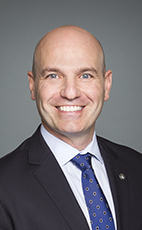
House of Commons photo

Crucial Fact

  • His favourite word was conservatives.

Last in Parliament October 2019, as NDP MP for Skeena—Bulkley Valley (B.C.)

Won his last election, in 2015, with 51% of the vote.

Statements in the House

Taxation May 5th, 2014

Mr. Speaker, the Conservatives are helping the Americans target law-abiding Canadians, but they are doing nothing to catch the fraudsters who are breaking the law by abusing tax havens. Last year alone, tax evaders diverted $170 billion. Canadians abide by the law and pay their share of taxes, but friends of those in power benefit from the Conservatives' inaction. The Conservatives promised to take action in the latest budget.

Was the diversion of $170 billion part of their action plan?

First Nations Control of First Nations Education Act May 2nd, 2014

Mr. Speaker, the first point I want to raise is where I come from and represent in this House of Commons, which is northwestern British Columbia. People have heard me speak of it often as a beautiful and diverse place. It represents almost a quarter of British Columbia, the northwest quarter, and has within it 49 first nations communities, which are some of the proudest and strongest first nations communities anywhere in the world, such as the Haida, Tsimshian, Taku River Tlingit, Heiltsuk. I could go on to name more.

The pride that is held in these first nations communities is with respect in particular to these generational concepts that are at the very heart of the way that they conduct themselves in law, the way they operate on the land, and the respect they show to one another. As a federal representative, it has been an incredible privilege of mine these past 10 years to attempt to have true and sincere dialogue and consultation, because we have had far too many governments and politicians stand up and attempt to justify that they were speaking on behalf of first nations and then go about their way doing almost the exact opposite and acting in a paternalistic and belittling way toward first nations communities.

I must also contextualize what I am saying. There is broad disagreement in this House around this particular bill. New Democrats have found that it is wanting in some of the most fundamental aspects of what true consultation and collaboration would mean. We have also seen that it will not do what the government is promising. That is a great shame because where we do have agreement in Parliament across the party lines is with respect to the importance of education and skills training particularly for young first nations people. We do not need to repeat the statistics. By and large, young first nations people growing up in Canada suffer with fewer hopes and opportunities than non-aboriginal youth. That is an enormous problem, not just within those communities and those families but for us as a country because it inhibits a huge number of our people but it also inhibits our nation in being able to move forward.

I would also argue that in a place like northwestern British Columbia it inhibits opportunities for the country writ large when it comes to resource development because first nations stand as the gatekeepers, as the protectors of so much of what is important. When the government tries to push through a mining project, an oil pipeline, or any such large-scale industrial project, it has to understand that respect means respect. Unfortunately, up until this point in some cases the approach of the Conservative government has not been one of respect. It has ridiculed opponents of its plans, demonized them, and called them enemies and radicals. That is not what will carry the conversation forward. What we need is the conversation to move forward.

Let me return to how this day started in Parliament. I have not done this before, but it is important because I was struck by it this morning as you read out the prayer of the House of Commons of Canada, something that happens every morning as members gather. It was the very end of the prayer that the Speaker of the House recites that struck me as we were going to talk about this piece of legislation today, about something so important as first nations education.

The very end of the House of Commons prayer reads:

Grant us wisdom, knowledge, and understanding to preserve the blessings of this country for the benefit of all and to make good laws and wise decisions.

I think about that as we are debating this particular piece of legislation: “Grant us the wisdom, knowledge, and understanding”. Has the government shown that when it is describing its vision for first nations education, where it maintains unilateral power and control by the federal minister of aboriginal affairs, where it maintains the old vestiges and old ideas that got us into so much trouble for so long, where it maintains this idea that Ottawa knows best about the problems of the first nations people and it will fix those problems?

The challenge for the government is that it puts a nice title on the bill and it has nice preambles in the bill that say all sorts of wonderful things, but if only wishing made it so. If what was said in the title and in the opening paragraphs were actually in the law, the parts of the bill that will be impacting the real world, not the nice words but the law, if it had only matched that lovely title and that wonderful preamble, then we would have a much more conducive Parliament and a much more helpful debate than what we have here. The cynical irony is that within hours of the debate starting on a first nations education bill, the government House leader got to his feet to shut down debate on first nations education. He then said that the government is very consultative and respectful and that what it wants to do is show respect for all people, when the first place it showed disrespect is in the very House of Commons that the people elected to represent them.

The audacity that the Conservatives maintain is unbelievable.

We have also suggested this. The Conservatives refused, on their unfair elections act, to have parliamentary hearings outside of Ottawa, because the Conservatives wanted to keep the conversation in the bubble as they were rigging our electoral process. We are now suggesting, with something so critical as first nations education, that certainly it would be the consultative and respectful thing to do to actually leave Ottawa. Heaven forbid that Conservative MPs had to leave Ottawa and go talk to Canadians, first nations, outside of Ottawa and understand what the impact on the ground would be of their legislation. More important, they would hear about all the incredible successes first nations educators and leaders and families are having in battling and dealing with the challenges that have faced first nations communities and families for so long. The successes are there, and the tragedy of this bill is that they are not incorporated.

We would think that the Conservatives would go out and look for the best-case examples, from coast to coast to coast, of people who are creating those innovative environments, having higher graduation rates and success rates, keeping kids in school for that amount of time, and seeing the success when they look for training to enter the workforce. Those successes are there in British Columbia and Alberta and right across to the east and up to the north. Instead, they do this. They impose this top-down model.

The time is limited, but on the very basic facets of what the government has proposed today, it is yet another chapter in the sad story of the way federal governments have dealt with first nations people in Canada. The only hope is that the power that rests in those communities, the bright lights that are working so hard with that right purpose and right mind, will know that they have allies in the New Democratic Party who will stand up for their rights, and that they will allow us one day, and that day cannot come too soon, to achieve some sort of fairness, dignity, and respect for all people in Canada.

First Nations Control of First Nations Education Act May 2nd, 2014

Mr. Speaker, I represent a part of Canada, northwestern British Columbia, that has a great number of first nations communities. There are villages, from the coast, all the way to the interior, the north, and the middle of the province.

There are a number of concerns and constraints that we have been raising with the current government and the previous government for many years. Generations of first nations people have suffered under a more patronizing form of governance in which Ottawa says it knows best.

One of the conditions set out that the member believes has been met is that there is no unilateral control kept by the minister. My question is this. With regard to this joint council being meant to advise the minister, on two parts, the unilateral control concerns me. One is that the minister does all the appointing and firing of that council. It is not done in consultation with anybody. He just chooses who the advisers are. They may be first nations or they may not. It does not matter. The minister, in this act, under what he is voting for, does this.

The second piece about this council is that if we are going to take the advice from this council, none of it is binding. The council can say that these are what the improvements need to be for first nations education, and the minister sitting in Ottawa, with the way that the act is drawn up right now, can say absolutely not, and there is no consequence.

I hear the member's words and the sincerity around wanting to put more control and determination in first nations communities, wherein the solutions lie, not in Ottawa, yet when I read the bill, I struggle with reconciling my friend's words and what the government has written in the text and the law. It gives the minister unilateral power to decide what happens with first nations education. That is the fundamental crux of the argument.

I would like my friend to respond.

Canada-U.S. Relations May 2nd, 2014

Mr. Speaker, one would think that if it was such a fabulous agreement, the Conservatives would not have buried it in the middle of a 400-page omnibus bill, but they did.

The Conservatives called the long form census a terrible invasion of privacy, but now they are in a mad rush to hand over to the IRS personal and private financial information from up to one million Canadians. They are ramming through the implementation of FATCA in spite of these serious concerns.

Will the Conservatives pull this flawed agreement from the omnibus bill, take a breath, and get this right for once?

First Nations Control of First Nations Education Act May 2nd, 2014

Mr. Speaker, I sincerely thank my friend from Edmonton for her comments. I think she based them both on her personal experience and the experience of this country in connecting the travesty and the tragedy of what happened with residential schools when governments acted unilaterally, imposing their will on first nations people and saying that they knew what was best for them.

We know that path has led us to great harm that has lasted generations. It is a shame upon this country. The Prime Minister did the right thing in offering the apology, but within weeks cancelled the aboriginal healing foundation program, which was established to help people deal with the effects of residential schools. Therefore, one could understand why first nations people in this country feel a certain amount of cynicism or dread when they see the Conservative government come up with a first nations act and say, “Trust us. This one is good for you. We know best.”

To the member's point about what is happening on the ground in terms of where the solutions lie, because they do not lie here in Ottawa, not with the minister and certainly not with the government, the solutions to the challenges faced by first nations people in Canada rest with first nations people in Canada, and those educators who are out there with minimal resources doing a remarkable job and in some places a job that has been noted by many groups.

I will ask my friend this question. The C.D. Howe Institute, not generally known for progressive analysis, had noted in its research on British Columbia that the programs that had been established in coordination with the B.C. government with first nations people had been producing results and were in the process of dramatically increasing those graduation rates and those success rates. The first nations education steering committee in B.C. just had the rug completely pulled out from under it by the government. All the funding is gone, all the work is gone, all the progress is gone.

I ask my friend from Edmonton what, from her experience, and that of the first nations people who she has spoken to, the chiefs and educators, the sentiment is like on the ground for those who have worked so hard to achieve results under difficult circumstances when they now look at this act and the way that this act is being brought in by the government, and the details in there, the unilateral control and power that rests with the minister, who has made himself the minister of first nations education that the panel established but without any true, joint consultative process? I am wondering what message she believes is being sent to first nations people and to first nations educators across this country when they look at this act, despite all the efforts they have been doing on behalf of the entire country.

The Economy May 1st, 2014

Mr. Speaker, what is frightening is this minister's selective reading of important real facts about what is happening to the Canadian economy.

The Toronto-Dominion Bank, the Conference Board of Canada, and now the OECD all contradict what that minister just said. Income inequality is a growing threat to the Canadian economy.

Denial and Conservative ideology are not going to fix the problem. Because of the government, the vast majority of Canadians are falling behind top earners faster than those in France, Spain, and even Portugal.

The income gap has seen decades of dramatic growth under both Liberal and Conservative governments. Why is the current government making policies that make a bad situation even worse?

The Economy May 1st, 2014

Mr. Speaker, a new study from the OECD confirms what Canadians already knew. Income inequality in Canada is spiralling out of control.

The OECD says:

Without concerted policy action, the gap between the rich and the poor is likely to grow even wider in the years ahead.

However, not only are Conservatives failing to act and close this gap, they are actually presenting budgets and writing policies to make this problem even worse.

Why is the government failing to ensure that all Canadians benefit from our nation's economic growth, and not just a select few?

First Nations Control of First Nations Education Act April 30th, 2014

Mr. Speaker, I have been in actual consultation with first nations across the region that I represent in northern British Columbia, and they are astounded at what they are seeing coming from the Conservative government with respect to education.

One place we can find agreement in this House among all the parties is with regard to the importance of first nations education in terms of achieving the kinds of success that we hope for for all Canadians. We know the statistics. We know the results and the failures that have gone on.

I have a question for my hon. friend across the way. In a number of communities in northern British Columbia and across British Columbia, new programs and new initiatives with greater control from the first nations communities have been under way. These first nations communities have been directing the programming and directing and supporting the types of initiatives that they know will work in their communities. They know best what will work, and they know it much better than the Minister of Aboriginal Affairs and Northern Development here in Ottawa does.

These people are actually on the ground with the students and the families. They know what the challenges are and what the solutions to those challenges might be.

I appreciated many of the comments by for my friend from the Liberal Party. Concerns are being raised, not just by us in the opposition but by first nations education leaders who have read the legislation. They have looked through the act and realize the implications of a consultative body that is appointed by the minister when the minister is not obligated to actually listen to the consultation.

My question is this: if we have had success and if we have started to see initiatives working that are more locally controlled, why, for heaven's sake, would the Conservatives choose this moment in our troubled history with first nations to try to seize more control back to the federal government, rather than support the programs that are working and that by and large have placed control much closer to the communities that are involved?

Pensions April 30th, 2014

Mr. Speaker, let us read a quote from the finance minister's own department, which said, “...expanding the CPP would bring economic benefits”.

The minister refuses to listen to the premiers, refuses to listen to the experts, refuses to listen to Canadian seniors, and refuses to listen to his own department.

This is not a partisan issue; it is simply common sense. Boosting public pensions helps Canada's economy and, particularly, small businesses. By the way, it allows Canadian seniors to retire with dignity.

Will the minister put aside his ideological blinders long enough to listen to Canadian seniors, work with the provinces, and boost Canada's pension plan?

The Budget April 29th, 2014

Mr. Speaker, when the facts do not meet the ideology, the Conservatives ignore the facts, because the facts are that wages for middle-income Canadians have been stagnant for almost 32 years.

The PBO report also shows that reckless Conservative cuts will cost the Canadian economy $9 billion. Canadian families are already struggling to get by with record high household debt, fact; stagnant wages, fact; and a rising gap in inequality in this country, fact.

Canadians do not expect their government to do them more harm. Why is the minister choosing policies that give us less growth and fewer jobs?