
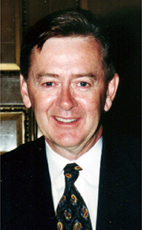
House of Commons photo

Crucial Fact

  • His favourite word was federal.

Last in Parliament May 2004, as Canadian Alliance MP for Calgary Southwest (Alberta)

Won his last election, in 2000, with 65% of the vote.

Statements in the House

British Columbia June 8th, 1998

Mr. Speaker, on December 11 last year the supreme court brought down its ruling on Delgamuukw, the B.C. aboriginal land claims case.

In its decision the court vastly expanded the concept of aboriginal title to the point where the B.C. first nations summit has now claimed aboriginal title to all land and resources in British Columbia.

My question is for the minister of Indian affairs. Who owns British Columbia?

Hepatitis C June 4th, 1998

Mr. Speaker, we prefer to hear from the Prime Minister rather than from the government's lawyer.

One of the federal government's options put forward by its negotiators was labelled the status quo option. I assume that is the Prime Minister's favourite option since he favours the status quo on everything. But in listing the pros and cons of this option the federal officials under the cons say it does not meet recommendations set out by Krever.

Will the Prime Minister finally admit that his preferred position on hepatitis C does not meet the recommendations of Justice Krever in his report?

Hepatitis C June 4th, 1998

Mr. Speaker, the Prime Minister's negotiators had two proposals, a do nothing proposal and a do next to nothing proposal.

All the Prime Minister was willing to do was set up a few additional hospital beds so that the victims would have somewhere to die; not a word about additional compensation. But of course there was a warning about bad press that might come from that decision.

Why does the Prime Minister not just admit he is stubbornly refusing to allow his negotiators to offer one more dime in additional compensation?

Hepatitis C June 4th, 1998

Mr. Speaker, today we received all the working papers from the recent health officials meeting in Edmonton. This was the meeting where the hepatitis C victims stormed out when they were not allowed to see the federal position.

But now we know why the Prime Minister did not want the victims to see the federal position. The federal position did not provide one dime in new compensation.

Why did the Prime Minister say he was willing to look at all the options and then instruct his negotiators not to provide one more dime in new compensation?

Government Contracts June 3rd, 1998

Mr. Speaker, if what the Prime Minister says is true, if this deal is really that beneficial to Canadians, then the Prime Minister should have no difficulty at all in proving that point to the House. All he has to do is lay before the House the documents that show how this contract was arrived at and how it led to this $2.85 billion deal.

Why does the Prime Minister not back up his claims that this is a great thing by tabling in the House the documents, not excuses, that will prove his point?

Government Contracts June 3rd, 1998

Mr. Speaker, it is the taxpayer who has the right to see the information exchanged between the government and Bombardier that led to an unsolicited, untendered and unadvertised $2.85 billion contract.

It has been seven months since the official opposition formally requested the government to disclose how this contract was arrived at. We have repeated this request every month since then and all we got was a worthless verbal briefing from the government.

If this deal is really as clean as the Prime Minister says it is, why has he been suppressing the relevant documentation on this deal?

Government Contracts June 3rd, 1998

Mr. Speaker, when the largest service contract ever awarded by the Canadian government was given to the Prime Minister's favourite company, then the government's contracting guidelines should have been followed to the letter, but they were not. There were no competitive bids, there was no public notice and the government refuses to answer access to information requests.

My question for Bombardier's favourite relative is this. If the deal was so good on its own merits, why did the government find it necessary to bend the contracting rules?

Government Contracts June 2nd, 1998

Mr. Speaker, I would be happy to repeat the speech in those places where they voted more for Reform than they ever did for the government. No wonder the private sector was anxious to get this deal. This deal is one in which if profits are made, Bombardier gets to keep them, but if the losses are big enough, the public gets to pick up the tab. It is also a $2.85 billion dollar project. That is four times the budget of Prince Edward Island.

I will ask the Prime Minister again. On a deal as sensitive and as big as this, why would the government not scrupulously follow all the procurement rules?

Government Contracts June 2nd, 1998

Mr. Speaker, you would think with a contract with these characteristics that the government would endeavour to scrupulously follow the rules, but it did not. It bypassed the rules on competitive bidding. It bypassed the rules on public disclosure of sole source contracts. Now the Prime Minister ignores access to information requests on this deal.

What is it about this deal that the Prime Minister is endeavouring to hide?

Government Contracts June 2nd, 1998

Mr. Speaker, you would think when the government was awarding the largest service contract in history and giving it to a party with close ties to the Liberal Party and with close family ties to the Prime Minister, that it would—