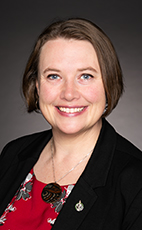
Madam Speaker, I thank the member for Courtenay—Alberni, our spokesperson on Veterans Affairs, for his passion and dedication to this issue. As we share a region, we know what veterans are experiencing in our area, and across Canada.
A great honour for me, in my role as member of parliament for North Island—Powell River, is the fact that I represent 19 Wing Comox. I have spent many times on the base, looking, learning, and listening to military members there. They do so much to protect people across our region, our country, and the world. Right now many people are overseas doing the important work the government has asked them to do. Their families are waiting for them to come home. Every day, they pray and hope they will come home safe and well, which is not always the case.
Another wonderful experience for me is in my role in the NATO parliamentary assembly. We travel to different countries and meet with other NATO countries. We talk about what is happening in the world. What I hear again and again is the deep respect that so many countries have for our men and women in uniform, and the work they do. It is quite amazing to travel and meet people who talk about how our military members are so brave. They say that they stand by them and fight every day for peace. They are so appreciative for what they have brought to their countries and how they have worked with their countries to support peace across the world.
When I think about what we are debating today, I am devastated that we are having this conversation.
The motion reads:
That the House call on the Prime Minister to apologize to veterans for his insensitive comments at a recent town hall in Edmonton and show veterans the respect that they deserve by fulfilling his campaign promise to them, when he said on August 24, 2015, that 'If I earn the right to serve this country as your Prime Minister, no veteran will be forced to fight their own government for the support and compensation they have earned'.
In the last election, veterans across my riding clearly told me that they were devastated by the realities they faced. They felt immensely betrayed by the former government and what had happened in their relationship to veterans.
One of the most powerful moments for me during the election was coming across some signs in one of my communities. Veterans had built them and put them in front of the Conservative candidate signs. It outlined, in detail, the betrayal they had experienced. That is so important. When we were all out campaigning, we heard again and again from veterans who felt profoundly betrayed. They had faithfully gone and done exactly what our country had asked them to do. They came home and were treated terribly.
In the last few months, we have also seen something tragic in our riding office, with veterans coming through our doors, veterans who had a lot of hope. They had been waiting patiently to give the government a little time to set things up. They were facing some distance challenges being part of a rural riding, not having quite the level of services they needed to deal with post-traumatic stress disorder and other health concerns. They were going to give the government some time, but expected to see some fundamental changes. They wanted that sense of value, having served the country. However, over the last several months, more and more veterans have come into the our offices. It is really sad for me, and for the people who work for me, to see how devastated a lot of those veterans are. They have waited, they have been patient, but they nothing has changed for them.
It is important remember that during the last election, the Prime Minister said, “We will also make new and significant investments to meet the sacred obligation that we have to our veterans.” That was part of the Liberal messaging.
Many veterans felt hopeful for that, and now my office hears regularly from veterans that they thought this was a sacred obligation, and things were going to change. They had hope, and now they are having to face reality. We have now heard that veterans will have to wait until April 2019 to choose between the existing lump sum and a new lifelong pension that, when all is said and done, will pay less than half of the pre-2006 pension. This is a very deep betrayal.
Three veterans came to me when they heard about this motion, and said they wanted me to share their stories. I am going to do that, because that is part of my obligation to my constituents. William Webb is one of those veterans in my riding, who served for 20 years before being medically released in 2016.
One challenge for him is that there are few supports for veterans released medically. There is another challenge that is important, and I hope the government hears this, case managers for veterans are always changing because they are on stress leave, and nobody is able to help the veterans navigate the very limited supports available. This is important.
We need to understand that services are falling apart because the people delivering those services leave because of their own stress. In February, his pension was cut significantly due to the pension transition funding. Mr. Webb has been fighting Veterans Affairs for two years, with a 10% success rate. He has PTSD, he tried to qualify for the disability tax credit, and he keeps getting rejected.
The other reality, which I have heard not only from Mr. Webb but other veterans as well, is that they have service dogs that support them with their post-traumatic stress disorder, and Veterans Affairs does not see service dogs as beneficial to veterans, so there is no financial support. It is important for the House to recognize that service dogs are extremely expensive. Getting service dogs is a great expense to veterans. One of the biggest challenges for William is that he cannot find housing. Now that he has a service dog, trying to find housing is increasingly hard. When is the government going to make sure that veterans receive the housing they need?
Then there is Don Choiniere. Don served the military for a fairly short period, but when he enlisted, he had no health issues. During his service, he came into contact with asbestos, and now has significant health issues because of it. He has been fighting Veterans Affairs since the 1980s with regard to the chemicals with which he came into contact. He wants some compensation for this, because the medical outcome, and what he endured for this country, has had a huge impact on him, and always will. Again, he is facing the challenges of so many veterans, whom have very limited supports, because they were medically released from duty.
Finally, there is Max Gaboriault. Max and I have had numerous conversations, and I have a deep respect for how strongly he is fighting for his rights every day. He was in the military, and went to Afghanistan. During his time in Afghanistan, a lot of people around him were lost, and it was really painful for him.
We have to recognize that when this country asks people to do this, we are asking them to risk their own lives, and watch others pass away in tragic circumstances. When he came home, his family and friends noticed a difference, but he felt sort of peaceful, because daily life was so much easier than what he experienced.
However, that peace turned into violence and aggression, and he still struggles with that. Today, he has PTSD, and has been diagnosed with generalized anxiety disorder. Max continues to struggle. He wants his pension reinstated. He is at risk of being homeless by the end of this month, so when and how will his little boys visit him?
These are the realities. The Prime Minister needs to stand up and apologize, because what is happening across this country is not right, and I ask the Prime Minister to do the right thing.