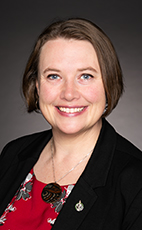
House of Commons photo

Crucial Fact

  • Her favourite word was veterans.

Last in Parliament April 2025, as NDP MP for North Island—Powell River (B.C.)

Won her last election, in 2021, with 40% of the vote.

Statements in the House

Air Canada Public Participation Act April 18th, 2016

Madam Speaker, I want to thank my hon. colleague for that most amazing speech. I also want to recognize that this amendment would legalize lay-offs, which was previously illegal. What it would do is to increase the uncertainty for people who rely on those jobs to take care of their families.

Right now in my riding, the people of the community of Port Alice are waiting to see what is going to happen with their well-paying jobs from the local mill that has been shut down. I am getting a lot of emails and calls from people who are frantic. I am in solidarity with these amazing people who have worked so hard. They are going to be losing their jobs. How does that relate to the people who will be talking to their MPs who are not standing up for them today?

Air Canada Public Participation Act April 18th, 2016

Madam Speaker, I want to comment on the fact that across Canada we are seeing growing disparity. We know that well-paying jobs are getting harder and harder to come by. A lot of that has been led by a past Conservative government that did not really put the time into making sure we look after workers.

Knowing that we are really giving power to a business to make some decisions that would potentially leave workers behind in this country, and knowing that this would open the doors to allow a company to bring workers in rather than making sure those jobs stay with Canadians, how does the hon. member feel that is going to make an impact in this country?

Canadian Organ Donor Registry Act April 15th, 2016

Madam Speaker, first I want to thank the member for Edmonton Manning for bringing the bill forward and also sharing his very personal story.

I am so pleased to speak in support of Bill C-233 . Last week, my son Henry donated blood for the first time. His commitment came from having a cousin who battled leukemia and at this point is healthy, as his mother watches and waits.

Often when we know what we can do to help, we do it. For many years I was a volunteer with a hospice. Every Saturday evening, I would sit with the palliative patients and their families. Some of these families were still holding out for an organ donation to save their family members. It was incredibly hard to sit with these families who could do nothing but hold onto hope.

We know that every year 1,600 Canadians will be added to the organ donor list, while 5,000 Canadians are still waiting. These numbers tell us a story. They tell us the story that we need to do better.

A national registry would make a significant difference. It would help people across this country. It would increase access, address disparities, and increase efficiency. It would be a national program that could bring all the provinces and territories together to make a difference, to give people a second chance in this life.

In my riding of North Island—Powell River, I have a constituent named Debbie Hooper, who is a 56-year-old grandmother. She has been waiting three years by her phone, waking every morning hoping the call will come that means her lung disease will be fixed by this amazing gift of an organ transplant.

Across this country, people are facing challenges that many of us have never experienced. We have to do our due diligence as people who have been elected to sit in this place to make sure we are helping save the lives of people in this country, and that we are creating accessibility.

I have heard from the other side, and I am so sad to see that the bill will not be passed by the other side.

We need to send the bill to committee. We need to be hearing those witnesses from across this country. We need to hear how it is going to work. We are asking that the bill be before committee so that we can see potential solutions that would make a difference and give people their lives.

Brenda Small is another constituent who received a transplant, and she said something extremely poignant. “It’s the worst day of somebody’s life and the best day of yours. I cry every time I think about it.”

If we are not doing our work, bringing forward this issue to committee, having the discussions we need to have so that we can make the best decisions, bringing together the provinces and territories to see how we can do this more effectively, then we are not doing our jobs.

I ask, please, for people to take this into their hearts, to think as we are supposed to in the House of Commons, and to make a decision that looks after the people of Canada.

I thank the member for his hard work. I am thankful for the history that we have in this place of multiple members bringing forward private member's bills in this same theme of creating a united country, acknowledging that we have a universal health care system, and making a change that will save lives.

Canadian Coast Guard March 22nd, 2016

Mr. Speaker, last week the member for New Westminster—Burnaby and I visited the Comox marine communication centre, where staff shared their concerns about the pending closure. We are very worried too.

This month, the fisheries committee heard recorded evidence of the poor quality of the so-called new technology that the minister claims will replace life-saving search and rescue capacity.

Will the minister see reason, abandon the foolhardy Conservative plan, and commit to keeping the Comox MCTS station open?

Indigenous Affairs March 9th, 2016

Mr. Speaker, last week on March 4, the community of Powell River and Tla'amin First Nation celebrated a deeply respected elder named Dr. Elsie Paul. Members of both Tla'amin and Powell River joined in the spirit of reconciliation to recognize the work and commitment Elsie has shown in building a stronger community, both within her nation and in the communities surrounding it.

Raised by her grandparents, Elsie had limited interaction with residential schooling. This allowed her to be raised in her culture, to be fluent in her mother tongue, and to learn from the rich environment around her. Elsie is a beacon of traditional knowledge, feeding the roots of her people and seeing them flourish with her efforts. This leadership only grew across Canada and the world when she published a book on her life called Written as I Remember It.

I want to thank Elsie for being who she is, for holding the culture safe to pass on to another generation, and for being the graceful woman that she is.

Fisheries and Oceans February 25th, 2016

Mr. Speaker, the minister seems to have already made up his mind on the imminent closure of the Comox MCTS. Why does he not just level with the House?

Last week, the fisheries committee approved a study on this issue. Why are the minister, his staff, and the Coast Guard not interested to find out the different implications of the closure? Clearly they do not want to do their homework. Why can they not wait for the findings of the committee before deciding on the future action for this vital centre?

Fisheries and Oceans February 25th, 2016

Mr. Speaker, the Comox MCTS is the third busiest marine traffic centre in Canada, handling an average of 900 marine accidents and emergencies per year, behind only Victoria and Halifax's.

When the government talks about consolidation of the Coast Guard, do not be fooled. It is talking about cuts, cuts to people's livelihood, cuts to safety, and cuts to service that would impact smaller communities across the beautiful riding of North Island—Powell River and the B.C. coastline.

When such a drastic change is made, I would assume that the homework is done, that a plan is made, stakeholders are consulted, and personnel changes are taken into account, and the risks are assessed.

I want to take a minute to talk about the associated risks and the necessity of risk assessments in this case. Prince Rupert and Victoria, the two projected remaining MCTS centres, both lie in tsunami hazard zones. The Comox station is in a safe zone and during an earthquake would not face an evacuation due to a tsunami. The Liberal plan would leave the two communication stations to be evacuated during a major earthquake, potentially leaving the entire B.C. coast without any Coast Guard communications coverage.

Risk assessments are generally a simple calculation of two components: the magnitude of the potential loss and the probability that the loss will occur.

The coast of British Columbia is on the ring of fire. Earthquakes happen frequently up and down the coast. Being prepared for the potential of a large earthquake and the resulting likelihood of a tsunami is part of our makeup. British Columbians know the probability of a tsunami.

Within this context, I want to make sure that the government is doing its homework. The Comox MCTS base should be staffed for the emergencies inherent in a seismic event. When the Conservatives decided not to do a risk assessment, common sense went flying out the window and the voters voted them out.

Will the government make sure that a risk assessment is done before the closure? Will it protect communications coverage in B.C. in case of a seismic event?

I am proud to have met the members of the Coast Guard; I know the excellent work they do day and night.

I also wonder if the government has assessed the reality that the radio sites are limited on the screen. This means that the radio coverage cannot be expanded to watch all the sites. We have heard that the staff have been trained and have the appropriate resources. However, when the Tofino centre was closed, only two of those three positions were moved to Prince Rupert. This is simply about logistics. If there are not eyes, if there are not enough screens, and the screens do not hold all the images, how are we safe? How are our ocean and coastline protected? The new government had a chance to review the Conservative decisions, consult with people, and make decisions in that context.

The British Columbia coast offers some of the most breathtaking scenery in this country. I love my riding. The coastline that I represent is full of many islands and remote coastal communities, which are populated. Often, for the small and remote communities, the communication station is their only connection, as there are not phone lines or cellphone access in that area. Local knowledge is key when faced with these challenges.

People on the coast want to see strong safety and emergency measures in place. The specifics of living in this part of the country expose us to some hazards, but we know we can count on the Coast Guard to be there. Our very lives depend on it.

I represent people in these communities. We have grown up with a very proud sense of local knowledge. This cannot be lost. The local Comox MCTS amassed an understanding of our region, observed and understands local weather.

How can the minister claim that this is not a big loss for our region?

Business of Supply February 25th, 2016

Madam Speaker, I want to thank the member for the question. This is my first term, but I thank him for thinking I am doing such a good job. It feels like I have been here for a while longer.

For my community, one of the biggest hardships has been the forestry industry and the changes around manufacturing. It is seeing all of those raw logs floating from our communities and we are not able to process them. All those people who were proud workers are no longer able to do their jobs.

We did see a huge decrease of jobs in our riding during the Conservatives time in government, and we were faced with multiple challenges. We continue to strive. I look forward to seeing jobs increase across this country for the hard-working people of Canada.

Business of Supply February 25th, 2016

Madam Speaker, I would like to start by saying that it is offensive to the people in my riding to assume that people would work for a short period of time just to happily sit on EI. The people I represent are hard-working people. They want to work. They want to get out there and do good things in their communities.

The plan is about supporting people when they need a hand-up; it is not about creating a handout.

Business of Supply February 25th, 2016

Madam Speaker, I would like to remind my hon. colleague that we are entering a time of increasingly precarious work. Short-term work and part-time work are increasing, and families are struggling. They have to work two or three jobs, up and down, all over the place. When we look at a number like 360 hours, this is about giving a hand to those families who are facing those challenges. It is making sure that they get the things they need. It is affordable, in the sense that it will support those families to move toward their goals and have a positive family life.