Madam Speaker, we do not accept it.

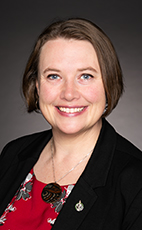 House of Commons photo
Won her last election, in 2021, with 40% of the vote.
Business of Supply November 7th, 2023
Madam Speaker, we do not accept it.
Veterans Affairs November 6th, 2023
Mr. Speaker, women veterans will be attending commemoration services this week. Many of them will be asked if the medals they are wearing belonged to their husband, or their son or their father. Too often, they feel invisible and diminished when they should feel acknowledged and respected for their service. This must change.
Will the minister commit today to ensuring the participation of women veterans in Remembrance Day commemorations this year?
Veterans' Week November 6th, 2023
Mr. Speaker, as we enter Veterans' Week, I want to take this opportunity to thank the members, past and present, for their dedicated service. We know both from history and today that the cost of conflict is far too high. All too often, we, as Canadians, think of their service during this time of year, rather than recognizing it every day. After years of working for both serving members and veterans, I understand that the dedication to service is high. Their thoughts always focus on the “us” rather than the “I”.
This year, I am particularly thinking of service women and veterans who are women. I know they have served and that those realities, both past and present, are all too often left invisible. They participate in Remembrance Day services wearing their medals and civilian gear, and are asked, “Are those your father's, husband's or son's medals?”
This year, let Canadians recommit to seeing veterans, all of them, and to acknowledging and appreciating their service. I thank all the women who have served or are serving. I see them. Lest we forget.
Business of Supply November 2nd, 2023
Madam Speaker, the member is my neighbour, so it is always good to see neighbours get up and do work in this place.
I recognize that we are in a climate crisis. I know that if we look across B.C., we are seeing terrible forest fires and whole communities are being washed out by rivers literally falling from the sky, and people are becoming increasingly concerned. We know this is having a huge impact on insurance costs, and things like that, as we are dealing with those significant challenges. I also recognize that people are struggling profoundly right now with trying to make ends meet, and it is getting increasingly scarier.
This motion really does not address a key factor, which is that B.C., Quebec and the Northwest Territories have their own carbon pricing process. That means if this is voted on in a positive way, then it would not have an impact on those communities. The NDP offered an amendment to the motion to save GST in those provinces and territories so that they could see results as well.
Can the member speak to that and to why the Conservatives did not take that opportunity?
Questions Passed as Orders for Returns November 2nd, 2023
With regard to the Veteran and Family Well-Being Fund, broken down by fiscal year and by province or territory: (a) what are the details of all organizations that have received funding, including (i) the name of organization, (ii) the amount received, (iii) the type of organization, (iv) the number of veterans and equity-seeking Veterans on the board of the organization, (v) the number of veterans and equity-seeking Veterans as staff in the organization, including CEO and owners, (vi) the number of veterans and equity-seeking veterans as volunteers in their programs, (vii) the number of veterans and equity-seeking veterans who used the programs and/or services, (viii) whether the organization reported on how the funding was applied and lessons learned; (b) for organizations listed in (a), which organizations qualified for funding because their application provided curated and specialized programs or services to equity-seeking groups, including (i) women, (ii) 2SLGBTQ+, (iii) homeless, (iv) Indigenous veterans, and (v) racialized veterans; (c) what metrics and analytical tools, including Gender-based Analysis Plus, does the government use to assess applications, and does the government apply considerations based on the (i) impact on single veterans, (ii) impact on veterans and their families, (iii) innovation to address unmet needs, as defined by research and veterans themselves, (iv) financial risk and ability to administer and deliver services, and (v) ability to provide a safe and welcoming space for marginalized veterans and equity seeking groups; (d) what staff level, working groups, panels, or review bodies assess applications for funding, and are veterans represented in these decision making bodies; (e) what is the total number of applications that were received; and (f) of the applications in (c), reflected as a number and a percentage, what is the total number of applications that were denied funding?
Questions on the Order Paper November 2nd, 2023
With regard to appointments and meetings attended by the Minister of Veterans Affairs and Deputy Minister of Veterans Affairs, since January 1, 2021: (a) what is the total number of meetings held on the subject matter of (i) women veterans, (ii) Indigenous veterans, (iii) 2SLGBTQ+ veterans, (iv) the table of disabilities, (v) entitlement eligibility guidelines, (vi) research priorities, and (vii) award funding; and (b) what are the details of all meetings listed in (a), including the (i) date, (ii) names and titles of the government representatives in the meeting, (iii) names of the organizations or groups in attendance, (iv) location of the meeting, (v) length of the meeting?
Committees of the House November 1st, 2023
Mr. Speaker, first of all, I just want to start by saying how disappointed I am that we are having this debate on a concurrence motion, when we should be debating the trade agreement with Ukraine.
I just have to stand here and express the profound grief I am hearing from so many across my riding of North Island—Powell River. When the illegal war began when Russia invaded Ukraine, there was a feeling of profound heartbreak. There are a lot of Ukrainians in my riding who came together to fight really hard to do all they could.
I remember being on the phone with constituents who were telling me that they were calling their families at home and that in the background, they could hear the explosions. They were so worried about where their family members were and whether they were safe. There were conversations during which explosions would happen, and then the line would die. I have sat, as I hope many people in this place have, with people who are refugees from Ukraine and are so terrified because they do not even know when it is going to be safe to go home. They are worried about their loves ones.
This is really important, and here we are discussing a committee report that was unanimously agreed upon, instead of talking about how we could work to make this country stronger and better, and how we could work with Ukraine in a positive way. It is important that as we have these discussions, we remember that we are the voices of our constituents and that so many of them right now are hurting profoundly. It is important because we know that when this happens, it destabilizes other countries. That destabilization has an impact on all our communities and our country. The people in our communities who are related to those folks in other countries have a profound response, and we must recognize that.
That leads me, of course, to think about my personal pain and heartbreak connected to the profoundly terrifying experience we are seeing right now in Israel and Gaza. All of us in this country are seeing things on the screen, and it is painful for us to see them. I cannot imagine living that. Our leader has been very clear, repeatedly, in this place and in the media, that we condemn unequivocally the terrorist violence of Hamas, which has killed thousands. I have heard from the Jewish community, in my riding and outside my riding, of the profound pain, concern and trauma it is experiencing right now because of this action. What we are witnessing in Gaza is beyond overwhelming. We know that children are being killed at a rate we have not seen in a very long time, and that women and the elderly are indiscriminately attacked. So many are dying. Civilians of these countries are dying. We must all stand together to say that is not okay.
The NDP and our leader have been very clear. We are calling for an immediate ceasefire. I despair that the government has not chosen to stand up with respect to this issue. When we see what we are seeing, we have an obligation, morally, to call for a ceasefire and to do all that we can as a country to stand strong against it. We all know, historically, what it looks like when we do not.
How many apologies do we have to make in this place because we do not stand up and do the thing that is right when it is time to do it? Right now, in our own country, anti-Semitism and anti-Palestine hate are increasing. Islamophobia is increasing. People are afraid. They are afraid for themselves, for their loved ones and for our children. When we do not stand up collectively, we create a much less safe environment for everyone. That is really important. When we think about our privilege in this place, we have to think about how we take that power and what we do with it, and when we do things, what that means for people who do not have the same voice as we do. People are not safe. We all have to stand up against that.
I remember speaking with a dear friend of mine who escaped the Holocaust, just barely, and lost so many loved ones to concentration camps. She no longer believed in God. She no longer believed that anything in the world could allow this to happen. I remember those conversations with her and the terror she had experienced. One of the things I will never forget is that she said she did not believe in God but prayed for peace unceasingly. Every day, she prayed for peace because she did not want anyone to experience what she had experienced, and she did not want anyone to lose the family that she had lost. I hope that all of us are remembering that, every time we do not do all that we can for peace, we are really disrespecting those who are gone.
In this time as well, when we are seeing an increase in foreign interference in our elections and when we are seeing communities being destabilized because of an active agenda of some countries to interfere, we have to again remember that every step we take matters, that people are watching and looking for leadership and stability. They are looking for consistency. I call on the government again. Please stand up and say that it is time for a ceasefire and that our voice, collectively, as Canada, is calling for that, so civilians get what they need to survive and so we can do everything in the name of justice, moving forward.
To come back to the concurrence motion, it is about Ukraine, and I am going to talk about it. Again, I want to remind all the listeners at home and, of course, especially in North Island—Powell River, that this is something the Conservatives moved. It is a concurrence motion, which means we are not debating the bill we were supposed to debate today, which is on having a trade agreement with Ukraine. The report that we are right now spending this time debating was supported unanimously. We are debating it to say, again, that we are going to agree with the report.
I think it is important that this committee is the foreign affairs committee. Right now, that committee is meeting. What they are meeting about is the situation at the Russia-Ukraine border and the implications for peace and security. Right now, that work is happening in another space in this place, and it is really important work. The Global Institute for Food Security is talking. The United Nations' World Food Programme and the Grain Farmers of Ontario are also some of the witnesses today. They are talking about the importance of this, so why are we here when this work has already been done? Why are the Conservatives making us debate something that has already been agreed upon? I think there are political reasons, and it is very disappointing. If they have a problem with the bill that is in front of the House, then let us debate it. Let us do the work of the House and look after that.
I have to say that, in my riding, not too long ago, we had an amazing couple of events called Still Standing With Ukraine. The Comox Valley Ukrainian Cultural Society put them together. It was a couple of events just to bring awareness again to what was happening in Ukraine and to highlight some of the refugees locally within our region who are in our communities and who are doing the best they can when they are under such emotional distress because of what is happening in their own country. They were beautiful events where we got to see some profoundly amazing Ukrainian dancers from Alberta who came out to fundraise, to make sure that the people here in our area have the supports that they need. I want to give special thanks to Janette Martin-Lutzer, who is the ED there and who did just a phenomenal job of educating people. I just think it is so important.
I want to say that when this happened in my riding, when Russia attacked Ukraine, we had so many phone calls to our office. Tons of people were calling. They wanted to do all they could to help, so we collected a list. It was a significant list of constituents. We were able to create an email list, and then our office went out and found everybody in the region who was doing work to support refugees who were coming. We were able to bring them all together. We did a town hall. A lot of people showed up for the virtual town hall, and all those organizations and groups that are doing incredible work in the riding were able to talk about what they were doing, how they were doing it and how people could help. It was amazing.
Something I am so proud of in my riding is that when people need help, we come together. There is a large Syrian family in our riding. A lot of people came together to support that family, and every time I see the leaders of that family, I am told about all of the success because of what the community invested and because the community stood up. Again, for this, I have been profoundly moved. People come together. They want to support people who are struggling and suffering, and we need to make sure those supports are in place, so why are we here debating this when there is so much work to be done?
I will talk about some of the recommendations and show the people that all parties agree. One of the recommendations is “That the Government of Canada continue to play a leading role in the pursuit of justice and accountability for war crimes, crimes against humanity, and violations of international human rights and humanitarian law in relation to Russia’s war against Ukraine.” I agree with this, and I think it is something we should be talking about in the context of what we are seeing happen in other places in the world. Of course we want to see the Government of Canada stand up. Hopefully every party here agrees, and according to the report, all parties do agree, that we should do that. We should stand up for human rights and for justice. I know people in my riding are calling for that. They want to see action taken. They want to see accountability, and they want to know that human rights are being protected and that Canada is doing everything possible to make sure those human rights are being protected.
Another recommendation is “That the Government of Canada work with Ukraine and other international partners in support of the documentation, investigation, and prosecution of sexual- and gender-based violence committed during Russia’s war against Ukraine, and provide support to survivors.” This is a particular passion of mine. We know that in every war, women and children are the focus of much violence. As well, the 2SLGBTQIA+ community is targeted for horrific crimes that we should never see happen, but that we know, unfortunately, do. We need to make sure there are processes put into place. I know that in my work in the Canadian NATO Parliamentary Association, we have talked about how important it is for women, peace and security that these things are documented and that we make sure that international law has the capacity to take information. Things are changing quickly, and information is recorded often on social media. Something we need to make sure of is that, if things are recorded and they can be verified as clear sources, that information can be used under international law to hold people to account for the violence they do during wartime.
There are a lot of conversations. I am glad to see that all parties agree that this is important. We need to protect people. We need to have very strong international law so that when people do terrible things like this, they know they are going to be held to account.
Another recommendation is “That the Government of Canada work with Ukraine and other international partners to prosecute individuals principally responsible for Russia’s crime of aggression against Ukraine by supporting the establishment of the Special Tribunal for the Crime of Aggression against Ukraine or another similar mechanism.” It is a little bit rich to be in this space having this conversation, knowing that the work is being done in committee, and here we are agreeing to agree instead of talking about how we are going to support Ukraine in the trade deal. We are at the part where the legislation has not even gone to committee yet. Let us get it to committee. If there are concerns, let us do the work in committee. That is where the work happens.
Again, I am frustrated. At a time in the world when we are seeing so much incredible violence and when young people across this country are worried about that violence and are worried about the climate crisis we are in and the fact that we are teetering on the brink of profound outcomes that could leave the world physically unsafe for people to even be in, why are we wasting time in this place when we could be doing the work that needs to be done? There are serious things happening in this country and other countries that we have to take a leadership role in as Canada, and this is what we are doing instead.
It is really important that we talk about the recommendation to “strengthen global food security, and the role of Ukraine as one of its guarantors, and join the efforts with Ukraine on the Black Sea Grain Initiative in the Global South.” The reality is that we have sanctions. I have seen the graphs in my work at the Canadian NATO Parliamentary Association. The sanctions had an impact, which was then lost. We need to support this country, and I hope we can get on to more important business.
Committees of the House November 1st, 2023
Mr. Speaker, the member and I work together on the veterans committee, and I enjoy working with her. However, I do wish that we were actually debating the Ukraine trade agreement, as we were hoping to do.
I have looked at the recommendations of this particular report. Right now, we are doing a very important study in committee about women veterans, and I see that recommendation 2 talks about having the “Government of Canada work with Ukraine and other international partners in support of the documentation, investigation and prosecution of sexual- and gender-based violence committed during Russia's war against Ukraine, and provide support to survivors.
All too often in war, women and children are targeted very specifically. I wonder whether the member agrees with this, and how she thinks Canada can better support it moving forward.
Criminal Code October 27th, 2023
Madam Speaker, I am here today to speak on Bill S-205. The bill would amend the Criminal Code with respect to interim release and other orders related to intimate partner violence and offences. It is a critical step towards addressing the pressing issues around intimate partner and gender-based violence in Canada.
In this country, intimate partner violence has a long history; one that so many in our communities have fought hard to stop. There are a lot of processes in place, but a lot of those non-profits that do tremendous work in keeping women, gender-diverse people and children safe struggle to make ends meet just to get those services done. It tells us, as a country, that we have to continue to reflect on the impact that these communities are facing as we see so many women and gender-diverse people come forward to talk about the offences that are happening to them from their partners and they have so little voice to be able to fight back.
I have talked to a lot of women across my riding and a lot of people from gender-diverse communities who talk about doing what they can and, again, with their own will, having to fight and fight. We saw, especially during the pandemic, more and more women and gender-diverse people locked into situations that were incredibly violent. When they were in that isolated status and not able to come forward, they were feeling very unsafe. Also, as we hit this significant housing crisis across the country, we know it is having a big impact on intimate partner violence. So, Bill S-205, although there are some concerns that will be dealt with when it gets to committee, takes a step in the right direction to start to move us forward.
So that constituents back home in North Island—Powell River understand, the bill would allow judges to consider whether an accused should wear an electronic monitoring device as a condition of their interim release, and this is important. We know that in the U.S.A., 23 states have started to use this format and have seen a decrease in violence. One of the things that is a challenge is that women and gender-diverse people are always trying to explain to the police or the RCMP what is happening, and proving it is really a struggle. So, having this in place would make a huge difference in allowing those voices to be heard and understood without having to feel like they are fighting against a system that is not interested in protecting them when they are a survivor of intimate partner violence.
The bill would also require a judge to ask the prosecutor whether the victim of an accused intimate partner has been consulted about their safety and security needs. Now, this may seem very basic to so many across this country, but we know that it is not happening. We know that, again and again, the people who survive intimate partner violence are often put in a situation where they are having to interact with the person who abused them repeatedly. They have very little support from the system at this point, which leads to a lot of violence and sometimes death, and that is why this is so important.
We have to make sure, when situations arise in this country and somebody is victimized, that when they move forward to challenge it there are actually processes in place that put into consideration their safety and security. However, we know that is not the case. So many have come forward bravely sharing their story, and we know that it often results in a fundamental loss of rights. Sometimes people who are victimized, who are survivors, have no choice but to go back to the person who hurt them. We need to stop that, and the bill is an important step in doing that.
The bill would also re-establish a new type of recognizance order for survivors, which, if granted, would allow the judge to impose conditions, including electronic monitoring, treatment, or a domestic violence counselling program. Again, we have to find systems in our country where we do not put the onus on the person who is suffering the consequences of somebody else's violence. We have to say that there is a system in place and we will not allow them to carry this on their own. This is a step in the right direction.
Across this country, every six days a woman is killed by her intimate partner. This is a crisis, and one that we have not taken seriously enough. The bill is a small step, but hopefully we will get there soon.
Across my riding, there are a lot of organizations that do very diligent and hard work to support people who experience intimate partner violence. It is incredibly important. I want to thank the Powell River and Region Transition House Society, the Comox Valley Transition Society, the North Island Crisis and Counselling Centre and the Campbell River and North Island Transition Society. These organizations do tremendous work in the regions they serve, and they do a lot to build awareness. They have, in some cases, available housing and secondary housing.
One thing, of course, that is very concerning is that we see people fleeing violence and getting the help they need but there is no second-stage housing for them. In rural and remote communities, this can become a bigger challenge. We need to make sure that those resources are put in place and that these organizations are given the resources they need so that they do not always have to do so much fundraising on top of the amazing work they do.
That is why I think it is important to mention that $150 million has been cut by the Liberal government from 600 women's shelters across this country. If we are serious about protecting women, gender-diverse people and the children of our country, we have to put these dollars in the system so that people can be cared for. Hopefully we will see that change really quickly.
I cannot talk about violence against women and gender-diverse people in this country without talking about murdered and missing indigenous women and girls and gender-diverse people. We know that at this point, only two of the recommendations of the 231 calls for justice from the national inquiry regarding missing and murdered indigenous women and girls and gender-diverse people have been implemented. I think we need to do a lot better.
This leads me to a quote. Sarah Niman, legal counsel and assistant manager of legal services at the Native Women's Association of Canada, said this about the bill:
Bill S-205 seeks to provide violence victims something of a voice. This bill places the onus on the criminal justice system to check in with victims, consider their safety through the proceedings, and produce outcomes that consider their safety. Bill S-205 does not create a response specifically tailored to Indigenous women, but it does create a framework for them to be seen and heard in a system that otherwise does not.
It is very clear that incredible work still needs to be done, particularly for indigenous women, girls and two-spirit people. Again, if this country is fundamentally committed to things like feminist principles, non-violence and reconciliation, making sure that these populations are honoured and respected in these processes has to happen.
Of course, one of the key things that have been asked for again and again is the red dress alert. We need indigenous women, girls and two-spirit people to be found when they go missing. They need to be treated like every other Canadian, and that means they need a red dress alert, because we know that this population in particular goes missing without any accountability.
I want to thank, in my riding, the Indigenous Women's Sharing Society and the Lil' Red Dress campaign. Both of these organizations work diligently on bringing forward these voices, telling the stories and letting our region know about missing indigenous women, girls and two-spirit people. They work diligently every day, and I am so grateful for that commitment. If it were not for the folks who come up every day and continue to fight, the voices would not be heard. I am really glad to be here in Parliament reminding everyone that if we are serious about reconciliation, the red dress alert must be implemented.
I look forward to seeing this bill move to committee. Hopefully, we will have some positive changes that reflect the needs of this country.
Health October 27th, 2023
Mr. Speaker, on Wednesday in my riding, a 13-year-old overdosed at a local business. Luckily, a nurse and local firefighters saved her life, and I am so grateful.
In B.C. alone, more than 1,800 people have died this year due to the toxic drug supply. The Liberals have delayed mental health funding while people die, and the Conservatives want to punish people who are struggling.
When will the Liberals deliver a national health-based plan to address the toxic drug crisis?