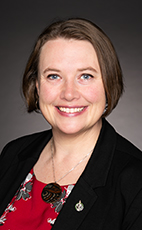
House of Commons photo

Crucial Fact

  • Her favourite word was veterans.

Last in Parliament April 2025, as NDP MP for North Island—Powell River (B.C.)

Won her last election, in 2021, with 40% of the vote.

Statements in the House

Indigenous Affairs June 8th, 2021

Mr. Speaker, genocide against indigenous people is part of our country today. That is what happens when a government is asking itself how much a childhood costs and when a government asks itself if survivors like those from St. Anne's have the right to information on their own torture.

When someone does not stand up and say yes, then they are saying no. Yesterday in this House, 271 members voted unanimously in favour of an NDP motion in honour of 215 children. Who did not vote says something. How can Canadians believe that the Liberals want real reconciliation?

Fisheries and Oceans June 4th, 2021

Madam Speaker, in my riding, wild salmon is key to our cultural and economic health and needs immediate action from the government to survive.

In 2019, the Liberals made it clear, both in the election and then in the minister's mandate letter, that fish aquaculture would be changing. The parliamentary secretary has been consulting on this since well before Christmas with the industry, indigenous leaders and the public.

Now, after waiting over two months, aquaculture workers and wild salmon advocates are looking for clarity. There is no time to waste. Would the parliamentary secretary give us a date on when we can expect to see this report?

Regional Development June 3rd, 2021

Madam Speaker, I appreciate the member's response and I also appreciate that he represents a very large rural and remote riding.

I am paraphrasing him, but he just said that the regional offices were the best sources for local investment. I really want to ensure the government is hearing that. If we do not see these offices also located in rural and remote communities, we will never see that fundamental change that needs to happen in the country. Therefore, I hope the member will continue to advocate alongside me to ensure my riding has this representation.

Also. the funds for small businesses, especially the tourism sector, really need to be extended past the deadline provided by the government. Many folks in that industry are worried that they will not be able to hold through this period of time. Tourism is not going to come back this year, and that is a huge concern.

Regional Development June 3rd, 2021

Madam Speaker, on February 26, I asked the minister a question about the B.C. regional economic development agency. I requested that a location of one of the offices of this new agency be located in my riding. In November of last year, I put forward a motion, Motion No. 53 in the House of Commons, calling for the federal government to be guided by principles for a sustainable and equitable future, when considering funding for COVID-19 relief and recovery.

Rural and remote communities across Canada are facing specific challenges that are often ignored and unrecognized by the Government of Canada. I asked the House to recognize and honour that Canada, as a nation, has a rich history of resource-dependent rural communities providing the economic prosperity many Canadians have benefited from; that this prosperity has been at the expense of, or specifically excluded, local indigenous peoples and communities; and that the future of these resource-dependent communities is at risk due to climate change, the changing resource sector, the loss of ecological diversity and integrity and, of course, the effects of the COVID-19 pandemic.

Rural and remote communities have built this country and lived through multiple boom and bust cycles. This is a challenge that I want to work with the government to repair. This can only be done with fair disbursement of funds, so when the announcement came from the government about the B.C. regional economic development agency, I wrote immediately to the minister to let her know that our region is a good one to invest in. I believe it is essential for offices of government to be located in urban and rural communities. As rural and remote communities face challenges in the changing economy and environmental realities, it is imperative that there be a specific focus for these areas.

Our industries are changing, and COVID has had serious impacts. I, in my office, have spoken to many in the tourism industry who are very afraid of the future of their work. The forestry sector is still recovering from a lengthy strike; the federal government has announced a change for spot prawn fisheries that has seriously concerned the industry; public fisheries continue to want to hear more about the commitment to mark selective fishing; and communities are still waiting for the report that the Parliamentary Secretary to the Minister of Fisheries and Oceans promised this spring on what a more sustainable aquaculture will look like. Summer is days away. The consultations have happened with communities, industry and indigenous leadership, and we are sill waiting. With recent DFO science identifying the concerns of open-net farms, it is important that this report on sustainable aquaculture comes out to clarify the next steps for our region. People want to know. We have also heard a commitment for investment in wild salmon, a key part of our region's cultural and economic health. Communities are waiting for the details to support and protect the wild salmon that are struggling so profoundly.

My motion demands that funds be applied and distributed equally by federal riding, geographic region and province or territory. That is why I am asking the minister: When will B.C. hear more about the B.C. economic development branch? Does she commit to having locations in rural and remote communities to better understand these particular needs and voices? When will she answer my letter and let my constituents know if an office will open in our region?

Citizenship Act June 3rd, 2021

Madam Speaker, I ran a non-profit organization that supported newcomers to Canada for many years, and one of the things we learned was that often indigenous communities were not something they knew a lot about. Sometimes they would come into Canada and hear from other people really discriminatory aspects of that perspective and did not understand the history. When they learned the history, it was very overwhelming sometimes because there were some stories that really related to the experience they had in their home country.

I am just wondering if the member could speak a bit about how important it is to have that acknowledgement in our citizenship oath so we encourage all members of the community who become Canadian to know the history of our country in this context.

Business of Supply June 3rd, 2021

Mr. Speaker, former senator Sinclair was very clear in his testimony in INAN today, where he outlined the fact that there has been research done on where some of those graves are projected to be.

It is absolutely essential that Canada be very respectful in its conversations, but that it take a leadership role in making sure that if, for example, there is private property, that property is dealt with so we can get those babies home. That has to be a number one priority. Genocide was committed and continues to be committed by Canada. Canada must own it and take a lead on the steps to remedy this.

Business of Supply June 3rd, 2021

Mr. Speaker, this was absolutely genocide, and it continues to be genocide. When they find a mass grave of 215 children, all explanations end.

I encourage all of us as parliamentarians, regardless of party, to own this history. Until there is truth and until there is justice, indigenous communities will not be able to fully heal, and that is our responsibility.

Business of Supply June 3rd, 2021

Thank you, Mr. Speaker, and I thank the interpreters who have to put up with this. I know it is so hard on them, and I would like to express my deep appreciation.

I thank the member, who I know is finalizing her time here, as a future retiree of this place. I want to thank her for her commitment and work on this file. I deeply respect some of the work she has done.

I could not agree more with the testimony we heard today about how the urgency we have seen for COVID needs to be applied across the board to indigenous communities in Canada. The reality is that we know we are not meeting basic human rights in Canada. Not one Canadian should be okay with that.

Business of Supply June 3rd, 2021

Mr. Speaker, today I will start my speech with a thank you. I want to thank and acknowledge my Granny Minnie who went to Lejac residential school for far too many years of her life. When I was growing up, she would say to me, “No complaining, Rachel. We are all still here. Get to work.”

It took me many years to fully understand that she understood that Canada had tried to kill her, had tried to kill her community and had succeeded in killing too many. She also recognized that, although she grew up indigenous in a country trying to kill indigenous people, they are still here. She built us strong, carrying a lot of multi-generational trauma, which my family continues to work through. We are strong and the preciousness of our children is powerful, even for the little two-year-old white girl they picked up along the way.

I want to also thank and acknowledge my husband, who is a survivor of a residential school. His love for all of his children and grandchildren is deeply tender and kind. He grapples bravely with the wounds he has, and he has succeeded in a commitment of making sure that not one of his children or grandchildren will ever see him under the influence of any drug or alcohol.

I also acknowledge how he has carried the tradition of his people, especially in his spirit baths. He has taken many people to bathe when they come into their maturity as young people and when they are grieving. This includes our two sons, Henry and Kai, who completed one full year of bathing daily in the river when their voices changed.

I want to thank the many elders who have guided me in my life. There are so many who are still with me, and some who are on the next step of their journey. I want to thank them for holding me up and setting me straight with a kindness and gentleness that I am still practising to emulate. I want to thank all the generations of indigenous children, and my children and grandchildren, who are so generous in their forgiveness for the wounds we are all trying to heal together. I am awed by their love and strength for what they must carry.

I also want to send a special moment of love to Rebecca, who lost her mother several years ago today. She was another victim of a colonial past that damaged her so badly and deeply that it was impossible for her to continue. I want to thank all indigenous parents, and my sister is one of them, who have had to tell their young children about residential schools sooner than they wanted to because of the public discovery of these 215 precious babies.

It is hard to know when to tell one's children that Canada has waged and continues to wage a war on them because of who they are and because they are indigenous. When is the time to tell one's children to be prepared for the racism in Canada because it is coming for them? At what age is it appropriate to tell one's children the one thought every indigenous parent must think about in this country?

I recently heard a non-indigenous person expressing their grief on the discovery of the 215 precious children. They spoke about the loss of innocence they were experiencing in Canada. An indigenous woman, much wiser than me, responded with such kindness, acknowledging that for this person and many Canadians, this revelation has been an awakening.

I hope all Canadians are having this awakening and that their perspective of Canada is fundamentally changing. This is what has happened and is happening in our country. We need to own that as Canadians because this is not a surprise or a shock for indigenous communities across this country. This is a confirmation.

Former senator and chair of the Truth and Reconciliation Commission, Murray Sinclair, said in an interview recently that survivors of residential schools called him and said, “I told you so.” I want to tell non-indigenous Canadians to stop trying to fix this and to help the nations carry it. They should carry with them this knowledge that generations of indigenous communities have had to carry by themselves. When they told, their voices were ignored and silenced.

Canadians should understand that this genocide happened and is happening in Canada. They should listen and amplify the voices of indigenous people and where there is injustice, they should help the fight. Many indigenous elders and leaders have told me that there can be no healing without justice and truth. It is hard to keep fighting when they are the ones who are wounded. What Canada needs now is for all Canadians to stand together and fight the injustice that is happening today and in the past.

Canadians can help by telling the Government of Canada, both historically and today, to stop putting the responsibility at the nation's doors and start looking for the truth.

I will give Canadians an example. Yesterday, the Minister of Crown-Indigenous Relations reannounced $27 million from the 2019 budget to help indigenous communities find their children who died in residential schools, to help bring them home. When the minister was asked why the money was only coming now, the minister said the communities were not ready before this time. I can promise members that there is not one indigenous community across this country that was not wanting their children to come home.

Today, in the indigenous and northern affairs committee, the chair of the governing circle of the National Centre for Truth and Reconciliation was very clear in response to the minister and said that this is simply not the case. She told the committee that survivors have been asking for funds for years, especially through the Truth and Reconciliation Commission, but those requests have been severely underfunded and often not responded to.

I believe the chair of the governing circle of the National Centre for Truth and Reconciliation. I believe the communities and the voices of indigenous leaders across this country, who have told us again and again that there are children buried. I have no doubt that all communities have always been looking for the children to be returned.

After hearing this, a chief asked me, “Are first nations now responsible for investigating their own genocide?” I agree. Whatever action that is taken should be done 100% with the lead of the nations every single time. However, the reality is that Canada is the perpetrator of this genocide. Canada has information that will guide them from the Truth and Reconciliation Commission.

In fact, former senator Murray Sinclair spoke to the work done to identify potential grave sites. This information is there, and I would suggest to the government that it is a very good place to start. All too often the government tells Canadians that indigenous communities have other priorities on one issue or another. I want to be very clear in this House that that is complete gaslighting. What is true is that, even with the work being done by the government, first nations children are still in court and a Canadian Human Rights Tribunal order is not being honoured.

I want to thank Cindy Blackstock for her amazing work on this, and I would say to the Government of Canada, it is time to let her put this burden down. It is time to make sure that no more first nations children lose their childhood. It is time to step up and do the right thing. It is time to get it done.

I also want to say that St. Anne residential school survivors are still being denied access to justice. They are survivors. They have a right to have a voice. For too long, the government has blindsided them with processes that continue to keep the agony alive.

The implementation of the TRC calls to action are not being honoured with the seriousness that they must. We are hearing that from indigenous communities. The people who are experienced in this are the experts. That is who we should be listening to.

It is time for there to be spaces for trauma healing centres across this country for indigenous communities. Former senator Murray Sinclair said it very well. He said it is time for us to have spaces where survivors and their families can come together and share this together. It is time for us to make space for that and honour that.

To all of the indigenous communities across this country, from this deep sadness, what I wish them all is joy. For so many generations, with every child that was taken and every child that is taken today, the joy has been stripped from the communities.

It is absolutely time for Canada to step up, recognize the basic human rights of indigenous communities and finally do the right thing, have justice and have truth, so these communities can finally have joy.

Business of Supply June 3rd, 2021

Mr. Speaker, there have been discussions among the parties and I believe that if you seek it, you will find unanimous consent to extend the time for today's supply proceedings by 15 minutes.