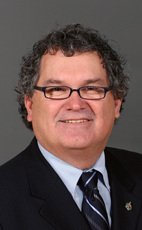
House of Commons photo

Crucial Fact

  • His favourite word was situation.

Last in Parliament March 2011, as Bloc MP for Gaspésie—Îles-de-la-Madeleine (Québec)

Won his last election, in 2008, with 40% of the vote.

Statements in the House

The Environment December 7th, 2004

Mr. Speaker, even though the Minister of the Environment appealed the decision on the Bennett toxic waste incinerator in Belledune, no moratorium was imposed on the plant's operations.

How can the minister try to make us believe that an environmental impact assessment of the potential transborder effects of this project is necessary and justified, when no stoppage of operations was ordered?

The Minister of the Environment has all the necessary powers to ask the court for an injunction to prevent tests from being conducted at that plant until the Federal Court of Appeal issues its ruling. Moreover, the federal government could invoke the Fisheries Act and close the plant for the period that it deems necessary, so as to proceed with an environmental impact study.

People in eastern Quebec and New Brunswick are urging the government to act responsibly regarding this issue, and they are demanding nothing less than a moratorium.

Canadian Broadcasting Corporation November 26th, 2004

Mr. Speaker, I am very concerned about the recent reorganization of the Canadian Broadcasting Corporation in the Gaspé Peninsula and the Magdalen Islands.

Budgets for CBC radio correspondents in Chaleur Bay and the Magdalen Islands were cut, and now the CBC just transferred its correspondent for the Chaleur Bay region to its facilities in Matane, moving him more than 200 kilometres away.

Rather than promoting regional development, the CBC prefers to abandon the regions. Yet, in September 2004, its CEO, Robert Rabinovitch, said that the CBC had a duty to provide a balanced and high-quality information service on which all Canadians could rely.

The Gaspé Peninsula and the Magdalen Islands deserve better. This situation must be corrected and it must be corrected quickly.

Canada Labour Code November 25th, 2004

Mr. Speaker, I am pleased to speak about the anti-scab legislation, but at the same time, I think it is a shame that we are still talking about this issue today. In my opinion, there should have been federal anti-scab legislation a long time ago.

The speech we just heard from the hon. member for Sault Ste. Marie really struck a chord with me, especially when he was talking about the human side of this issue. That is what I will try to address in the next few minutes. I also had the experience of going through a labour dispute from October 20, 1982 until January 6, 1986—38 months—and I survived.

If I had the time, I would describe what I experienced in detail, but first I will talk about the issue in general. Nonetheless, the human side that the hon. member talked about is very important. That is where we find the essence of what anti-scab legislation could be.

I am also aware of the fact that the hon. member for Louis-Hébert presented this bill.

I went through a 38-month labour dispute, but I was not alone. We were 12 at the time. We were 12 at the beginning of the strike, but 38 months later we were eight. In light of various commitments and financial difficulties, among other things, four of the strikers had to go to another company or elsewhere.

Let me give you a little context of the time from 1982 to 1986. Of the 12 strikers, there are two who still work at the same place. It is called Radio CHNC ltée. It is in New Carlisle in the riding of Gaspésie—Îles-de-la-Madeleine. That is where I worked for over 20 years.

At first, I was simply a man who went on strike on October 20, 1982 knowing full well that the dispute would mean that there were difficult times ahead, especially considering that there was no federal anti-scab legislation and that radio stations are under federal jurisdiction. In a way, we knew what to expect. However, what is at issue here—and we had the opportunity to hear speeches about this—is the game. It is not, however, the kind of game that entertains or is fun. The length of labour disputes depends on a the balance of bargaining of power. When there is no anti-scab legislation, as is the case in Canada's history, disputes last for an extremely long time.

I had to go through a 38-month strike. Others have been locked out. Others in the same sector, especially in Quebec—I am thinking of the people from Télé-Métropole—were locked out for about two years. I also remember people I knew from the CKML radio station in Mont-Laurier who had to go through similar labour disputes.

When people negotiate, they simply assume that the balance of power will bring about better working conditions. Indeed, unionized workers looking to renew a contract simply strive to improve their working conditions. Nobody wants to go out on picket lines or stay home for months. I went on strike on October 20, 1982 thinking it would only last a few weeks. It lasted 38 months.

On a personal level, I learned a lot from that experience. I learned that one should make the best of one's bad fortune. Actually, what I went through is quite similar to what the hon. member said.

Let me share some memories. It will soon be Christmas. I remember I had to go through four holiday seasons before getting a final result, on January 6, 1986. I don't think this is the kind of situation that the employer as well as the strikers would like to go through again, nor would we wish others to live the same situation. Even just a few weeks of labour dispute can be extremely trying. Imagine then what almost four years of strike can do.

Some people go through severe depressions. We were 12 employees at the radio station and as many were replacing us. As a matter of fact, we were picketing every day and we could clearly see those people passing by because they did not come in buses or vehicles with tinted windows. Those people were members of the management staff or scabs. We could also see them elsewhere because some of them lived in our community. This can create uneasy situations and even very serious problems within families or communities.

When I started striking on October 20, 1982, I could not have guessed that the labour dispute would be so long. I had an opportunity to observe the solidarity that can exist between workers, in particular in the labour sector. People from all areas of Quebec came, at one time or another, to encourage us on the picket lines. At the same time, we went through moments of discouragement because at times we felt like we were hitting a wall. We wondered if we would ever overcome that situation.

To add to the horror that we were living day after day, asking ourselves how we would solve the issue, the power relationship, the balance we were referring to earlier, was distorted. This situation allowed the employer to prolong the dispute. At the end of the day, everyone lost. After 38 months, when we came back to work on January 6, 1986, I felt like I had won nothing more than respect and I got my job back.

Such a long dispute can lead to absurd situations, and we went through a very bad one. At some point, about two years after the dispute began, the scabs who replaced us, who were there because there was no anti-scab legislation, wanted to unionize. That means that the board had to examine this.

During the weeks or the months that the dispute went on, despite a public hearing and the legal quibbling that may have taken place at the time, let me tell you that the situation was extremely difficult for us. The labour dispute has already been going on for too long and your realize that those who are working in your place, the scabs, are asking to unionize and it is indeed a possibility.

Finally, we won and there was no agreement on the unionization of scabs. However, this shows how far the imbalance can go in this area.

Last, I will take a few seconds to pay tribute to the people who went on strike with me at that time. We were 12; so the 11 other people were: Mario Roussi, Denis Lévesque, Raoul Gagné, Gérard-Raymond Blais, Diane R. Poirier, Diane Poirier, Gabriel Lebrasseur, Angéline Joseph, Jacques Parent, Claude Roy and Claude Girard.

Wharf Maintenance November 19th, 2004

Mr. Speaker, small vessel harbours are important to my riding. The numerous wharves located in my area are used by fishers and pleasure boaters. Many of those wharves are, however, in such a serious state of neglect that they are dangerous, if not actually unusable.

There are plenty of horror stories, particularly concerning Rivière-au-Renard and Grande-Vallée. In the latter location, the federal government has so neglected maintenance that most of the facilities have been closed down. They have put metal fencing around them to block any access.

The Grande-Vallée municipality has been demanding repairs for the past 10 years. Today it would cost close to $900,000 to get the facilities back in shape.

The Minister of Fisheries and Oceans must take immediate action so that the local people, fishers and tourists can start using the Grande-Vallée fishing port and all the other small vessel port facilities that are so greatly needed.

Economic Development Agency of Canada for the Regions of Quebec Act November 5th, 2004

Mr. Speaker, I listened with great interest to the speech just made by the member. I found some elements particularity interesting. When the various initiatives of Canada Economic Development are mentioned, one is left with the impression that everything is just fine.

However, for regions such as mine, which I know quite well, we can also take stock of what Canada Economic Development has done. With regard to the Gaspésie-les-Îles region recovery plan, any action taken was late as well as minimal. And this was a situation which required urgent action.

It may therefore seem important to list all the initiatives taken by Canada Economic Development in Quebec, since this makes it look efficient and active, but there is unfortunately another reality, one which hits us close to home. It has to do with what we see when we take stock of what Canada Economic Development has done in the Gaspésie-les-Îles region.

And I am not the only one saying it. On May 26, 1991 in Chandler 7,500 people gathered in an arena to complain about what the federal government and Quebec had not done for the region.

About 10 years later, there have been complaints in the region, again in relation to the federal government's inaction. When we talk about the agency, putting aside the numbers, putting aside what I have heard a moment ago, I think we must look at the situation as it is. Unfortunately, the results are weak and negative.

I would therefore like the hon. member to explain why, with so many good initiatives, we are faced with problems in this region and it is hard to see a future there. We have the impression that there is a lack of action, that we are being ignored, that we are being forgotten by the federal government.

They offer up all sorts of initiatives, but I think it would be appropriate to look at the other side of the coin, what is really going on. The fact is that initiatives have been infrequent, ineffective, late and often partisan. In this respect, Quebec needs to play a greater role. We know what the needs are, and we also know the solutions.

Economic Development Agency of Canada for the Regions of Quebec Act November 5th, 2004

Mr. Speaker, I would like to take this opportunity to commend my colleague from the Bloc Québécois on the soundness of his comments. I think the hon. member put his finger on the real issue. I would ask him to elaborate further on what is going on with Bill C-9 that is before us.

Indeed, I understand that we need to be very careful about what we have now, because this bill could be just smoke and mirrors. So I would like to hear again his views on federal interference and the new government asymmetry. I think we could learn more from the hon. member.

Economic Development Agency of Canada for the Regions of Quebec Act November 5th, 2004

Mr. Speaker, it is rather unfortunate to hear the member's comments about the Gaspé. I clearly remember how the hon. member, who exercised other responsibilities in another life, bragged about having played a key role in the Gaspé recovery plan; he made sure that $70 million dollars would be not invested but loaned—mark my word, loaned—even though $110 million had been requested. We had to wait 18 months to receive this answer.

To that extent, if there is a fiasco, it is due to the manner in which the federal government, the department and its minister, handled the Gaspé file at the time, that is, by dragging their feet before making an announcement. Moreover, they have provided much less money than was anticipated, making it a lot more difficult for investors, the people who wanted this recovery plan and who believed in it.

Why was the Gaspé recovery plan credible back then, and is now being dismissed out of hand? This makes no sense.

Economic Development Agency of Canada for the Regions of Quebec Act November 5th, 2004

Mr. Speaker, unfortunately I was unable to listen to all of the hon. member's speech. However, I would like to give him the opportunity to explain to me further what he thinks of the way the current government and Canada Economic Development are fulfilling their responsibilities and doing their work, for the Quebec region in particular, so that we can speak further on the development of our regions in Quebec.

In that sense, I would like to hear his comments on how he sees the situation. I would like him to assess the result of the actions or maybe I should say inactions. What does the hon. member have to say on that subject?

Economic Development Agency of Canada for the Regions of Quebec Act November 5th, 2004

Mr. Speaker, it will take me only a few seconds to provide other numbers which exemplify very well the situation we are faced with.

The budget for Quebec is three times less generous than the one for the maritime provinces. Proportionately, the federal government invests three times less in regional development in Quebec per capita than in the maritimes. The level of support in the four maritime provinces is $164 while it is $51 in Quebec--three times less. For each unemployed person this comes to almost $3,000 as opposed to barely $1000--almost three times more.

This gives you a fairly good idea of the situation. And we could go on and on with numbers. But what would be really useful for people in the Gaspésie—Îles-de-la-Madeleine region would be to put an end to duplication and start cooperating with Quebec to look at the region's future and to set aside destructive--

Economic Development Agency of Canada for the Regions of Quebec Act November 5th, 2004

Mr. Speaker, first, I thank the minister for allowing me to comment these figures. I simply want to tell him he is wrong.

He is wrong because, had he listened to my remarks carefully, he would have realized that I was talking about the recovery plan in my riding of Gaspésie—Îles-de-la-Madeleine, a plan which was made public just before the election in 2000. The recovery plan and other actions of Canada Economic Development are not the same thing. For example, a program like the coastal Quebec fund is not a recovery plan. A recovery plan means new money.

In 2000, the government made a great deal of noise about how it would help a region in deep trouble with a recovery plan especially designed for this region and with additional funding. But now, the minister is telling us that it was not true. What was announced then was perhaps the recycling of old money, and that the $35 million could be spent, but with the contribution of existing programs.

The Gaspésie—Îles-de-la-Madeleine recovery plan was meant to bring in new money, not use the money that could be invested through existing programs.

The minister should do his homework. If he wants to have a frank and probably interesting discussion, I am ready to meet him at the appropriate time, here or in my region, so that we can further discuss these figures, and perhaps go beyond them.

I can tell you serious work needs to be done in my region. I think people in Quebec can do it, and do it well. Those at Canada economic development or in the CFDCs can also play a role. In that sense, I think we will eventually be able to work all together for the future of my region.