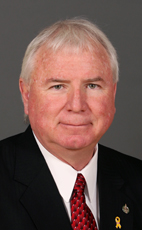
House of Commons photo

Crucial Fact

  • His favourite word was children.

Last in Parliament March 2011, as Conservative MP for Lethbridge (Alberta)

Won his last election, in 2008, with 67% of the vote.

Statements in the House

Supply March 15th, 2001

Mr. Speaker, I am not sure that is clear to all members of the House. I want to bring in one aspect that I was not able to bring in in my previous remarks. A couple of weeks ago we had the pleasure of hosting the British prime minister, Tony Blair, who gave what I felt was a very good presentation. I will quote Mr. Blair who is the leader of the British labour socialist party. He said:

Finally on trade—. It is time I think that we started to argue vigorously and clearly as to why free trade is right. It is the key to jobs for our people, to prosperity and actually to development in the poorest parts of the world. The case against it is misguided and, worse, unfair. However sincere the protests, they cannot be allowed to stand in the way of rational argument. We should start to make this case with force and determination.

On the day Mr. Blair was here, I had the opportunity to sit in the front row with the hope of talking to him before he left, and I did. I was able to shake his hand and thank him for his comments, but I was also, in the few moments I had, able to remind him that the subsidies the European Union was giving its agricultural producers were really causing a lot of pain in our country. I asked him if it would be possible to reduce those subsidies to take some of the pain away from our people.

I want to get back to the issue of being more forceful at the negotiating table. I know there have been reports lately, and I am slipping back to agriculture, that the agriculture minister was in Europe. He suggested to the Europeans that their subsidies were hurting our producers. They told him that he could go to the hell because that was the way it was and will continue to be.

Over a billion dollars worth of business goes back and forth across our borders with the U.S. That has to be worth some kind of lever when we sit down and start negotiating an important agreement like the softwood lumber agreement.

Supply March 15th, 2001

Mr. Speaker, it is a pleasure to speak to the motion brought forward by our Bloc colleagues. The Canadian Alliance certainly supports the motion as it supports free trade.

What is wrong with what is happening is that the agreement expires at the end of the month. We have no clear indication from the government of what angle it will take. We have conflicting reports from the Prime Minister. He thinks we should have it all linked together with other issues. The trade minister says that it will be negotiated on its own. We have to speed up the government or get it interested in the issue to have some resolution of it.

Previous to the softwood lumber agreement there were challenges against our trade with the U.S. in softwood lumber. Every time a challenge has been brought forward we have won. It has been proven that there is no subsidy issue which would allow the Americans a countervail tariff against our industry.

I know very well how hurtful a countervail tariff can be. It happened in my area of the country last year, when a challenge was brought by R-CALF in the United States against our cattle industry. Canadian producers had to post bonds at the border while this challenge was ongoing. Money was taken off all cattle that went across the line; a proportion of the amount was taken away.

In the end after months of investigation they actually came into the offices of feeders and went through their books. It was an horrendous process. It cost not only the amount of money that was taken in tariff, but millions of dollars to fight the issue that could have been better used. We won in the end. The tariff money that was taken was given back.

What is wrong is that the U.S. passed a law last year to say that if there were a challenge, a countervail put against our lumber, it gets to keep any money taken, even if Canada wins in the end. It could cost our industry billions of dollars, and that is totally unfair. That is an unjust law and the trade minister should have straightened it out by now. If we are talking about free trade with the United States, let us talk about free trade. Let us make it free, fair and rules based trade that we can all live by.

Here we are a few weeks away from the expiration of this agreement and we do not have the rules in place to move on.

One thing on which we have to be absolutely certain is that we do not do this alone. If only four or five provinces sign on to the deal then we are lost. We cannot be separated on this. We must hang in together. If the trade minister can keep us together as a country, then I am sure his leverage and power would create a fair package for our softwood lumber industry.

The softwood lumber industry is huge and, as has been pointed out by members opposite, it is important to Canada. It needs to have the government's full focus.

I feel that in many ways we have let down certain sectors of our country. Certainly one that I want to bring into the debate is our grain and oilseed sector. Because of some of the agreements the government has made with reducing tariffs and support to our producers, they have been put in a hole that I cannot figure out how they will get out of unless we support them ourselves.

We need to be more aggressive when we fight the Americans and the European Union on subsidies. We need to beat down the unfair subsidies that distort markets and production. We need to use more force. We do not think enough effort has been put forward by Canada.

We trade a lot of goods and we are a good trading partner. Trading partners can count on us to have good quality products that will be delivered on time and at a fair price. When we have those kinds of deals and that kind of reputation, why are we not using that as a bigger hammer when we go into these negotiations with the European Union and the United States?

The other challenges that have been brought forward in the past against the softwood lumber industry have crashed. The United States has done everything it can to try to point out that our industry is being unfairly subsidized, and it is not. If it does go to a challenge, let us use the present systems of WTO and NAFTA to deal with that. I am sure we would be successful.

However the thing that is really scaring the industry is the law that the United States has passed that says that any tariff collected would be kept. I cannot understand how on earth that would work but that is what it has done.

I had the opportunity in the last parliament to meet with some U.S. senators in Montana: Senator Craig, Senator Thomas and Senator Burns from Wyoming, Idaho and Montana. We were only able to meet for a morning but it was good to be able to do that. I think five or six of my colleagues attended the meeting in Great Falls. My realization from that meeting was that we need to have more open discussion.

There were many issues at that time but the one that was important to me concerned cattle. A lot of the stories on both sides of the border were not true, were mistruths or were misunderstandings. Even for the couple of hours that we sat down and went over a few issues we were dumbfounded on both sides by the number of things being said that were just absolutely untrue. Opening a line of communication and debate is very important. Just a few hours spent on one morning was very helpful on a lot of issues.

A coalition of senators has come together to lobby the United States government to protect its softwood lumber industry. It is a big and an important issue to them and we have to be aware that there is very strong lobby in the United States to protect its industry, unfairly we think. Getting back to open, free and rules based trade is absolutely essential, not only in this area but in others.

We have seen it in other sectors of our society where some of these agreements have really hurt certain parts of Canada's industry and we cannot be doing that.

The other issue is that of messaging to the people of the United States that these tariffs are increasing the cost of a home in the United States by $1,000 U.S. We have to make sure that we have coalitions built with people there that the message gets out that their own people are being hurt by these countervailing duties.

The importance of one stance from coast to coast to coast in this country on this issue cannot be overemphasized. I believe we have to appear united on it because in the end it will be far better for all if we can do that than to hive off separate provinces and separate parts of the industry to different programs.

It makes me a little nervous that the trade minister and the Prime Minister are not on the same page as of yesterday. We need to be absolutely certain that this will become a bigger priority at the cabinet table and that we do take a united position on this. If the Prime Minister is talking to the vice-president of the United States saying one thing and our international trade minister is at negotiations saying another thing, then the Americans know we are not being cohesive and they can split us apart and make a better deal for themselves.

My colleague, the member for Vancouver Island North, could not be here today to speak to this but he has let me know about all the work that he has done on this file. He is getting together with a bunch of folks on the west coast to talk about west coast issues, and I am sure this will be at the top of the list on their agenda. He has done a tremendous amount of work on this deserves some credit as far as keeping his colleagues on this side of the House informed of what is going on.

I will finish by saying that we need to have this free trade in softwood lumber and it has to be coast to coast. It also has to be pushed with the emphasis that it deserves because of the importance it has to Canada.

Criminal Code March 13th, 2001

Madam Speaker, I thank all members who spoke tonight for their support. This is obviously an issue that needs to be addressed. As the member for Elk Island said, we have talked all day about the things that happen in our society that we should not really have to talk about but we do.

We need to give our law enforcement agencies and our courts the tools to do a good job, and that is where we went with this bill. The research that was done on it was to add one small item to their arsenal that would help them put a pedophile or a pornographer out of business for as long as possible.

I am encouraged by the comments made by the parliamentary secretary. I will take him at his word that there are some changes to the criminal code coming down and that this particular aspect of the amendment to the code to allow for forfeiture will be included.

I hope that when the legislation comes before the House again there will be a public and open debate on it and all Canadians will have input. Literally thousands of Canadians have supported me in this endeavour. The Canadian Police Association on down through the police organizations in Canada have supported this bill as well. This is something that needs to be done and I am encouraged to hear that the government has recognized that.

The issue of our children and the Internet scares me. I have two granddaughters, aged five and eight. The five year old can sit down at the computer and make it do things that I cannot. This scares me but that is the way of the world.

The one thing I would like to leave with the people who are watching is that as parents we have to be diligent when our children are on the Internet and on the computer because there are all kinds of people on the Internet system who like to prey on kids. Parents should keep an eye on what their children are doing and be aware of who they are talking to and the agreements that are being made.

I was going to ask for the unanimous consent of the House to make this bill votable but I will take the parliamentary secretary at his word, that this bill will be included in the amendments that are coming in to the criminal code, and leave it at that.

Criminal Code March 13th, 2001

moved that Bill C-247, an act to amend the Criminal Code (forfeiture of property relating to child pornography crimes), be read the second time and referred to a committee.

Madam Speaker, it is a privilege to be here today to once again present my bill, Bill C-247. For those who do not have a copy in front of them, Bill C-247 is an amendment to section 163.1 of the criminal code which would allow a court that convicts a person of an offence under those provisions to order the forfeiture of anything by means of which or in relation to which the offence was committed.

Before I start, I would like to recognize a number of people who have helped me with this process. One of the main drives behind this bill and this initiative is Detective Inspector Bob Matthews. He is the head of Canada's lead agency in the fight against child pornography. That is the 16 member Ontario Provincial Police child pornography unit, project P.

Detective Inspector Matthews is a widely respected voice in the debate between free speech advocates and law enforcement, and is one of Canada's top law enforcement agents in the field of child pornography investigations.

The second person I wish to thank is Detective Noreen Waters of the Organized Crime Agency of British Columbia. Detective Waters has been a child pornography investigator for eight years and was part of the team that brought in the now infamous John Robin Sharpe. She has been an enthusiastic supporter of our bill.

I also wish to thank Sergeant Randy Brennan of the Ottawa-Carleton Regional Police high tech unit. Sergeant Brennan has been involved in many successful child pornography investigations and is a valuable source of information.

I also want to recognize Mr. Steve Sullivan, the hardworking president and CEO of the Canadian Resource Centre for Victims of Crime. Steve has been a tireless advocate of victim's rights and has worked with members of parliament to change the justice system to place the rights of victims before criminals.

The list goes on. These individuals and many other law enforcement officers, victim's advocates, federal parliamentarians, provincial justice ministers and everyday normal Canadians from across this country have contacted me and offered their support. I want to thank these concerned Canadians and tell them to keep up the good work. I also want to thank them for fighting to protect children because today more than ever they need our help.

I want to broaden the theme of my speech today to discuss the challenges of controlling child pornography in today's Internet age. In my speech I hope to expose the depth of the problem facing policy makers and law enforcement. I also wish to share with members and viewers some of the ideas that I have to tackle these challenges.

At the root of these challenges lies the hydra like nature of the Internet. In its humble fledgling as a forum for academia and the military, the Internet was boring and difficult to navigate. It contained only dry text, no images or flashy graphics. However the creation of the graphical interface known as the worldwide web in 1993 has created a surge in popularity.

From just over 100 sites in 1993, the web has exploded to the point where some industry experts estimate that over 800 million web pages exist today with some 160,000 pages being added each and every month.

The Internet has revolutionized communications. Most of us in the House did not even know what e-mail was up until five years ago, yet today our children and our grandchildren are growing up having never known anything else but instantaneous communication. Businesses, organizations, government agencies and individuals have seized upon this technology by setting up websites and revolutionizing the interaction between people.

As in all facets of life there are decent, virtuous online users and there are deviant predators making use of this potent tool. In his report “Innocence Exploited: Child Pornography in the Electronic Age” prepared for the Canadian Police College, Winnipeg Professor Doug Skoog estimates that there are at least one million pornographic images of children on the Internet.

Detective Waters shared recent statistics with me that estimate that 53% of Internet traffic is concerned with sexually explicit material.

Calgary police detective Butch Dickens of the vice unit had this to say about child pornography on the Internet in a newspaper article last year. He states:

A year ago, we probably only got one phone call a month about it. Now we get four a day.

Before the advent of the worldwide web, child pornography detectives around the world could say with confidence that they were winning the war against child pornography. The old methods of creation and distribution were extremely perilous. Carefully arranged meetings, secret mailing lists and postal drops placed pedophiles at tremendous risk of being caught and punished. Those days are gone.

Inspector Bob Matthews relates:

The Internet has become almost the perfect vehicle for pedophiles to distribute child pornography, the reason being that at the stroke of a key, anyone can send large volumes of information from one country to another without being detected by the authorities.

The anonymity offered by the Internet allows child molesters to stalk their victims in their homes, schools and libraries without ever being physically present in any of those places.

The following are a few of the techniques they use to exploit children: Chatting online, Internet chat rooms, where users can send type to each other in real time, provide plentiful hunting grounds where child pornographers can stalk their young victims.

The next one is the sex tourism trade. With the increase in use of the Internet for the sex trade and sexual abuse against children, the number of websites providing information to travelling pedophiles has increased dramatically and is extremely explicit in detail.

Another technique is image morphing. With a decent computer and a little skill child pornographers can turn almost any picture into a pornographic image.

One of the worst of all is real time molestation, or streaming video, which shows live video on the Internet and enables child molesters to display their victims in real time to selected members of child pornography rings and clubs.

Skilled child pornographers will encrypt their messages, rendering them unreadable to outsiders.

These are some of the ways that they have been intruding into our homes and the lives of our children using the Internet.

Parents who were once confident that living in a small town would insulate them from the troubles associated with big cities can no longer be unmindful about the security of their children. With the click of a mouse, children in remote areas can be exposed to the seamy underside of the net. In what is becoming an all too often occurrence, cases are occurring where children under the age of 18 are being threatened or even molested by someone they met online.

In July of last year, a 45 year old man from the P.E.I. town of Summerside plead guilty to a child pornography charge. He had secretly videotaped a 14 year old girl whom he had coerced into doing a striptease and then played it live on the Internet for viewers in a special interactive online chat room. That same month, on the other side of our country, police arrested a 28 year old Washington man in the ferry line up, ready to leave Vancouver Island. Police found a 14 year old B.C. girl in his van. They had been exchanging e-mails.

In March of last year, the Ottawa Sun reported that an 18 year old man was arrested and charged with possession and distribution of child pornography. An undercover police officer met the man online while the accused was looking for a partner in a plot to kidnap, rape and kill a young child.

While for pedophiles, child molesters and pornographers the Internet is like a dream come true, it has become a nightmare for decent Canadians. The downward spiral into child exploitation usually commences with the collection of child pornography, progressing to sexually explicit online conversations with youngsters and eventually seeking child victims online for sex.

Tragically, authorities can only act when the pedophile acts on his urges. Experts report that before they are arrested, the average child molesting pedophile abuses 35 children. They will share methods and techniques in finding children, gaining their trust and facilitating seduction. Along the way many, compulsively save mementoes to validate their actions. This is how child pornography is created.

However, understanding the problem, as difficult as it may be, is only half the job. Problems require solutions. Some of those concerned about this problem advocate complete censorship and regulation of anything that appears online. Others lecture that any restriction on speech is unacceptable and prefer to place the responsibility on the users. The answer lies somewhere in the middle of these two polar viewpoints. As policy makers, it is our task to strike that balance, for we alone have the democratic mandate of the Canadian people.

Shortly after her swearing in as chief justice of the supreme court, Madame Justice Beverley McLachlin predicted the court would deal extensively with issues of computer crime. The court, she said, would have to find ways to cope with offences that were international in scope, given the breadth of the Internet and computer communications.

Strong, effective legislation is one way the impact of child pornographers can be reduced. The supreme court did the right thing in upholding the ban on this illicit material in the Sharpe case, but now we must provide another tool to the justice system to stem the tide of child pornography flooding the web.

In 1993, in the wake of the R. v Butler decision, parliament passed Bill C-128, criminalizing all aspects of child pornography, including the creation, distribution, importation and possession of such material. It is considered among the strongest anti-child pornography legislation in the world. That is something of which all Canadians can be proud.

Unfortunately, a provision ordering forfeiture of equipment was omitted. This omission can be best described as an oversight when one considers forfeiture orders exist in 55 different federal statutes and in various places in the criminal code. This clearly demonstrates the justice system is not opposed to such penalties for criminals. To correct this omission in the law, I introduced C-247, which would have given courts the authority to order forfeiture, providing police with an extra weapon in their fight against child pornography.

Currently, forfeiture of equipment, in the context of a child pornography offence, is handled differently across the country. In Ontario the equipment is often forfeited as part of a bartering between the defence and the prosecution. In British Columbia prosecutors rarely ask for equipment to be turned over.

To see the danger in this patchwork practice a little insight is required into how charges under Section 163.1 of the criminal code are dealt with.

One must struggle to conceive of a crime more horrible than the sexual victimization of children.

Because of the strong public condemnation of child pornography, many offenders will do anything to keep their names out of the public domain, often eagerly agreeing to plea bargains, resulting in reduced sentences and often with no jail time. This creates a situation where the case law on this section is scant because the courts have had few opportunities to comment on it.

More dangerous is the fact that these plea bargains often allow the offender to return to the same environment in which he initially committed his crime. Returning him to that environment with high tech equipment intact is a temptation that could prove too strong to resist.

By ordering forfeiture, I believe the risk of recurrence can be lowered. Because a child pornography addiction is fueled by psychological problems, not by profit, many offenders will have limited means. Indeed, their compulsion likely creates financial hardship as the individual spends much of his free time and money in pursuit of his fantasy.

Confiscating several thousand dollars worth of computer equipment and perhaps even a vehicle or something more substantial will create a financial barrier to reoffending. I understand it is only money and does not address the root of the problem, but it is one way we can slow down the traffic in this repulsive time.

The technology of our rapidly changing world continues to create legislative challenges for parliament. Expanding the legislation, filling in the holes, adapting to change, as we are trying to do, is necessary. Criminals do not stand still and neither should we.

It is out of my concern for the safety of Canadian children that I took this initiative, researched the issue of child pornography and the Internet and tabled the bill. I acknowledge that my bill may not have been written in the most precise of legal terminology, but I am nevertheless disappointed that it was not deemed votable this year, as it was last.

I took on the challenge of tabling a private member's bill, a justice themed bill no less, knowing the odds were stacked against my success, but I did it because I believe in the spirit of the bill and I could not stand by without doing something to help.

I urge all members to take some time to think of the difference, even if it is a small difference, that the bill could make in the fight against child pornography so that one like it may return to the order paper in the near future. I implore the justice minister to take the spirit of the bill and enshrine it in law. Consider the law enforcement agents who have made it their life's work to make our country safe from the perversions of these child molesters. Think of the victims of these cold-blooded criminals and help us make a difference.

Curling March 12th, 2001

Mr. Speaker, over the past week a great Canadian tradition took place right here in Ottawa, the Canadian men's curling championship, the Brier.

Provincial and territorial champions came together to compete for this coveted prize now known as the Nokia Cup. The host committee composed of 1,100 volunteers did a wonderful job and the 150,000 or so spectators were treated to some great hospitality. Canadians were treated to tremendous shot making by all teams. Their skill and sportsmanship were something to behold.

When the dust and ice chips settled—and oh yes, a few feathers—the champions were the boys from Alberta, curling out of the Ottewell Curling Club in Edmonton. Skip Randy Ferbey, third David Nedohin, second Scott Pfeifer, lead Marcel Rocque, fifth Dan Holowaychuk and coach Brian Moore left no doubt that they were the Canadian champions.

Besides winning the Brier, they also qualified for the Olympic trials, and now, as Team Canada, they go to the world championship representing all of us. They did a good job and I wish them good luck.

Canada Shipping Act, 2001 March 12th, 2001

Mr. Speaker, I would like to get the hon. member to expand a little on one of the things he alluded to, which was the environment and how this bill would help protect our marine environment. This bill was designed to come into line with what the Americans are doing.

Would the member comment on whether he thinks it brings us up to par or is better than what they are doing and indeed deals with the issue of protecting our marine environment?

Species At Risk Act February 28th, 2001

Madam Speaker, that is exactly what I was referring to. If we have a heavy-handed command and control approach to protecting endangered species, we will not have any co-operation. We need to do it in a co-operative way, recognize that landowners are faced with some of these situations and help them get by.

One thing in the bill is penalties. There are penalties of a million or half a million dollars for this or that. If that is to be in the bill, why can we not have the compensation factor in the bill as well? We have to let people know there is some mechanism in place that will allow them to carry on with their way of life or their processes without giving them the heavy end of the stick all the time. We must have some method of keeping people working.

Certainly I was raised in an agricultural community and I too have some farmland. When I drive through the rural parts of this country, I am encouraged to see the things that people are doing on their own accord. Some of the practices we have today do take out some of the protective hedgerows and things. I will not deny that. However, in other areas people are still volunteering to put some land aside to create habitat and we really need to encourage that.

One thing the member mentioned too was this whole idea of people being able to point a finger at a person who is on the land, say that the person has just disturbed some critical habitat and bring a suit to bear against that person. We have a little bit of a problem with that as well. We think there should be a way to do this without having everybody who is going for a long walk in the country being able to point, say that something is wrong and get some action started.

Co-operation and the balance are the things we are getting at. We need to see that. If those things are not there, the bill will not work.

Species At Risk Act February 28th, 2001

Madam Speaker, it is a pleasure to rise and speak to this bill today. The idea of a bill to protect endangered species has been kicked around Parliament Hill for a long time. It has gone through numerous ministers. The only continuous factor has been the chairman of the environment committee, the member for Davenport, who has been through all of it and is certainly an advocate for strong environmental laws.

We support the protection of endangered species. My colleague from Red Deer said the other day that polls have indicated that 95% of Canadians support some kind of legislation to protect endangered species. He wondered why it was not 100% and why anybody would not want to do that? We agree that it needs to be done, but it needs to be done in a way that is fair and that deals with some issues that we feel are not being dealt with in this bill.

We will support the bill but we will put forth some amendments. We are hopeful that the government will, at some point in time during the bill's process through the House to become law, look at those amendments. We are also hopeful that the government will listen to the people of Canada and make the changes needed to make the bill work properly.

We cannot have the three s' s, shoot, shovel and shut-up, in Canada. It happened when some strong handed legislation was introduced in the United States and it did not work. We need to deal with co-operation, compensation, partnerships and working with stewardship initiatives in the private sector.

Compensation and scientific integrity are two issues in the bill for which we will have a lot of input. Scientists should decide what species are at risk. They should create the list and that is it. There should be no political interference in who decides what an endangered species is. It should be done scientifically and then presented to the House.

However, I feel, and I am sure this has been stated by others, that if any action is taken on that list it will require dollars and the intervention of some body with authority, which should be the duty of the elected politicians.

We have to be very careful that the co-operative efforts put forward already and the stewardship initiatives that we see across Canada are supported, enhanced and rewarded. We have a huge concern with that issue. We have to ensure that the people who are working so hard on their own to create habitat for endangered species and to preserve habitat that exists are recognized.

I had a great opportunity the summer before last to go up to the eastern irrigation district around Brooks. I was invited up there by a fellow named Tom Livingstone. There is a huge tract of pure virgin prairie grass that is being used for grazing. It is managed very well. There are oil and gas wells on this land.

Among all of this is the burrowing owl habitat. I was able to actually see a number of owls living there and raising their young right in among the cattle and the other development. The people there do things very carefully. They make sure that when the species need to be left alone, they are left alone. There is a huge tract of water that is used for wildlife and fowl. It was incredible. There were antelope and all kinds of ducks and geese there. It was quite a thing to see. These people have done that as an irrigation district to preserve what was on the prairies when we first came.

So in regard to this idea that we need to have heavy-handed legislation to bring our ranchers, our oil and gas exploration companies and our farmers into line, I do not think it needs to be done. If we work co-operatively with them and show them some support for their initiatives, we can go a long way to really doing this thing in a proper manner.

We have to make sure of something: people have told me that they want to have input into the bill. They want the committee to sit. After the committee gets Bill C-5, people want it to hear witnesses from all sectors of society. They want the committee to travel, to get out to parts of Canada, to get into the north. The member from the Yukon has issues in his area. People on the east and west coasts have issues. All across Canada people should have the ability to come to the committee to present their ideas to help make a bill that will work well. I encourage the members of our caucus on that committee and the others to work that way, to get out and go across this country to get that input that is so rightfully needed.

My party feels the compensation issue has to be in the legislation. To say that it will be worked out in regulation afterward is not something that we can live with. We certainly do not support the position presented by the Pearse report that one does not receive compensation until over 10% of one's livelihood has been affected and then one is only compensated for 50%. We would like to see full compensation. If we do it that way, we will encourage landowners and others to really take an active part in this. That has to be in the legislation. It has to spelled out very clearly that compensation will be given and that it will be given to the full extent that the landowner is affected.

The idea that all Canadians feel something needs to be done for the protection of endangered species brings us to the fact that all Canadians should be part of the cost of any mitigation implemented to preserve habitat. If it is a cost to society in general, then let us put it into the legislation and let all Canadians have a look at what that means. Certainly the elected officials have to be the people who are responsible for any spending of dollars that go into the protection of endangered species.

When I was on the environment committee we talked at length about residual powers, as we have here, about who should have effect over whom or which level of government and provinces should. A lot of the provinces have strong endangered species legislation. We have to work hand in hand. We have to receive the input from the provinces. We must make sure they understand that this is going to be a co-operative effort and that the end result will be to the benefit of the endangered species in the country.

We saw some really unusual coalitions formed when the bill was introduced last time in the House. We saw environmental groups get together with industry. We saw the mining industry come forward with the pulp and paper people, the Sierra Legal Defence Fund and the Canadian Wildlife Federation. Seeing all these people getting together to work together for the common good of endangered species was very encouraging. That is something that we as a country have to build on.

We have to encourage these types of partnerships and coalitions to get together to come up with the right plan that will work. If we have them all involved, if we have input from everybody and if we come up with the proper balance, there is no reason why we cannot have a law in place that will do the job but will allow us to go on with our lives.

Members know that we need to preserve what is here. I have children and grandchildren and I certainly want them to have the ability to see the things that I have seen in my life. We need to do this as a country.

In regard to the whole idea that it will not work, the idea that one part of society will go against the other and it will not come to be because we cannot come to an agreement, I do not buy into that. I think there are ways we can do it. If we have the compensation in the bill, if we work hard at the co-operative level to reward stewardship and reward the programs in place today—and enhance them if need be—if we show that we are willing as a government, as a body of elected officials, to receive input from Canadians in all parts of society, we will have support. We will have a bill that we can work with.

One of the things I experienced in the environment committee when we went through some other legislation was the wish of some to take out any reference to the word economics. If we were looking at social and economic reasons for doing something, people said let us not worry about the economics. However, I think we need to. When we are talking about the livelihood of people on the land and on the waters of the country, we need to bring that into the mix, into the formula.

Let us put the compensation aspect into the bill, let us work co-operatively, let us listen to all Canadians and let us come up with a bill we can all be proud of.

Trade February 28th, 2001

Mr. Speaker, any agreement with Costa Rica will lay the foundation for future negotiations with other Central American countries and eventually the FTAA.

Will the government live up to a commitment it made to western Canadian beet producers when it was in western Canada last year that it will do nothing to destroy their industry? Will he stand here today and say that the government will not hurt the sugar industry in Canada?

Trade February 28th, 2001

Mr. Speaker, the government is currently negotiating a trade deal with Costa Rica on sugar. Canada already has the most open sugar market in the world. Any change to the present rules will be disastrous to Canada's sugar cane refineries, sugar beet processors and sugar beet producers.

Why is the government so hell bent on systematically destroying our agriculture industries one at a time by poorly placed trade policies?