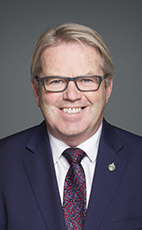
House of Commons photo

Crucial Fact

  • His favourite word was program.

Last in Parliament October 2019, as Liberal MP for Cape Breton—Canso (Nova Scotia)

Won his last election, in 2015, with 74% of the vote.

Statements in the House

October 1st, 2009

Mr. Speaker, it is almost entertaining to hear the parliamentary secretary say, “Please work with us”.

I would like to make a point of clarification. My colleague from Markham—Unionville was with the banks at the time he made those statements. The Liberals stood and voted against deregulation. The Reform Party, which constitutes a great deal of the current government, voted 100% in favour of deregulation, so we might have found ourselves in the same mess the United States is in had those members been in government at the time. That is the reality.

What has the finance minister done? The only thing he has done is he has approved 40-year mortgages with 0% down, just like the subprime mortgage problem that triggered the downfall in the United States and helped the world economy tumble. He has come back and since corrected that, putting it to 35 years, but--

October 1st, 2009

Mr. Speaker, it is a pleasure to take part in these adjournment proceedings and specifically relate back to a question that I had asked in the spring session, a question that was prompted, I guess, by some of the selective amnesia on the other side of the chamber. Maybe I will use my four minutes to provide a bit of background as a reminder.

The question I had posed was about the banking system which, at that time, the finance minister was taking great credit for the situation that we found ourselves in here with the meltdown in the United States, south of the border. Our banking system was in relatively strong shape and he was taking the bows and being very self-congratulatory about that.

History shows that a great number on the other side, some now in cabinet on the other side, were some of the greatest champions of the deregulation at the time. They wanted to see the banks go global. They wanted to see them grow. They wanted to see them take on the face of Citibank. That is exactly what those people on the other side were advocating and pushing for.

However, it was successive Liberal governments that did not yield to that type of pressure, that did not yield to compromise the regulatory regime that had been in place, and it was our past prime minister, Jean Chrétien. In retrospect, in hindsight it was absolutely the proper decision to make at the time and, fortunately, Canadians are the benefactors of that strength, that wisdom and that courage that he showed in ensuring that regulatory regime stayed in place.

That is nothing new. History shows that with regard to his decision on Iraq. The people across the floor thought that we should have been there with the Americans but, no, at that time, Prime Minister Chrétien stood his ground and made the right decision, and I think Canadians know that fully now. One on one, I think they on the other side of the chamber might even admit it.

I could go on and on. There was the G20. When I look at the Prime Minister just back from his talks last week, one would think that he invented the G20. However, when Paul Martin was putting forth the importance of developing a G20 including those developing countries, he was vilified by the current Prime Minister saying that multilateralism is so yesterday and that it was a sign of weakness in this nation.

Time after time, issue after issue, whether we look at income trusts or broken promises to widows, there have been problems. The reason for the non-confidence motion today is that we do not get straight answers from the government. There is no recollection of its history and no regard for fact.

I will pose my question for the Parliamentary Secretary to the Prime Minister. When can Canadians expect to get truthful answers, facts, from the government--

Richard Wackid September 29th, 2009

Mr. Speaker, it was with great sadness that I learned yesterday of the passing of our dear friend Richard Wackid.

Richard served every Liberal whip since Jean-Robert Gauthier and every Liberal leader since John Turner, with both honour and distinction. The consummate professional and team player, Richard was part of the glue that kept the Liberal caucus together in the best of times and the worst of times. He faced his battle with ALS just as he lived his life, with courage and dignity.

His love for the Liberal Party, the Liberal caucus and the House of Commons is an example for all political assistants, and this affection was only surpassed by his love for his wife Danielle and his daughter Stephanie.

On behalf of the entire team in the whip's office and our entire Liberal caucus, I would like to extend my most sincere condolences to Danielle and Stephanie. We will miss Rick.

Political Parties September 18th, 2009

It is official, Mr. Speaker, pigs have flown. Not only that, hell has frozen over. The opposition parties who said they would never in a million years vote confidence in a right wing Conservative government, have just united in an unholy alliance.

The marriage has been consummated. All that is left to do now is to figure out what to call this political ménage à trois. A suggestion would be the hypocrisy alliance. How about socons? That is short for socialist and conservative. The conservative lapdog triplets, how about that one? The train wreck trio. How about an acronym, BURN Canada, as in bloc united with reform conservatives and new democrats. Let us try Jack and Gilles crawl down from their hill. The possibilities are endless.

Whatever we call it, Canadians know full well they will never call it “coherent”, and they sure as heck will not call it “principled”.

Questions Passed as Orders for Returns September 14th, 2009

With regard to the Veteran’s Independence Program: (a) how many applications were received in the years 2007, 2008, and 2009 to date; (b) how many of these applications were approved to receive assistance; (c) how many of these applications were refused; (d) does the government plan to expand the program to include all Second World War and Korean War veterans’ widows; and (e) has the Department of Veteran’s Affairs been provided any documents or departmental briefing notes with regard to a cost-benefit analysis for expanding the program?

Questions Passed as Orders for Returns September 14th, 2009

With regard to the Atlantic Gateway initiative: (a) how much federal funding has been announced to date; (b) how many funding expenditures have been approved to date under this program, (i) what is the federal contribution, and matching contribution from provincial or private partner sources for each expenditure for a total project cost, (ii) where is each expenditure located, (iii) what are the criteria for the approval and anticipated outcomes of each expenditure; (d) what are the amounts given to each province since the creation of this funding; and (e) what are the projected economic benefits for the Atlantic Region?

Questions on the Order Paper September 14th, 2009

With regard to aid for the Atlantic Canada Fishery: (a) how much funding has been allocated to each province from the Department of Fisheries and Oceans’ recent $65 million funding announcement; (b) what sectors of the fishery will receive the funding; (c) has any funding been allocated to support loss of income among fishermen; (d) does the government plan to contribute funding for the retirement of lobster licenses; (e) does the government plan to implement changes to the Employment Insurance system that will assist workers in the fishery sector; (f) has any new funding been allocated for industry infrastructure; (g) has any new funding been allocated toward research and development; (h) has any new funding been allocated toward easing access to credit for those in the fishery; and (i) what is the breakdown of the funding for each fiscal year from 2009 through 2014?

Questions on the Order Paper September 14th, 2009

With regard to Employment Insurance: (a) has the Minister of Human Resources and Skills Development been provided any documents or departmental briefing notes that outline changes to the processing time of Employment Insurance cheques; (b) under the rules, how many days does an unemployed worker have to wait for his or her first cheque; (c) on average, how many days does an unemployed worker currently wait for his or her cheque; and (d) how many service telephone lines are available to workers looking for information, and how many of those telephone lines are staffed at one time?

Conservative Party of Canada September 14th, 2009

Mr. Speaker, Canadians have learned over the past four years that if they want to know the Prime Minister's real agenda, they have to listen to what he says behind closed doors.

In public, his comments are an inconsistent mess. First, it was no recession and no deficit. Now we know he has the biggest deficit in the history of this country. However, in private, when the Prime Minister knows the cameras are not rolling, or thinks they are not rolling, he is completely consistent. Recent video has exposed his real agenda.

He needs absolute power so he can teach his enemies a lesson, and he makes it clear just who his enemies are: women, minorities, anyone who dares to fight to protect their charter rights.

Regarding the courts, the Prime Minister had the audacity to characterize one of the most independent and impartial judiciaries in the world as “left-wing ideologues”: Conservative Party in public, Reform Party in private.

Liberals will stop accusing Conservatives of having a hidden agenda when Conservatives stop talking about it behind closed doors.

June 16th, 2009

Mr. Speaker, if the government is looking at some economic stimulus, if it is looking at a bit of job creation, maybe one place it could start is with the Conservative research bureau. It should tell it to get off its duff and maybe try to actually answer a question.

That is shameful. He gave the same answer last night to my colleague, the member for Nipissing—Timiskaming on a question about EI.

The people in my riding, the people across the country want to know what the government will do when they do not qualify for EI. I am not alone on this. Premiers Brad Wall from Saskatchewan, Gordon Campbell from B.C., even Dalton McGuinty from Ontario are all on the same page with this.

The government has to do something to provide for these people who are exposed right now, not just come back and regurgitate the same answers. Please, what is the government going to do to help these people?