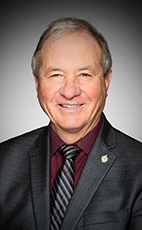
House of Commons photo

Crucial Fact

  • His favourite word was alberta.

Last in Parliament April 2025, as Conservative MP for Calgary Signal Hill (Alberta)

Won his last election, in 2021, with 59% of the vote.

Statements in the House

Business of Supply May 30th, 2016

Madam Chair, I want to talk a bit about the debt that the budget is going to leave future generations of Canadians. We all know there was a promise in the election campaign by the now Prime Minister that we would run a $10-billion deficit and it would be used to build infrastructure. We now have a situation where the government is putting us $30 billion in debt as a result of the budget and that the $10 billion in infrastructure that was promised by the Prime Minister is now spread over two years.

I would like the finance minister to explain how the numbers do not add up. How can we go into debt to the point of $30 billion when only $10 billion of that is infrastructure money that is going to be spread over the next two years?

Business of Supply May 30th, 2016

Madam Chair, the minister did not answer the question whether he agreed with his department, which obviously does not agree with the new government.

My friend who is the chair of the finance committee made comments about Canada is back. The evidence that the minister received in his briefing from his department clearly points that Canada had not gone anywhere. Canada always has been back. For the minister to stand here and say that somehow we have had slow growth over the past number of years is incorrect based on his own briefing documents. We will leave that.

I would like to go back to the job creation side of the question. This also gets back to small business. There has been a lot of talk about an increase in CPP premiums. I would like to have the minister tell this committee what his thoughts are relative to those premium increases and what calculations have been done and what impact that might have on small business as we move forward.

Business of Supply May 30th, 2016

Madam Chair, words do matter because at least the budget that was delivered in 2015 was balanced. We have gone over those numbers to the point where the only person who does not believe that there was a balanced budget in 2015-16 is the Minister of Finance.

I do not think I got a very concrete answer. It still sounded to me like the Minister of Finance is pulling a lot of job numbers out of the air.

When we speak about the private sector, I would like to re-emphasize what my colleague said about it. There was a promise to reduce the small business tax and the Liberals broke that promise. That is how jobs are created in the private sector.

Let me move on to borrowing. It is clear that over the past dozen or so years, Canada outpaced its G7 counterparts in growth. Since the early 2000s, the Minister of Finance continues to insist that there was slow growth. However, I want to quote from his briefing binder, which was prepared by his own department when he took office. It states that Canada's real income per capita growth was the strongest of all G7 countries in the 2000s compared to the weakest growth in the 1990s, which, as we all remember, was a previous Liberal government.

I want to ask the finance minister whether he agrees with this assessment by his own department.

Business of Supply May 30th, 2016

Mr. Chair, it is my pleasure to participate in committee of the whole this evening and further examine the budget that was delivered a short time ago.

I am a little disappointed that we have not really had answers to many of the questions that have been posed here tonight, so we will just carry on and see if we can do a little better.

The finance minister is the person in cabinet with the ultimate responsibility for our national economy. The strength of our economy can be measured in many ways but one is how many jobs are created. Unfortunately, job creation has not been a priority for either the government or the finance minister. That tone was set with a throne speech that was all about expanding government programs but made no mention of private sector jobs.

The finance minister followed the Prime Minister's lead by crafting a budget that leaves entrepreneurs, workers, and private sector businesses on the sidelines. Instead of focusing on businesses that create jobs, wealth, and opportunity in our society, he delivered a budget that expands spending on government programs by a massive 7.6% overall this year.

I would like to quote Hendrik Brakel, who is the senior director of economic, financial, and tax policy at the Canadian Chamber of Commerce. He did some research on this budget compared to the last one that the Conservative government presented to the House. In the last Conservative budget, the word “business” appeared 622 times. That is compared to just 87 times in this first Liberal budget. Similarly, in the 2015 budget the word “hiring” appeared 15 times and in the finance minister's budget “hiring” is only mentioned three times and it is mentioned only in the context of hiring more government employees to work at the Canada Revenue Agency. Even as he massively expands government spending by tens of billions of dollars, his budget sets aside just $173 million for business growth and innovation. That amounts to about 1.5% of this new budget spending.

The parliamentary budget officer has shown that the job numbers that were presented in this budget were inflated by some 40%. In addition to that, the finance minister refuses to release any information so that we can understand how he came up with his numbers.

I have some questions for the Minister of Finance about growth and job creation. The first one is the obvious one. Could he explain a little more about how he came up with the numbers for jobs in this particular budget?

Life Means Life Act May 19th, 2016

Mr. Speaker, I thank my hon. colleague because that is exactly what the bill would put to rest to a large degree for the families of victims.

We see it happening every day. We see how traumatic it is when the family has to go through the court process and provide victim impact statements.

I have not, thankfully, had to be involved in this kind of situation, but I can imagine how difficult that must be to have to face that particular situation and sometimes continue to relive it and maybe face the criminal in terms of the parole process. The bill makes it very much an end decision, so that the families of victims can move on with their lives and not have to worry about going through that process time and time again.

Life Means Life Act May 19th, 2016

Mr. Speaker, I suppose that if we believe in something, we do it, and many of us on this side of the House do believe that this is the type of legislation that is required.

There may have been certain circumstances where particular legislation may not have been deemed constitutional by the Supreme Court. That should not stop us from doing what we believe Canadians elected us to do, and that is to bring in legislation about which we feel strongly. In this particular case, through a private member's bill, I feel very strongly about protecting the rights of victims' families who have gone through a traumatic experience with a crime of heinous nature.

Life Means Life Act May 19th, 2016

Mr. Speaker, on the first question relative to a dangerous offender, it seems to me that it is easier said than done to declare someone a dangerous offender. I have seen numerous situations where application has been made to have someone deemed a dangerous offender and it has been unsuccessful. This is pretty straight and clear as to what the rules would be, what the direction would be to the courts. Having it written in law is more fair to the victims' families and for that reason, I believe the bill is warranted.

Relative to the Parole Board, one of the things in determining how special circumstances would apply, the elected official, the Minister of Public Safety , and ultimately the cabinet, are responsible to Canadians. They are elected by Canadians and they have a responsibility to Canadians. I am not trying to say that the Parole Board does not work well and does not take all considerations into account, but at the end of the day, the Parole Board is not reportable to anyone. In other words, board members are not elected by Canadians. I would prefer that it would be those who are elected by Canadians who would make the special circumstances exception.

Life Means Life Act May 19th, 2016

moved that Bill C-229, An Act to amend the Criminal Code and the Corrections and Conditional Release Act and to make related and consequential amendments to other Acts (life sentences), be read the second time and referred to a committee.

Mr. Speaker, I rise today to speak to Bill C-229, which would amend the Criminal Code and the Corrections and Conditional Release Act. Before I outline my reasons for bringing this bill forward, I want to make a few general comments, primarily for the members of the opposition who, I am sure, when speaking to this bill, are likely to say that it is just another approach to legislation by a hard right-wing Tea Party Conservative member.

However, I supported Bill C-14 at second reading and in all likelihood will support the bill at third reading. I will be supporting Bill C-16 because I believe all Canadians should be treated with equality and, frankly, it is the motivation behind proposing this legislation, which I will explain in a moment.

I am sure we can all agree that Canada has a reputation as a peaceful country of compassionate neighbours who live in relative comfort and security. We are fortunate that as a country our crime rates are low and we are generally able to walk our streets without fear. However, we must also acknowledge that there are some in our country who seek to do harm. There are some individuals who do not respect our values of peace and compassion. These individuals seek to harm others and make us feel unsafe in our homes, on our streets, and in our communities.

In our country, we perceive that people are innocent until proven guilty beyond a reasonable doubt, and that principle should never change. However, when someone is proven guilty beyond a reasonable doubt of heinous crimes such as multiple murders or murders which are so brutal that they upset us to even hear about them on the evening news, that person must be seriously punished for his or her actions. When a life is taken in such a manner, the families and loved ones of the victims are in essence given a life sentence with no chance of ever seeing that loved one again.

In the past 10 years, the former Conservative government introduced and passed over 60 substantive pieces of legislation to help keep criminals behind bars, to protect children, to put the rights of victims ahead of criminals, and to crack down on drugs, guns, and gangs.

I want to highlight some of the former Conservative government's justice accomplishes. They include the Serious Time for the Most Serious Crime Act, the Tackling Violent Crime Act, the Canadian Victims Bill of Rights Act, the Tougher Penalties for Child Predators Act, the Safe Streets and Communities Act, the Abolition of Early Parole Act, and the Drug-Free Prisons Act.

The most serious offence in the criminal code is murder. First degree murder, a murder that is planned and deliberate, carries a mandatory penalty of life imprisonment with an ineligibility of parole for 25 years. Murders that are not planned and deliberate carry the same penalty where they are committed in certain circumstances, including where they involve the killing of a police officer or sexual assault.

Through previous legislation, the former Conservative government strengthened penalties for murder, including eliminating the faint hope clause, which allowed a murderer to apply for parole after 15 years, and enabling consecutive periods of parole ineligibility for multiple murderers so they would no longer receive a sentencing discount.

Today, I am introducing the life means life act to ensure that the most heinous criminals would be subject to mandatory life sentence without parole. The life means life legislation would ensure that offenders who were convicted of heinous murders and those who were convicted of high treason would be imprisoned for the rest of their natural lives with no access to parole. This would include murders involving sexual assault, kidnapping, terrorism, the killing of police officers or corrections officers, or any first degree murder that would be found to be of a particularly brutal nature.

The life means life act would amend the Criminal Code to make a life sentence without parole mandatory for the following crimes: first degree murder that is planned and deliberate and that involves sexual assault, kidnapping or forcible confinement, terrorism, the killing of police officers or corrections officers, or conduct of a particularly brutal nature; and high treason.

The bill also gives courts the discretion to impose a sentence of life without parole for any other first degree murder where a sentence of life without parole is not mandatory, and second degree murder where the murderer has previously been convicted of either a murder or an intentional killing under the Crimes Against Humanity and War Crimes Act.

The law allows a criminal serving life without parole to apply for exceptional release after serving 35 years. This application would be made to the Minister of Public Safety and the final decision would rest with cabinet. The family of the victim would be able to provide input before any decision. This is consistent with the traditional approach of granting clemency and addresses legitimate constitutional concerns.

I recognize that some of my colleagues will object to this bill. They will say it is wrong to lock up someone for life because the person can be rehabilitated. To them I say, no amount of rehabilitation can bring back the victim of a murder. No amount of rehabilitation can bring back the stolen birthdays, holidays, and special moments in that victim's life. No amount of rehabilitation can bring back that victim to his or her family.

I believe Canadians will largely agree that some crimes should result in the murderer never walking free again. The victims of these murders deserve nothing less. As I said at the outset of my remarks, some of my colleagues will say this is just another Conservative tough-on-crime bill. Well, I am a Conservative and this does fit the definition of tough on crime. Similar laws already exist in the United States, the United Kingdom, New Zealand, and Australia. These governments have found similar measures to protect victims and their families.

To those who would call the bill another Conservative tough-on-crime bill, I would say to them that they are right. As mentioned earlier, when in government, our party introduced a series of measures to restore the balance between the rights of the criminal and those of the victim's family. I believe this bill is the final piece of the Conservatives' efforts to ensure that the scales of justice in the future are never tipped in favour of those who commit heinous crimes at the expense of the family of the victim.

Excise Tax Act May 13th, 2016

He was just reading talking notes anyway.

Budget Implementation Act, 2016, No. 1 May 10th, 2016

Madam Speaker, that has certainly been something that these particular 98 members of the House have been advocating throughout several of the debates that have taken place in this House, and I would agree with my colleague.

I do think, however, that one of the challenges the new Minister of Health will have to face is the cost of health care and how we as a country can deal with that. That is part of the whole discussion.