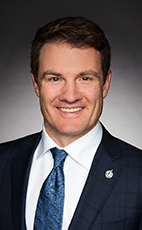
House of Commons photo

Crucial Fact

  • His favourite word was rail.

Last in Parliament April 2025, as NDP MP for Skeena—Bulkley Valley (B.C.)

Lost his last election, in 2025, with 39% of the vote.

Statements in the House

Marine Transportation October 3rd, 2024

Mr. Speaker, it has been three years since the tugboat Ingenika sank, killing Troy Pearson and Charley Cragg, and it has been two years and three transport ministers since the government promised strengthened marine personnel regulations to protect workers like Troy and Charley. Every single day, workers are going to sea without the protections that the government promised.

How can the minister justify continued delays when workers' lives are on the line?

Privilege October 2nd, 2024

Madam Speaker, I thank my colleague from Simcoe North for his remarks on an amendment to a motion that we are supporting, which is a good thing.

My question is at a higher level. The member did an excellent job of enumerating the Liberal government's many ethical breaches, and we have heard other colleagues in this House, both from the NDP and across the way, list the many ethical breaches of the former Conservative government.

For an average citizen watching this debate and reflecting on successive Liberal and Conservative governments that seem to have trouble acting ethically, what are they to take away from that? Is one of the messages that the protections against such ethical breaches are not strong enough? Is that one of the messages that people should take away from watching successive Liberal and Conservative governments not act in the public interest and break the ethical code that is supposed to govern this place?

Mental Health and Addictions September 27th, 2024

Mr. Speaker, toxic drugs continue to kill people's loved ones in northern B.C. at an alarming rate and first nations' families are disproportionately affected. In Terrace, the rate of death from toxic drugs is the second highest in our province. The Northern First Nations Alliance has been pushing for years for more detox and treatment capacity so that people do not have to travel to the Lower Mainland for services.

The alliance has urged the Liberal government to help. Why has the government not acted?

Missing Children September 23rd, 2024

Mr. Speaker, there were tears of joy and relief across northern B.C. last night when news broke that six-year-old Oaklynn Schweder had been found safe.

Oaklynn was reported missing Thursday evening, and what occurred over the next 72 hours was one of the largest searches in northern B.C. history. On Saturday alone, over 800 people were out searching for her. I hope my colleagues will join me on behalf of all Canadians in thanking the RCMP, search and rescue teams from across B.C., the Canadian Rangers, Skin Tyee First Nation, Chinook Emergency Response Society, the B.C. Wildfire Service and, especially, the hundreds of everyday citizens who travelled from far and wide to be part of the search effort.

As we rejoice that young Oaklynn is back in her parents' arms, this morning, our hearts and condolences go out to the family in Shamattawa, Manitoba, who have received tragic news concerning their missing loved one. May they find strength and support in the days to come.

Recent Deaths of First Nations People During Police Interventions September 16th, 2024

Mr. Speaker, the member's question was whether current indigenous police officers be consulted in the transformation of the national police force. I see no reason why that would not take place.

That would be a rational aspect of such a transition. However, there is ample evidence, and we only have to read the report from the standing committee to see all of the evidence lined up for transitioning to a civilian police force and ensuring that officers are getting the training and being given the tools to deal with the situations they are being asked to deal with.

We are actually doing them no favours by putting them into situations where they have no training in dealing with critical mental health crises, where they are put into situations that they are ill-equipped to deal with.

This idea of transitioning the model of the force towards a civilian model with a national oversight board would create much needed accountability. Maybe we will start to see some changes.

Now to the member's question about what one thing would I do tomorrow if I had the ability to enact any of these changes. That is tough because the most important single thing could be to read through all these recommendations as the government, pick one and implement it as quickly as possible.

Recent Deaths of First Nations People During Police Interventions September 16th, 2024

Mr. Speaker, I thank the member for Winnipeg North for the question, and of course I do.

What I was trying to articulate at the end of my speech was the fact that not only does the current scenario and culture not serve indigenous people in this country, as the statistics clearly show, but it actually does not serve the police. For new police officers coming into the RCMP or coming into a municipal police service, those cultural elements do not help them do their job better. We need to see reforms to policing in Canada.

The thing that is so frustrating is that those reforms have been articulated in detail, in report after report, and we have not seen action from the government. I am going to read one recommendation:

That the Royal Canadian Mounted Police be transitioned away from a para-military force into a police service model with civilian oversight through a national oversight board with a legislated mandate to make this transition

This has not happened. In fact, reading through the report, which is from 2020, so few of these changes are under way. I share the dismay of others that the progress under the government has been so painfully slow.

Recent Deaths of First Nations People During Police Interventions September 16th, 2024

Mr. Speaker, I know the hour is late. It is almost midnight here in Ottawa, but I cannot think of a more important conversation for us to be having as a country than this one right now. I want to start by thanking my colleagues, the member for Nunavut, the member for Winnipeg Centre and the member for Timmins—James Bay, whose interventions tonight have really done justice to a difficult and important topic.

This is an issue that touches many in northern B.C., the region that I am so honoured to represent. Because of the topic of tonight's debate, I want to start, as others have, by expressing my deep condolences to the families of the six indigenous people, five men and one woman, who lost their lives at the hands of police in just 11 days this month. I also want to use my time tonight to give voice to the anger, pain, dismay and frustration felt by the family members of Dale Culver. Dale was a 35-year-old Gitxsan and Wet'suwet'en man who lived in Prince George but had family roots throughout the northwest.

On the evening of July 18, 2017, the police in Prince George received a call from someone about a suspect, a Caucasian male wearing dark clothes, who was looking into parked vehicles. They said that he might have a weapon and that he might have a partner working with him. The police attended the scene and saw Dale Carver, a clearly indigenous man, on a riding his BMX bike. They called at him to stop, and when he did not, they chased after him, grabbed him by his backpack and pulled him off his bike onto the ground. What happened after that can be read in the B.C. Prosecution Service's report, but the details are horrifying given the violence that was inflicted upon this young man. The report talks about the officer kicking and punching him and spraying him in the face with pepper spray. The officer called for reinforcements, and when those reinforcements showed up, they did the same. They punched him in the head. They kicked him many times. They pepper sprayed their gloves and then put them over his mouth.

Twenty-nine minutes after the altercation, Dale was dead. There were bystanders filming the incident on their cellphones. One of the officers demanded that the bystanders delete the videos from their phones and tried to grab one of the phones out of a bystander's hands. Those bystanders did so because they were threatened by this officer, so there was very little evidence when this case went to court. At one point when he was on the ground, I will add, Dale cried out, “I can't breathe. I can't breathe.”

Two of the officers were charged with manslaughter, something very rare, and it did go to court. The first autopsy and pathology report found that blunt trauma to the head was a likely contributing factor in Dale's death, and through a series of events after that, the prosecutors ended up commissioning a second opinion on the pathology report, which came back with a different conclusion. In the end, the charges against the two officers were stayed. The third officer, the one who grabbed at a cellphone and demanded that bystanders delete the videos, was just recently convicted of obstruction of justice.

We have heard a huge outcry from the families, from the Union of British Columbia Indian Chiefs and from the regional chief of the Assembly of First Nations, Terry Teegee, about the process, about the struggle that indigenous people have in obtaining justice and about the shortcomings of the independent oversight bodies that exist. They are calling for change, and their calls for change relate directly to what is being discussed tonight.

Dale's death, of course, is part of a pattern. It is part of a larger picture. It is a picture that this place, the House, has talked about before, has debated before and has held hearings on before. It makes me think of other stories I have heard from northwest B.C. It makes me think of a remote detachment in our region that saw fit to hang a flag with the thin blue line symbol on it in the detachment. This was brought to my attention out of concern for what it represented; it is a symbol that people in the House will know, and as the Calgary Police Commission has described, as having a “contentious history with roots in division, colonialism and racism”.

It makes me think of another story from the same community, where a young constable was posted. Community members found on his Facebook page a photo of him wearing an Afro wig, with a raised fist and the caption “Black and proud”. He is a Caucasian officer. Another post showed him in colonial dress in front of a Union Jack, with the caption “Now, what's to be done with these pesky natives stirring up trouble in the colonies?” It makes me think of my colleague's comment earlier about the importance of better screening in the recruitment and hiring of RCMP officers.

Of course, these stories make me think of a recent audio recording played in a Smithers courtroom. The recording was made after arrests on November 19, 2021. This of course involved land defenders on a road in a remote part of northern B.C. The recording is of several RCMP officers heard laughing about police violence, mocking arrestees and making derogatory comments about symbols worn by two indigenous women to honour and remember murdered and missing indigenous women and girls. They said, “Do they have [effing] face paint on too? They're not orcs?” Orcs, of course, are fictional monsters from The Lord of the Rings. These are peace officers who were recorded saying this about indigenous people.

Perhaps most disturbing was a clip that caught an officer describing an indigenous arrestee as “that big [effing] ogre-looking dude, he's actually...autistic.” Then he goes on to describe one of the officers grabbing this individual by the testicles and twisting. These are the stories that are part of this picture.

I could get into the parliamentary report on systemic racism in policing in Canada. It has been mentioned already this evening. I think everyone in the House is aware that this is a problem. I heard my Conservative colleagues calling it something else, but with the same effect: that these are systemic biases. They are entrenched biases that affect society and the ability of people to obtain the justice they so rightly deserve. We know these systems of discrimination affect not only indigenous people but also others, and we cannot act urgently enough to see the changes that are needed. That is what I want to say.

I will add this final point, which is that the media built up today, the first day back in Parliament, as a day of division, rancour and expected conflict in the House. What I have heard tonight is quite the opposite. I think there is the basis here for something that could be very important, and I call urgently on my colleagues for us to take this opportunity to ensure that the steps are taken. We need to do better. We need to do better by indigenous people and we need to do better by police officers. Systemic biases do not help the police do their jobs better. They do not help women in the police forces do their jobs better.

With that, I will end by again thanking you, Mr. Speaker, for agreeing to this debate and thanking members for their contributions tonight. Let us not let this go without action.

Questions Passed as Orders for Returns September 16th, 2024

With regard to the Canadian Transportation Agency’s (CTA) resolution process for air travel complaints since the inception of the Air Passenger Protection Regulations in 2019, broken down by year: (a) what is the average time from complaint submission to resolution; (b) how much compensation has been paid to passengers; (c) how many complaints filed with the CTA have been dropped voluntarily by the complainant before resolution, broken down by what stage in the process they were dropped; (d) how many complaints have been refused by a CTA complaint resolution officer; (e) how many complaints have been resolved through each of the resolution methods (i) mediation, (ii) settlement, (iii) adjudication without mediation; (f) what is the backlog of unresolved complaints; and (g) what is the current number of unresolved complaints before the CTA?

Questions on the Order Paper September 16th, 2024

With regard to the decision of the Department of Fisheries and Oceans (DFO) that “recreational fishing for Chinook salmon will be closed on the Skeena River watershed and all rivers and lakes in Region 6 flowing into PFMAs 3 to 6, not including the Kitimat River and Nass River watersheds,”: (a) how does this decision relate to the DFO’s allocation policy; (b) on what empirical data was this decision based; (c) given previous seasons since 2018 have also seen similar closures, what evidence does the DFO have regarding the efficacy of this measure; (d) given the DFO forecasts a 2024 Skeena Chinook return of 28,000 fish, which is lower than last year’s return and far below the historic average, how is the DFO improving management to ensure both conservation and recreational opportunities in future seasons; (e) what does the DFO estimate the impact of the Alaskan commercial fishery’s interception of Skeena-bound Chinook salmon will be in 2024; and (f) what conservation measures are being imposed on other fisheries that catch Skeena Chinook?

Questions on the Order Paper September 16th, 2024

With regard to the decision to alter the remote work policy for federal employees to require them to appear three days in-office: (a) what are (i) the names of all individuals involved in the decision making process, (ii) the criteria used to justify the change, (iii) the needs assessments and office capacity assessments conducted, (iv) productivity indicators used to make the decision; and (b) how do these productivity indicators compare to those in the departmental plans?