Mr. Speaker, on a point of order, I would like to point out that the “Fiscal Monitor” is a snapshot in time, and does not give the fiscal situation—

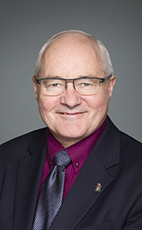 House of Commons photo
Won his last election, in 2019, with 41% of the vote.
Points of Order February 25th, 2016
Mr. Speaker, on a point of order, I would like to point out that the “Fiscal Monitor” is a snapshot in time, and does not give the fiscal situation—
Half Your Plate Campaign February 23rd, 2016
Mr. Speaker, I stand today to pay tribute to one of Prince Edward Island's most accomplished citizens, Chef Michael Smith.
Members have probably seen him on television as the host of Chef Michael's Kitchen, Chef Abroad, or Chef at Home on Food Network Canada or Global, or as a judge on Chopped Canada.
Chef Michael is a strong believer in the importance of getting Canadians to eat more fruits and vegetables and the need to make the healthy choice the simple choice. That is why he is proud to be the culinary ambassador for the Canadian Produce Marketing Association's Half Your Plate campaign, a healthy initiative that empowers Canadians to eat more fruits and vegetables.
Although truly a chef and citizen of the world, Chef Michael's favourite role is dad at home on P.E.I. with his wife Chastity and his children: Gabe, Ariella, and Camille.
On behalf of the House, we salute Chef Michael's many accomplishments and look forward to seeing him in action tonight at the CPMA reception, where he will show how easy filling half one's plate with fruits and vegetables can be. Eat healthy.
Canada's Contribution to the Effort to Combat ISIL February 22nd, 2016
Mr. Speaker, I was really shocked to hear the remarks from the member for Battle River—Crowfoot.
How could he be so far off base in terms of where Canada is at with respect to the ISIS mission? Canada is not withdrawing from a combat mission. Canada is strategically looking at how we can be best placed to defeat ISIS. That is what we are really doing. There still will be air support.
For the member to stand up in the House and say that because we are withdrawing from air support, there will be no air support at all is absolutely not true. We are working with our coalition partners to ensure there is air support, support for our troops that are training on the ground, and support for our people who are doing humanitarian aid.
We are not just standing around looking at nice aircraft and military weapons, as the previous prime minister did. We are strategically looking, with our coalition partners, at what is the best approach to defeat ISIS. That is exactly what the government is doing.
Interparliamentary Delegations February 18th, 2016
Mr. Speaker, pursuant to Standing Order 34(1), I have the honour to present to the House, in both official languages, four reports of the Canadian delegation of the Canada-United States Inter-Parliamentary Group.
The first concerns the 2015 Annual Summer Meeting of the National Governors Association, held in White Sulphur Springs, West Virginia, United States, July 23-25, 2015.
The second concerns the 68th Annual Meeting of the Council of State Governments—WEST, CSG West, held in Vail, Colorado, United States, July 28-31, 2015.
The third concerns the Annual Legislative Summit of the National Conference of State Legislatures, held in Seattle, Washington, United States, August 3-6, 2015.
Finally, the fourth concerns the 55th Annual Meeting and Regional Policy Forum of the Council of State Governments' Eastern Regional Conference, held in Wilmington, Delaware, United States of America, August 16-19, 2015.
Income Tax Act February 1st, 2016
Mr. Speaker, it would actually take about 30 minutes to answer that question, but it is all good and it is all leading to the country being more prosperous, with greater benefits going to the middle class.
As was said in my remarks, this is just the first plank. It deals with some of the necessary tax changes. It had to be done in a way that it would come into effect early this year. Following on that will be the new Canada child benefit, which will bring greater benefits to all families that are raising children, regardless of income. From there, we will go to housing programs, and on and on will go the list.
Income Tax Act February 1st, 2016
Mr. Speaker, the income levels of the middle class varies across the country, whether in my province of Prince Edward Island or in the province of B.C.
What the member of the Conservative Party should understand and support is that the Liberal Party is supporting the average Canadian in the middle class. He is a member of a party that in the last four years supported the wealthy in our country. His party put a burden on our children and grandchildren going forward into the future.
I heard some of the questions coming from members of the Conservative Party earlier. They were talking about their government ending up with a surplus, which is just a fictional surplus. All that government had were deficits. The Conservative government had the worst economic record in 80 years, since R.B. Bennett. In the last four years, the Conservative Party added $150 billion to Canada's debt. You, sir, should be standing up and supporting this government in getting our country back on track.
Income Tax Act February 1st, 2016
Mr. Speaker, I should probably not say this in this place, but I always love to get questions from Saskatoon because it is one of my favourite cities. I had an office there for some 11 years. It is a great community.
We are all about fairness in the taxation system. Those people in the low-income bracket that the member mentioned will be handled in other ways, as the Parliamentary Secretary to the Prime Minister mentioned earlier, through housing programs and other means within our total package. That will target those people in the less than $45,000 tax bracket.
Let me go through the tax brackets. Those at $90,563 to $140,388 would stay at the rate of 26%. Those at $140,388 to $200,000 would stay at the tax rate of 29%. The rate for those with an income over $200,000, as is proposed in the bill, would change from 29% to 33%. We would bring better balance to the tax regime within Canada.
Income Tax Act February 1st, 2016
Mr. Speaker, it gives me great pleasure to share my time with the member for Glengarry—Prescott—Russell, who is my new neighbour in our offices in the Valour building.
It is really great to be able to speak on Bill C-2, an act to amend the Income Tax Act, which is really the first plank as we move to implement the commitments upon which we were elected. That plank was outlined in our platform of growth for the middle class. Our key message was real change, a new plan for a strong middle class. That platform specifically stated, as it relates to Bill C-2:
We will give middle class Canadians a tax break, by making taxes more fair. When middle class Canadians have more money in their pockets to save, invest, and grow the economy, we all benefit.
Bill C-2 follows through on that commitment.
However, I will say this. Having listened to the discussion thus far today, it is only one plank among many. It is the first plank, in terms of a package that will assist the middle class and assist prosperity in this country.
As stated in the summary of the bill:
This enactment amends the Income Tax Act to reduce the second personal income tax rate from 22% to 20.5% and to introduce a new personal marginal tax rate of 33% for taxable income in excess of $200,000. It also amends other provisions of that Act to reflect the new 33% rate.
What does this mean?
What it really means is those with a taxable income of between $45,282 and $90,563 will see their current rate of taxation of 22% drop to 20.5%. That is a considerable saving for those individuals. We are targeting that group because they are a part of the middle class.
On the other hand, those with taxable income of over $200,000 will increase from the current rate of 29% to 33%.
In essence, what it really does is bring better fairness to the taxation system. It tries to lessen the income disparity and the tax advantages and disadvantages throughout the income tax system to bring better balance and ensure that those who are in the wealthiest sector of our society, who have the means, can contribute more to the fiscal coffers in a way that those monies can bring better balance to Canadians throughout society.
The second major part of the bill from the summary is:
In addition, it amends that Act to reduce the annual contribution limit for tax-free savings accounts from $10,000 to its previous level with indexation ($5,500 for 2016) starting January 1, 2016.
This is extremely important as it brings greater tax fairness to our taxation system and ensures greater effort is made by those with the economic means to support our economic and social programs as a whole.
I will speak a bit more on that aspect of the bill if I have time.
However, it is important to note that members have already voted in support of a ways and means motion, which allowed these changes to come into effect on January 1. Bill C-2, now before the House, would formalize that motion, and it would give members and the public the opportunity to both criticize and praise the bill, and we have seen some of that here today, and maybe even find ways to further improve the bill, either through this act or through future legislation.
As others have said before me, there will be more legislation coming forward that will continue to build on our commitment to income security for the middle class.
The government, beyond these measures today, will introduce proposals in the budget to create a new Canada child benefit payment system under the new Canada child benefit, which will begin in July 2016. The proposed Canada child benefit will simplify and consolidate existing child benefits, while ensuring that help is better targeted to those who need it most.
It is important because one of the difficulties in this place is we debate one bill at a time. In order to look at our package as a whole, this is just one plank in that package, and the Canada child benefit is an extremely important part of our ability to ensure fairness in the system and ensure those who need most and those with families get the benefits we said during the election campaign that we would provide.
Let me come back to the tax-free savings account because there has been considerable discussion in the House on that point. There is no question that the previous government's plan to nearly double the contribution limit to the TFSA would have helped Canada's wealthiest individuals save more. However, we committed to a fairer tax system. We know that only 6.7% of Canadians eligible for the TFSAs contributed the maximum in 2013. The numbers show that a better policy would be to reduce those tax benefits that really only benefit the wealthy, and use those extra monies for other programs to bring greater fairness throughout the system, whether through the new child benefit or through other measures that we laid out in our platform.
We have to look at the 6.7% of Canadians eligible for TFSAs who contributed the maximum. The fact is that most Canadians cannot even contribute $5,500, but those with the means can contribute $10,000, and they are using it more as a tax dodge than anything else. Those monies would be better spent in other ways and bring greater fairness.
There are better ways than the current system of providing income equality for Canadians, and our platform was all about changing that system. This bill gets into two particular areas. It was moved as a ways and means motion in December so the tax changes would be in effect starting this year. This was the intent we talked about during the election. This follows through on that commitment. Again, I emphasize it is one part of our platform among many to make the package complete.
I would encourage members in the House to support the bill and to see it for what it is: a system of tax fairness targeting programs to those who need it most in a way that would help Canada and Canadians gain greater prosperity.
Allan MacDonald January 27th, 2016
Mr. Speaker, I stand to pay tribute to Allan MacDonald from Nine Mile Creek, P.E.I., who recently passed away.
Mr. MacDonald, at 87, was married to his beloved Mary for 67 years. They were the happy and dedicated parents of eight children.
He fished the waters of Northumberland Strait for some 60 years. Serving on many fisheries organizations, including the P.E.I. Fishermen's Association, he was awarded for fighting for the issues of island, Canadian, and international fishermen. Allan was instrumental in changing the design of the Confederation Bridge pillars to include ice shields, thereby breaking ice flows and creating less impact on the fisheries, a design noted in National Geographic.
An active community member, he volunteered all his life, including supporting the Liberal cause provincially and federally. Serving his community and family with dedication, Allan was trusted, faithful, and hard-working.
We offer condolences to his family and our thanks for Allan's life's work.
Retirement Congratulations December 9th, 2015
Mr. Speaker, I rise to pay tribute to Don Cudmore for his outstanding contribution to the tourism industry of Prince Edward Island.
Executive director of the Tourism Industry Association of Prince Edward Island since 1996, he has provided leadership to an active membership, with roles in lobbying, education, and awareness. Through TIAPEI, he has been instrumental in improving educational opportunities for tourism operators and employees, and nationally raising awareness of the industry with the public.
In 2010, the Tourism Industry Association of Canada recognized Don's dedication in making tourism an important part of his life's work by inducting him into the Tourism Hall of Fame. Last week, he was honoured with the 2015 Canadian Tourism Lifetime Achievement Award.
Residing in Cornwall, P.E.I., with his wife, Diana, he has two grown children, Dana and Jolene.
We wish him all the best in his retirement.