
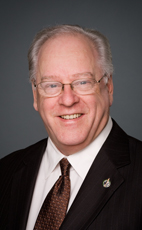
House of Commons photo

Crucial Fact

  • His favourite word was hamilton.

Last in Parliament October 2015, as NDP MP for Hamilton East—Stoney Creek (Ontario)

Lost his last election, in 2015, with 33% of the vote.

Statements in the House

Economic Action Plan 2013 Act No. 2 December 3rd, 2013

Mr. Speaker, I appreciate this opportunity to rise. I would have asked a question, except I have some issues I can pose to the entire Conservative caucus as opposed to any one individual member.

I want to start off by addressing the comments of the previous speaker about reaching a balanced budget by 2015. That is going to be much easier for the Conservatives because last year, as we understand it, there were $10 billion allocated in the budget they did not spend. There were people who were expecting monies, heritage and other places that was not spent. In other words, the Conservatives broke promises to people, which does not come as a great surprise. Therefore, hallelujah, they are going to announce that we have this money to put toward the deficit, so it is more important to meet this one target than it is to follow through on their commitments to Canadians and Canadian organizations.

I sat on the finance committee for a period of time through the last omnibus bills and all of the what I would call nothing short of craziness happened at committee as a result of the fact that so many things had been piled on top of the other that actually belonged, in our opinion, in other committees. With Bill C-4, the Conservatives are doing it again.

Of the last bills that came before that committee, Bill C-38, was the biggest one with which I was involved. It changed the Navigable Waters Act, the Environmental Assessment Act and all kinds of things that a person outside this place would ask what it had to do with the budget. The fact was it did not. It was just a tactic on the part of the government to jam things together to get it through as fast as it could, to keep it from being at committees where it could receive the proper scrutiny by members and the witnesses who could bring the expertise before the committee to fortify the situation.

Before the prorogation, we were dealing with Bill C-54 about the not criminally responsible. Some of the witnesses who came from the health community said that nobody in the psychiatric community was asked about that bill. All of this is symptomatic of what is happening with the government in the sense of not wanting to hear from anyone, MPs or anyone else.

My view and the view of the New Democratic Party is that committees are there to make bills better. We are there to help the government. The government brings forward a bill and we have a critique of it and recommendations, which are called amendments, never see the light of day because they are voted down at committee or motions are passed at committee to limit the time we have. If we do not meet that time allocation, anything that has not been voted on is deemed to have failed. Therefore, we could have a list of 25 good quality amendments and Conservatives will not even listen to them.

That anti-democratic aspect limits the ability of the sincere efforts of the House to try to improve legislation in a way that is just baffling. How in the world can Conservatives justify shutting out information, even if it is not from us? Information from the public or from experts in any given field relative to the budget or relative to those things that have been piled into the budget, how can they shut that down without giving it any consideration?

It makes us wonder what is behind the agenda. This is not new. As I said, it happened with Bills C-38, C-45, C-60. Other speakers today talked about the fact that all of those bills had some blatant mistakes that successive bills had to correct.

I am troubled again by the fact the Canadian Federation of Municipalities warned the current government and the previous government about a deficit in infrastructure to the tune of somewhere between $175 billion and $200 billion that needed to be taken care of now. Look at the situation with the bridge in Montreal, and we understand how desperate it can get really quickly.

It looks like some interim work has been done to repair the bridge and get the traffic flowing, but stepping back from that, we have almost $200 billion elsewhere in our country that deserves support. I believe the Minister of Finance has said that there is $800 billion of dead capital that businesses are holding onto for a couple of reasons. There is some sensibility to what they are doing because in 2008 they had trouble getting money from the banks. We had the lowest interest rates practically in the history of our country, so why was the government not taking 10-year bonds and partnering with the business community to start addressing some of the infrastructure needs?

In my community of Hamilton, we are near desperate on sewage. I hear of figures somewhere close to $200 billion of a deficit on Hamilton sewage. Basements of houses on certain streets in Hamilton flood every time there is a serious rainfall. They cannot even get insurance anymore. It is very clear for us.

The previous speaker made reference to temporary foreign workers. The figures I have may not be precise but they are certainly close. Two or three years ago we had roughly 240,000 new immigrants to Canada. They have support here. They have a sponsor who is responsible for all of their costs for 10 years, so there is no liability to us for them. However, in that period there were 241,000 temporary workers.

The temporary worker program was initially put in as support for the farmers. There was lots of work Canadians did not want to do and farmers needed help, and that program was originally set up to bring them in. Then all of a sudden, certain aspects of the business community woke up to the fact that they could pay temporary foreign workers less money and they would not have obligations to them. By the way, because they are here on a temporary permit, if they do not do exactly what they want, they get to go home really quickly. People from other countries come here. They are very dependent on money to help their families back home. It is a very insecure situation and they are being abused by the government and employers in Canada. That is shameful. There is no other word for it.

From my perspective, to hear the Conservatives talk about some modest change, I would love to have seen that at the immigration committee, to talk about temporary foreign workers and to look at that program in-depth, to step back from it and make some suggestions to help with that, but that opportunity was not afforded to us.

Going a little further on this, Bill C-4, as previous omnibus bills, piled together amendments to over 70 laws. One of them is the Public Service labour relations employment board act. That is a new addition. Another one is the Mackenzie gas project impacts fund act.

Why do we need a new act for labour relations when we have had labour relations in the country between the public service workers and the government for many decades? Why do the Conservatives suddenly need to change that? If we do need to change it, why is it not done through the appropriate department and the appropriate committee rather than a budget bill? It sounds like somebody is up to something. If I were a worker, with the number of cuts there has been to the public service workers already, I would be a little nervous just about the title of that bill.

Contained in Bill C-4 are very vicious anti-worker and anti-veteran measures. I never thought I would stand in the House of Commons in our country and say our government has anti-veteran policies.

The Conservatives have made changes to health and safety protection for workers. My time is running out and I have not even started my speech, but this is part of the give and take in this place. The last speaker spoke about some things that drew my attention to it, but if I have to close, I am certainly proud to close on defending veterans.

There is a Veterans Review and Appeal Board. We have seen day in and day out in the media of late where the ombudsman has spoken out in defence of veterans saying that they are not getting the health care or the protection they deserve and there are numerous budget cuts to that department. That is shameful. One thing Parliament must stand for is the veterans of our country.

This is an anti-worker, anti-veteran bill and it is absolutely shameful.

Health November 28th, 2013

Mr. Speaker, sadly, today we have learned that the Minister of Health has approved another addictive, easy to abuse form of oxycodone. Canadians all know that oxycodone abuse has destroyed families. There is a safer version, one that cannot be abused by addicts. Yet, despite pleas from Americans, who are trying to get oxycodone off the market and out of circulation, Canada's Minister of Health continues to approve the unsafe version.

Would the minister not relent and reconsider her approval for oxycodone?

Business of Supply November 26th, 2013

Mr. Speaker, with regard to the member for Saint-Laurent—Cartierville, I do not see that gentleman as a henchman. I see him as a duly elected member of Parliament doing his job.

I must say I was surprised to see so many Conservative MPs willing to risk or even sacrifice their personal reputations over this scheme that has come out of the PMO. I am reminded, and I am sure the member who just spoke is reminded as well, of the l970s, when a particular saying oozed out of Washington. It was called “plausible deniability”. This is the worst of times in this place because of that type of attitude.

However, my question to the member is this. He has listed off repeatedly the number of people in the Conservative Party from the PMO and from other places such as the Senate who are involved with putting together this scheme. Would he deem that to have been a conspiracy?

Cancer Awareness November 19th, 2013

Mr. Speaker, this past August 15 was a day our family will never forget, for that day my lovely wife Barb was found to have cancer.

A few short or long weeks later, depending on how one looks at it, after a short regime of radiation, she faced her surgery. Then came 13 bumpy days in hospital. Barbara returned home to several weeks of home care, and I was nurse number one. Then on November 11 we got the good news. The surgeon says they got all of the cancer, which brings me to the point of my statement today.

I want everyone here today to consider the situation. People have to be on their guard. Like a tactician, we have to know the enemy before the battle. Learn the symptoms of cancer. Get those colonoscopies, mammograms, and PAP smears. Gentlemen, after the PSA test when the doctor says, “Assume the position”, when they are finished, be sure to thank them because they may well be saving a life.

As for all of the people in this country and around the world living with cancer, may God bless them and keep them safe.

Fighting Foreign Corruption Act June 18th, 2013

Mr. Speaker, I want to thank the member for Saint-Bruno—Saint-Hubert for her remarks. Earlier the member for Winnipeg North was talking along the same lines and said that perhaps something could have been done earlier on this bill.

The member who just spoke was not in the House when Bill C-300 came before the House. I recall that night distinctly. The galleries were full of people from various NGOs and groups concerned about corporate social responsibility. It was debated when we had a minority Parliament. When the vote was called, despite the fact that it was a Liberal member's bill, it was lost, because 13 Liberals did not bother to vote.

We certainly have had an opportunity before to start addressing this.

Earlier I raised concerns that often we have NGOs trying to bring goods ashore to help people who are in difficulty. Often they are displaced persons or are even in another country. The NGOs have to pay an offloading fee or a tip, or we could call it a bribe. The reality is that those things facilitate getting that food ashore to help people.

Does the member see in this bill any concern about the fact that this might sideswipe the NGOs?

Fighting Foreign Corruption Act June 18th, 2013

Mr. Speaker, the speech from the member for Vancouver East, we would say is almost across the board. She has covered so many topics. However, when she started her speech she spoke of the fact that there have been so many time allocations in the House that our debate has been limited; I believe she said it has been 47 times.

The idea of this place and of committee is to take any bill that is put forward by anyone, be it a private member, government or the Senate, and to work together to try to make it better, yet what I find very troubling is that when we get into debate here, we oftentimes find that the government is not even engaging us. It asks the odd question, but government members are not getting up and giving speeches, putting forth a point of view and working back and forth on the bill.

In her remarks toward the end, she talked about NGOs that bring supplies to places, and refugees from Syria might be an example. They come into a country and NGOs have to pay a gratuity, a tip, or a bribe, whatever they want to call it, to get those goods off of the ship and onshore. That is a reality in the world. That is not something that is high level. Do you think that people would be sideswiped by that unintentionally?

Foreign Affairs June 14th, 2013

Mr. Speaker, for the past several weeks the member for Hamilton Mountain and I have been pressing the government regarding the case of two Hamilton men, Nick Miele, and his 18-year-old cousin, Ben Constantini, who have been behind bars in a Dominican jail since the early morning hours of May 28. Close family members are gravely concerned that these men are in ill health, and that they have not been afforded due process.

Will the minister inform the families of any progress in the efforts that are being made on behalf of these men?

Family Homes on Reserves and Matrimonial Interests or Rights Act June 10th, 2013

Mr. Speaker, we have just heard examples of real passion from two women who are speaking on an issue that is important to them. We should be respectful of that debate.

One of the concerns I have is this. I started reading the list of people who had expressed concerns with Bill S-2 such as the Native Women's Association, the Assembly of First Nations technical update of January 27, 2012, the National Aboriginal Women's Summit, Ellen Gabriel. I could go through a list of a number of people and groups who are concerned, including Dionne Schulze, Shawn Atleo, the Quebec Native Women, the Nishnawbe Aski Nation Women's Council, and there are more. I will not read them all, but the reality is that if we have that many people from that cross-section raising concerns with the bill, why would we not pause that extra bit longer and do it right to do the best we could to take those things into account? That is what I find difficult with this.

Tax Conventions Implementation Act, 2013 June 10th, 2013

Mr. Speaker, I want to thank the member for Burnaby—New Westminster for his speech and his passion, which he always shows.

One thing he highlighted in his speech was the $29 billion purported to be offshore now. Here is some news that came out recently. Heinrich Kieber, the whistleblower who brought this forward in 2007, offered the information to the Conservative government. The information is now being used by the British and the Americans. They paid a fee to Mr. Kieber to get that information. That could have been used in 2007-08 and going forward to prevent that $29 billion growing to what it is today, which is a national embarrassment.

Old Age Security Act June 7th, 2013

Mr. Speaker, like the previous speaker, I want to sincerely thank the NDP member for Laval—Les Îles. I was the critic for seniors and pensions following the 2008 election. Jack Layton asked me to take on this file. I travelled over the next two and a half years to 57 town hall meetings across the country. I listened to seniors and heard stories about how difficult it was for them to get along in society. They had contributed to this society, but in many ways, they were excluded from the benefits of society.

Before I go further, a previous speaker for the Liberals, the member for Saint-Léonard—Saint-Michel, talked about what the Liberals had done for seniors. I want to add a little more. Yes, the Liberals brought in OAS and CPP, but OAS was proposed to them by J.S. Woodsworth of the CCF, following the fact that on the Prairies, in those days, many farmers and their families were actually starving.

Again, in the 60s, in a minority situation in Parliament, Stanley Knowles, who was like the dean of this place, par excellence, brought forward the concept of the Canada pension plan. In both instances, we worked together to bring these forward.

I just thought it would be worth putting that on the record for people to hear to remind them of the participation and leadership shown by the CCF and the NDP in the House when it comes to seniors.

The member for Laval—Les Îles, who brought the bill forward, is actually moving forward on things we had in our 2011 platform.

I want to speak to a statement made in the House by a Conservative speaker about how they increased the guaranteed income supplement. Yes, they did do that, and we will give them some credit for that. However, in our proposals in the 2011 election, we proposed an increase of $200 a month for seniors on OAS and GIS who had a combined income of approximately $1,400 a month, just to bring some 300,000 of those folks to the poverty line.

I have spoken many times in this place of the hardships people face when they are on such a meagre income. Yes, the Conservatives brought in their $50 a month, but it is nowhere near what is needed to address the situation.

It has been stated by others in this place that it would benefit members to take the bill to committee to examine the pros and cons. If there are improvements we can make to the bill, that is the appropriate place to do that. However, we should think for a moment about the intent of the legislation.

The people I have spoken to and have listened to are in their senior years. I know that when members of their families pass away, and they are suddenly hit with $8,000 or $10,000 in costs, and for a number of reasons they have not set aside any money earmarked specifically for that but have perhaps put aside a little in an RRSP, to be able to take out $2,500 and put it toward that cost would take the edge off the stress during that time of loss.

It really needs to be stressed that it is not intended to do anything to replace the benefit from CPP, which some people are able to get.

There is another issue it is important to talk about. Some people who are on GIS have gotten part-time jobs and have earned a little money. The following year, after they have honestly filed their taxes and have brought that to the attention of the tax folks, their GIS has suddenly decreased. The provisions in the bill would ensure that this is not the case. In fact, their GIS would not go down, and they would not be penalized.

There is a reality, though. The bill says that the $2,500, when put to use, would have to have taxes paid on it. That is only fair to other Canadians.

Going back to the financial burden on seniors, oftentimes, when they have lost a lifelong mate, it is a burden. This is just a small way we can help these seniors deal with those times of trial.

Again, I spoke about the fact that in the 2011 election, my office and staff put together our platform on pensions and for seniors. I am very pleased to see the member for Laval—Les Îles bringing forward a concrete measure to this House in line with our thinking of that time.

I cannot say the same for the Conservatives. They are increasing the eligibility for OAS from 65 to 67, and adding another two years of burden on workers who perhaps works in a mine some place or as a waitress who has been on her feet all the time. I have had people actually say to me, “I do not know whether I can do it.”

I recall in my days at Bell Canada, there was a gentleman who worked to about 68 years of age. We were frightened every day, because he would go out and climb poles. He strapped spurs on his legs, and his legs were so spindly the spurs hardly even fit him properly. It was his choice to work that long. However, the government is saying, “You have reached 65 but you must work two more years” in either a hazardous job or one that is strain, like for the waitress. People just do not know how they are going to do this.

Some things are crucially important to seniors. We know how seniors tend to worry a bit more about some things in life, such as whether the kids in the neighbourhood are putting up too much graffiti. These things look larger to seniors. If the noise level of the party next door is too much, things like that bother them. We can imagine the feelings of loss of a family member, and then the additional sorting out of the finances. If this, in some small way, helps then I think it is well worthwhile.

Again, we are simply talking about sending this bill to committee to study. I look forward to our people from the NDP on that committee working with the government side. Perhaps there are ways to improve the legislation to make it better for seniors. We will be pleased to do that.

Some of the speakers on the government side today sounded somewhat reluctant. They have proposed some reasons why they have concerns about it. That is fair.

However, let us send it to committee so that it is studied properly. Experts can be brought in and we can look at this in a comprehensive fashion. Then, whatever comes back to the House will be as good a bill as we can possibly make it. I think it is a responsibility of all of us at committee. Sometimes we do not live up to that responsibility for a variety of reasons.

I want to stress that from those 57 town hall meetings that I attended, we brought notes back to my office and shared them with our colleagues. We set our agenda for the last election.

It also carries forward beyond that, because the problems that were there have not yet been addressed. For us, this is a continuation of ensuring that senior Canadians understand that they are a priority to the NDP. They should be a priority for this entire House.

There are some programs, like CPP or the Quebec pension plan, that have similar credits to this. Again, I want to stress this is not intended to compete with them in any way. It is intended for a very simple, direct purpose. It is to assist seniors in a time of need, both financially and emotionally.

I have brought up, a number of times in my remarks today, the importance of doing what we can to add peace to the life of seniors who have had a loss.