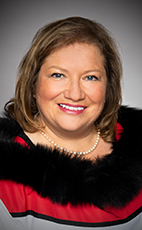
House of Commons photo

Crucial Fact

  • Her favourite word was indigenous.

Last in Parliament April 2025, as Liberal MP for Labrador (Newfoundland & Labrador)

Won her last election, in 2021, with 43% of the vote.

Statements in the House

Nááts’ihch’oh National Park Reserve Act October 2nd, 2014

Mr. Speaker, I have had the opportunity to travel across all of Canada's Arctic regions, including the Northwest Territories. I have not been into every community there, but I have had the opportunity to visit some of the towns and to meet with many different groups and organizations.

I know from living in the north about living in an area that is very much dependent on the natural environment around us to be able to survive socially and economically, but also to contribute to the rest of the country. I know that protecting the lands is a sacred thing because that is the kind of environment that I live in today, and I know that others in the Arctic share that as well. For us, without the protection of lands, without the protection of habitat and our natural environment, we know that we jeopardize the future of generations of our own people not just the rest of the people around us, so we always make a very conscious effort.

I will speak to the Nahanni Butte park, for example. The boundaries there have been expanded probably six times since the park was created, leaving us to believe that there was not appropriate land reservation for the protection of the ecosystem in that particular area. I would say for the government to pay attention to the aboriginal people and the advice they are giving, because when they are talking about expanding the lot of land to protect a certain portion of the ecosystem, I can guarantee that nine times out of ten they are the experts and they know what they are talking about.

Nááts’ihch’oh National Park Reserve Act October 2nd, 2014

Mr. Speaker, I am pleased to rise to speak in this debate. I thank my colleague, the member for Scarborough—Guildwood for sharing his time with me today. He is very generous.

Bill S-5 is really about expanding lands in the Arctic regions of our country. It continues a process that was started more than 10 years ago in this country by the Liberal government, and that is protecting different parts of Canada's north either through designation of national park areas or national park reserves. The Liberal Party has a long history of supporting the creation and expansion of our national park system in every part of the country.

We have a diverse geological environmental landscape, as we know, and we are very proud of that. It is one of the things that we continue to market as a country. In doing so, we also know that the animal species need to be protected and maintained in those areas, along with all of our agricultural species.

The Nahanni National Park Reserve was created in 1976, and I was reading that it was created by the Trudeau government. That would be a very proud legacy for the people in that particular area, as it would have been for many of the other parks that were created.

The Liberal Party has always been committed to the principles of habitat conservation. We must have regions in the Arctic of Canada that are dedicated to protecting and preserving our many species of flora and fauna, along with animal habitat. This particular reserve area, as was noted by others who spoke today, would certainly preserve the grizzly bear population, which has always been a national attraction in this country.

It is also important that we recognize the traditional lands and work in consultation with first nations groups before moving toward any of these particular designations. This is something the aboriginal people in the Northwest Territories, those self-governments in that particular area, have asked for. They have already seen the vision and the need to protect large reserves within and adjacent to their land claim areas to ensure that these lands are there for future generations to provide for those who live around them.

The Nahanni National Park is a great example of where we have seen aboriginal governments play a big role in the development of social and economic activity. We can only hope that the reserve that is now being looked at, the Nááts’ihch’oh reserve, would also some day be able to have those same opportunities.

I am sure there are very few national parks in this country that have mining developments. In the Nahanni National Park there is tungsten mining, all of it really being done in partnership with aboriginal governments. Almost all of the jobs in these mines are taken by aboriginal people and they have a large control over what is happening there, which I am very proud to say is a model that we could be using in a lot of other operations on aboriginal lands, which we do not see today.

I am very fortunate to have a riding where I am seeing the development of the Torngat Mountains National Park in Labrador. It was a process that started a very long time ago, as far back as 1969. It has been going on as long as I have been in the world. It took until 2005 for the park reserve itself to be established. We are now finally getting the agreement and consent of the Labrador Inuit people. We are seeing the vision of the Labrador Inuit people for this reserve land and how they want this national park emerge.

When their land claim agreement was finalized, soon after, in 2008, the Torngat transitioned into full national park status. That transition has taken them in large steps from that day to this, where they are seeing 10,000 square kilometres being developed. In fact, it is the largest national park in Atlantic Canada, and as Labradoreans, we are so proud of this. We are so proud of the unique area of this country that is being preserved in our homeland and being protected.

This year, in the Torngat National Park there were a lot of Inuit people who made the trek back to their original ancestral roots. There were a lot of schoolchildren who visited the park to learn about the environmental habitat of that particular park area, to learn the history of their ancestors. I can only hope that with what we are doing today with the Nááts’ihch’oh park reserve area, one day it will become a park and one day we will see those kinds of activities occurring in that region of the country as well.

I have had the opportunity to visit the Northwest Territories with my colleague in the NDP, who is the member of Parliament for the Northwest Territories, when we worked on the committee that was finalizing the land devolution agreement for that area. He is very passionate about what is happening in the Northwest Territories, and he is also very concerned that we do not have large enough areas of reserve in that area being protected. I understand, certainly, his view and his perspective, but I am sure as well he shares the tremendous excitement that exists there right now over the fact that they are able to create this reserve and are able to protect this entire area for future development.

Whenever we have those kinds of national park reserves and then they revert to national parks, there is also an expectation from people in the local area that it is not just an area of land that is protected, but it is also enhanced. It is an area of land that becomes a learning environment for all of us in Canada. It becomes a place where we can attract tourism, where we can attract development and infrastructure that will not damage the natural habitat and landscape but in fact enhance it and enhance the lives of the people who live there, allowing them to have good jobs and to have good programs and services in their area.

Oftentimes when these types of developments are done, they are accompanied with commitments from the federal government, commitments to provide for that learning environment, to provide for that infrastructure. I can only hope that it will happen in this case that people in this area will not just have a reserve area that can only be accessed or used by people who have deep pockets, but it will be a place of cultural learning and experience, a place where we can really promote this country and allow the people, the aboriginal people in particular who have ownership in these regions, to have real prosperity and growth.

I will conclude, but I just want to say I am very pleased to support the creation of this national park reserve. I hope that we can find new ways, great ways, to protect and preserve vital parts of this country for future generations.

Nááts’ihch’oh National Park Reserve Act October 2nd, 2014

Mr. Speaker, this particular bill is obviously favoured by people in the Northwest Territories, especially people who live in the Nahanni park area. I have heard many wonderful things about this particular area and the great work that has been done by many of the aboriginal governments in that particular area.

Whenever we build reserves or expand reserves like this in different regions of the country, obviously we do it to protect our natural habitat and our natural environment, but in many cases there is also an expectation by aboriginal groups for some real social and economic development as a result of it. So far, this is not happening in this particular region.

I am wondering if the government is really serious about investing here to ensure that development happens for the people who live there.

Aboriginal Affairs September 30th, 2014

Mr. Speaker, it is disappointing to hear of the government once again playing political games, this time repeatedly cutting funding to the Native Women's Association of Canada.

This is no surprise, given the lack of respect the government has shown toward first nations individuals in our country.

Could the minister tell us if these cuts are the result of the women's association's push for an inquiry into missing and murdered women and girls in our country, or is there some other rationale that the government can give us for these cuts?

Business of Supply September 29th, 2014

Mr. Speaker, we cannot speak out on both sides of this issue. Either we support what is happening in the House of Commons right now, or we support reforming it.

One of the things that is expected of cabinet ministers, as documented by the Prime Minister's own guide, is that they answer questions in the House in a way that is informative and honest. This motion would give the Speaker some power to ensure that is the case and that it is actually followed.

Why would the member not support the motion that is tabled here today? The alternative is that you agree with the kinds of actions we have seen in the House and the responses coming from some of your colleagues over the recent days.

Business of Supply September 29th, 2014

Mr. Speaker, I heard the member for St. John's South—Mount Pearl's speech, and I know we are dealing with a motion on the floor today that is talking about conduct in question period. I am assuming the member is supporting the motion. I do not know if he gave any justification as to why he thinks we need to do this. I heard about his fishing trip off Petty Harbour, but I did not hear a lot with regard to this particular motion.

Why does the member feel that the motion should be passing on the floor of the House today? I would like to say that I hope he used feather bait and not a jigger when he was down on Petty Harbour.

Business of Supply September 29th, 2014

Mr. Speaker, I would like to thank my colleague for bringing forward this motion. We all realize in this place that there needs to be change in the way that things are conducted in question period. We very rarely get answers to important questions that are asked on behalf of Canadians in this country.

Does my colleague who just spoke to this particular motion feel that the government has made any effort, in light of what transpired in the House last week, which ended in a teary-eyed apology, to provide better-informed answers to the Canadian public?

Business of Supply September 16th, 2014

Mr. Speaker, I thank my colleague for his remarks today and the motion that he has put forward.

I think all of us in the House will agree that no family or individual should ever live in poverty in this country. We are a country of tremendous wealth and opportunity. However, we know that those cases do exist, and I think that, wherever possible, government has to show leadership to industry, business and society in general that doing the right thing always pays off.

I would ask my colleague today how many people employed within the federal service work for less than $15 an hour. How would this increase impact these individuals if it is to be rolled out only over a period of five years? Will the inflation rate at that time have contributed to the necessity of a higher increase in wage?

Questions Passed as Orders for Returns September 15th, 2014

With regard to National Defence: (a) what were the projects, proposals, plans, or developments which were to have been the subject of the anticipated “announcements” concerning 5 Wing Goose Bay contemplated or referred to by the former Minister of Intergovernmental Affairs in an interview with CBC Newfoundland and Labrador On Point which aired on or about May 26, 2012; (b) were those announcements ever made, and if so, what were they, and when were they made; (c) if those announcements were not made, (i) what progress has been made towards the projects, proposals, plans, or developments contemplated in (a), (ii) when will they be made public; and (d) what steps have been taken since January 2006 towards the establishment at the base of (i) a rapid reaction battalion, (ii) an unmanned aerial vehicle squadron, (iii) any other unit, facility, or function which was not already established at the base on January 1, 2006, specifying the nature of that proposed or anticipated unit, facility, or function?

Questions on the Order Paper September 15th, 2014

With regard to corrections, since November 27, 2012: (a) has any department or agency conducted any review or assessment of physical conditions, practices, policies, or any other matter, pertaining to (i) the Baffin Correctional Centre in Iqaluit, Nunavut, (ii) correctional services in Nunavut in general; (b) what are the details, including dates and file numbers, of each such review or assessment; (c) has any department or agency conducted any review or assessment of physical conditions, practices, policies, or any other matter, pertaining to (i) Her Majesty’s Penitentiary in St. John’s, Newfoundland and Labrador, (ii) correctional services in Newfoundland and Labrador in general; and (d) what are the details, including dates and file numbers, of each such review or assessment?