
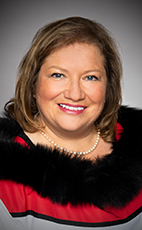
House of Commons photo

Crucial Fact

  • Her favourite word was indigenous.

Last in Parliament April 2025, as Liberal MP for Labrador (Newfoundland & Labrador)

Won her last election, in 2021, with 43% of the vote.

Statements in the House

Natural Resources May 9th, 2022

Madam Speaker, I want to thank my hon. colleague from Saanich—Gulf Islands for raising the issue. I want to say, from the outset, that I understand her question completely but I also know that she understands that there is a process. During that process that the government is taking with Baffinland, she knows that we should not be interfering politically. I want to be clear from the outset that our government supports a strong resource development sector in the north, one that is sustainable and that creates opportunities for indigenous and all northerners but respects the environment and respects the interests of the people who live there.

I want to assure members, from the outset, that the review of this proposed development has been led by northerners from day one. It has followed the environmental review process that is outlined in the Nunavut Land Claims Agreement, and this process is guided by the Nunavut Planning and Project Assessment Act. Through this process, the Nunavut Impact Review Board, or NIRB, has been ensuring that Inuit and other indigenous partners have been consulted. NIRB has also worked very hard to balance public health during COVID-19 and other issues throughout the review while also ensuring that the Inuit voices have been heard. As part of the review process, members of potentially impacted communities in the Baffin region, some of whom I have talked to myself, have had the opportunity to make their views known.

Public hearings that have been held by NIRB began in November 2019. The process has been ongoing since that time. While the pandemic delayed the process and some meetings had to be rescheduled, NIRB completed its hearings in January of this year. The board is now preparing its final recommendations, which will be presented to the minister and the department very shortly.

Throughout that whole process, however, residents have been able to both learn about the proposed project and give their feedback and input into the project, and NIRB has gone to great lengths to ensure that Nunavummiut have had the chance to participate in or watch the proceedings. In addition to that, many federal officials have participated in every step of the review, including the final public hearings and a community round table, which was completed last fall.

Once the NIRB report and the final report's recommendations are presented to the government, the responsible ministers will make the decisions that they are requested to make using due diligence and a very comprehensive decision framework. The member knows that the process is very clear, very defined and very transparent. We will not prejudge the outcome or the process and we look forward to receiving the board's report.

Natural Resources May 9th, 2022

Madam Speaker, our government recognized our role in global energy security long before this tragedy started to unfold and long before the member opposite stood in the House of Commons. In fact, energy security was front and centre for the Prime Minister and President Biden back when they met in February of last year. It was put forward in writing in the accord that was struck, called the “Roadmap for a Renewed U.S.-Canada Partnership”. The member opposite knows this.

The member also knows that our government has endorsed projects that advance security, including the Line 3 replacement, LNG Canada and the TMX pipeline expansion. We are the government that has been moving these projects forward because we know they are critically important. We are also—

Natural Resources May 9th, 2022

Madam Speaker, the ongoing tragedy unfolding before our eyes in Europe is one that I know everyone is concerned about. Regardless of political persuasion, we are all sickened by what Russia is doing to its neighbour, so it is no surprise that this is one of those issues before Parliament where opposing parties sometimes will largely agree.

For one thing, we share the view that this war represents a defining challenge for the democratic world. We also agree that Canada must work with allies to provide equipment to help Ukraine's brave soldiers fight off this unprovoked aggression. All parties support the democratic world's punishment sanctions: a package that includes a Canadian ban on imports of oil, gas and other petroleum products from Russia. Furthermore, we are united in doing everything we can to deal with this humanitarian disaster.

We also share the member opposite's belief in the critical importance of energy security, and the need for Europe and the world to reduce and eventually eliminate its dependency on Russian oil and gas. There is nothing here that he needs to convince us of. It is clear that the world must stand up to Russian aggression, and that is what we are doing. We are taking all the measures I have just cited, and are working closely with our allies to help Europe wean itself off of this dependency.

I would invite the member to consider our government's work with industry and provincial governments. The Government of Canada has identified Canadian industry capacity that can increase production by up to 200,000 barrels of oil and the equivalent of 100,000 barrels of natural gas. These exports will give America, now the world's largest LNG exporter, more leeway to export its petroleum products to Europe and other markets.

I would agree that this alone is a relatively small proportion of the amount of Russian oil and gas that we have to displace, but solidarity matters. The U.S., Brazil and other nations are also stepping up. We would once again urge members opposite to consider the International Energy Agency's 10-point plan to end its dependency on Russian gas. It includes moving Europe more aggressively toward alternatives, such as increased imports of LNG, renewables and hydrogen, and that is exactly what we are doing with our climate plan. It is one that includes a strategy to build a Canadian hydrogen industry that could help fill this void. On that note, I am pleased to say that Germany's ambassador recently referred to Canada as a potential hydrogen superpower.

What I just outlined really illustrates why it would be the worst time to abandon Canada's clean energy transition. We all have a job to do here. We all need to step up to protect the interests of Canadians, but also the interests of allies around the world.

Atlantic Canada Craft Awards for Excellence May 5th, 2022

Mr. Speaker, many were recognized at the 2022 Atlantic Canada Craft Awards for Excellence, and I would like to give a big shout-out to the entrepreneurs from Newfoundland and Labrador who won several prestigious awards.

The Craft Council of Newfoundland and Labrador was awarded for excellence as an industry leader. The award recognizes superior leadership in the development of craft and contributions to the industry in Atlantic Canada. Through the efforts of staff and volunteers, the organization has found new and exciting ways to promote craft-makers, creating new opportunities and new markets. I recognize the exceptional work of Ms. Rowena House, Ms. Shannon Reid and Mr. Bruno Vinhas and their team.

I also acknowledge the Newfoundland Salt Company, which was named recipient of the award for Outstanding Exporter. Peter Burt and Robin Crane have taken pride in their products. The company sends their finer salts to 18 restaurants throughout the province and to over 40 restaurants across the rest of Canada.

Closer to home, the incredible craft boutique of Slippers 'n Things in Happy Valley-Goose Bay received the Outstanding Retailer award. I congratulate Mike Voisey and his daughter Natasha, who continue to showcase the Labrador culture through crafting and design with their handmade slippers. They use traditional patterns that have been passed down through generations of the Voisey family. Their products are unique and a sense of pride for all the people of Newfoundland and Labrador.

Missing and Murdered Indigenous Women and Girls May 4th, 2022

Mr. Chair, the real information we need is the stories of victims and the stories of families. Many of them could only enable themselves to tell their stories with the health supports and victim support services that they have around them.

That is why the National Inquiry into Missing and Murdered Indigenous Women and Girls was so important. It was important so we could lay out the investments that were needed, not only to get to the root causes that contribute to the tragedy of missing and murdered indigenous women and girls, but also for the health supports and the victim services that are needed in so many communities, and the infrastructure that is needed. That is the road we are on. I just wish we could, in society, take that road a bit faster than we have been.

Missing and Murdered Indigenous Women and Girls May 4th, 2022

Mr. Chair, I thank my colleague for pointing out that violence against women and girls is not sector-related. It is happening in all aspects of society. I think we all recognize that, and we all have a responsibility to do what we can to end it. That is our job here as parliamentarians. That is what Canadians look to us to do.

In terms of human trafficking, the story of human trafficking around the world is one that we all look at with tremendous sorrow. We wish that we could stop it today and that we had the means and ways to end it in every single aspect of the world that we live in. We have many tools available to us to be able to do that. It is a matter of having the ability and resources to stop it before it happens. Educating people and making sure we have the right stops in place to stop human trafficking before it can start is the path we need to be on now, a path that really singles out perpetrators, as well as others who could be involved.

Missing and Murdered Indigenous Women and Girls May 4th, 2022

Mr. Chair, my colleague from Saanich—Gulf Islands always provides insightful thoughts in her questions in the House of Commons.

I am open to looking at all aspects of society that infringe upon the rights of women and girls. No woman, no girl, no individual should ever feel unsafe within their homes or communities. Whether that perpetration comes from within family, community, workplaces or any form or aspect of the society we live in, then we have a responsibility to address that.

I would tell my hon. colleague that I am always open to learning where harm is being done and doing my part to correct it.

Missing and Murdered Indigenous Women and Girls May 4th, 2022

Mr. Chair, first, I want to acknowledge that Canada's Parliament is located on the traditional and unceded territory of the Algonquin Anishinabe people, a very proud people.

I also want to take a moment to recognize all of the indigenous partners who have worked so hard to bring together in their communities the commemoration of Red Dress Day.

We are here this evening to debate a very important issue. It is an integral part of this government's efforts in the shared journey of reconciliation with indigenous people.

Tonight, I have listened to many of my colleagues on both sides of the House as they have spoken. They have spoken with tremendous insight and understanding. They have spoken after listening. They have spoken with action, and I truly appreciate their words. The violence that indigenous women and girls have suffered and the pain that this has caused survivors and their families is an injustice that has ripped at the very fabric of indigenous communities, of communities like mine.

Tonight, I would like to read into the record the names of some of those sisters who have been stolen in Labrador, some of the missing and murdered indigenous women and girls we continue to mourn everyday, whose families suffer. They suffer silently, they suffer in communities and they suffer while holding close in their hearts those whom they love and now miss: Nellie Broomfield, Dina Semigak Igloliorte, Molly Pardy, Daphne Mesher Brown, Anne Hilda Abraham, Sharon Murphy, Henrietta Millek, Hannah Obed, Pamela Asprey, Elaine Flowers, Dr. Mary Kerohan, Deborah Careen, Joanna Andersen, Misty Dawn Boudreau, Deirdre Marie Michelin, Marguerite Dyson, Mary Evans-Harlick, Sarah Obed, Kimberly Jararuse, Martina Ford, Bernice Joan Rich, Katie Obed, Loretta Saunders and her unborn baby Saunders, and Regula Schule.

What we do to support missing and murdered indigenous women, to help end the suffering of families, to rise up wherever we can, all indigenous women in Canada, we do in memory of women like those whose names I have read into the record tonight, women I have known whose lives are lost and whose families continue to suffer.

In our culture we have a ceremony. It is the lighting of the sacred qulliq, which is a traditional Inuit soapstone lamp. My colleague from Nunavut would know of it and practise lighting it in her culture very well. It honours the fact that women are the life carriers. It raises women up. It holds them in a place where they are teachers, where they show the strength and resilience to lead the way that is best for their families and for their communities.

As a government, we have a responsibility to shine a light as well. To shine a light on the injustices is our responsibility. I say that our government has been shining that light. We have been moving forward with missing and murdered indigenous women by providing different encouragement and investments as they have been identified through our dialogue and through our process of reconciliation. We will continue to do that in the path forward with each and every one of them.

I ask my colleagues to learn more, to share more and to continue to advocate more, because in doing so we are saving lives and saving heartache and grief for so many families in indigenous Canada.

Missing and Murdered Indigenous Women and Girls May 4th, 2022

Mr. Chair, my colleague, like myself, represents many indigenous women, who have sought and persevered through great challenges and sacrifices in their lives. They have grieved the loss of so many among them. I also know she understands that reconciliation does not come easy.

It is a very difficult conversation, and it requires a tremendous commitment of government, one that our government, for the first time in history, has stepped up to do. The member talks about next steps and what needs to happen. I would ask her to tell the House today, if there were one thing she could do on this path to help missing and murdered indigenous women and their families who are suffering, what would that one thing be? What would she pose to the government and to the House of Commons this evening that needs to happen?

Indigenous Law Graduates April 28th, 2022

Mr. Speaker, it is a pleasure to rise today to commemorate the first graduates of the University of Victoria's indigenous law program. These 23 trailblazers are graduating with a joint degree in Canadian common law and indigenous legal orders.

In highlighting the accomplishments of these incredible students, I want to acknowledge Jolene Ashini from the Sheshatshiu Innu First Nation, the first Labrador Innu woman to earn a law degree. Jolene was drawn to the study of law through her late father's work as a leader with the Innu Nation. She noted that this program was something she needed, because it was tailored to her idea of indigenous justice and advancing culturally significant law.

We are proud of Jolene and her 22 colleagues for being the first indigenous law graduates from the University of Victoria. We look forward to seeing how their courage, their expertise and education will advance reconciliation and create a stronger Canada for all of us.