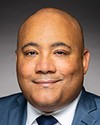
Evidence of meeting #23 for Agriculture and Agri-Food in the 45th Parliament, 1st session. (The original version is on Parliament’s site, as are the minutes.) The winning word was fcc.

A video is available from Parliament.

On the agenda

Members speaking

Before the committee

Heath MacDonald  Minister of Agriculture and Agri-Food
Hanson  Deputy Minister, Department of Agriculture and Agri-Food
Hendricks  President and Chief Executive Officer, Farm Credit Canada
Baccus  Executive Vice-President, Agri-Food, Alliances and FCC Capital, Farm Credit Canada
Mitchell-Beaudin  Executive Vice-President, Finance, Farm Credit Canada

The Chair Liberal Michael Coteau

[Inaudible—Editor] until I recognize you by name or you are asked a question directly by a member.

For those on Zoom, at the bottom of your screen you can select the appropriate channel for interpretation: floor, English or French. Those in the room, you can use the earpiece and select the desired channel. I will remind you that all comments should go through the chair.

Pursuant to Standing Order 108(2) and the motion adopted by the committee on Tuesday, January 27, 2026, the committee is resuming its study on the subject matter of clause 223, division 8 of Bill C-15, the budget 2025 implementation act, number 1.

I'd like to welcome our witnesses joining us here today. From Farm Credit Canada, we have Justine Hendricks, CEO and president; Corinna Mitchell-Beaudin, executive vice-president; and, in person, Darren Baccus, executive vice-president.

Thank you so much for being here. You have five minutes to make your presentation, and then we'll open it up for questions from the floor.

Justine Hendricks President and Chief Executive Officer, Farm Credit Canada

Good afternoon.

Thank you for inviting me here today. I'm very grateful for the opportunity to celebrate this great industry and the extraordinary people who make it all succeed.

FCC exists to support Canada's agriculture and food industry and the millions of Canadians whose livelihoods depend on it. That is our mission, and it's huge. This is our biggest manufacturing sector. It employs one in nine people in this country, and it accounts for 7% of our GDP.

Allow me to offer some examples of the amazing work our customers are doing. Take the operation in Elm Creek, Manitoba, where an FCC client is using robots to milk their 1,300 cows. The cows wear computerized collars to monitor their movements and health. It is state of the art.

There's a farm in Guelph, Ontario, that's pioneering indoor agriculture. Imagine the difference that can make in places where sunshine and farmland are in short supply.

There's also a company in Saint-Hyacinthe, Quebec, that's one of the leading producers of veal in North America and the second-largest sheep processing company on the continent. It's the future of agriculture in real time.

Demand for our services is strong. Over the past 15 years, we have tripled our book of business to $63 billion, and we're on pace to hit $85 billion by 2030.

In the past three years, total assets are up 24%, and 85% of our loans are $1.5 million or less, meaning about 60,000 loans in the book. That represents a lot of Canadian families. FCC exists to support these families' success.

Consider our small team in Brooks, Alberta. Last year, they lent $67 million to producers in that area. In addition to supporting our customers, that infusion into the community supported 275 jobs in Alberta and 148 additional jobs across Canada.

In fact, last year, Farm Credit Canada disbursed $19.9 billion, which helped our industry add $14 billion to the country's economy and support nearly 137,000 jobs.

I want to stress this: We are internally funded, meaning that FCC receives no money from taxpayers. In fact, we generate a reliable annual dividend to our sole shareholder, the Government of Canada, and we reinvest profits to benefit farmers and ranchers. As you know, there's no standing still.

In recent years, investment in the industry has lagged and so has productivity growth. We're evolving fast, improving our lending and other services while also igniting strategic innovation and investment. We are simplifying our lending process to serve customers more quickly and efficiently. We've redesigned our transition loan to help producers plan succession. We've introduced Root AI, our free virtual farm assistant, to help farmers solve problems on the go.

Our new FCC Capital unit is rolling out flexible financial products and proactively drawing private capital to the industry. Just since 2024, FCC Capital has directly invested more than $300 million in ag-tech innovation. Let me be clear: Every dollar FCC invests is for the ultimate benefit of farmers and ranchers. Our commitment to this industry is long term.

Last year, we pledged to invest $2 billion by 2030 to propel innovation and productivity growth. Earlier this week, FCC convened private investors who jointly pledged $5 billion of new investment in this sector by 2030. That's $7 billion by 2030. It is the biggest dollar commitment to Canada's agriculture and food sector—certainly in my lifetime.

Everything we're working on at this time is intended to support the success of this industry and the millions of Canadians who contribute to its growth. They won’t be the only ones to succeed. It's essential for Canada.

Canada is a major exporter of food products, sending goods to over 190 countries. We're working tirelessly to support this industry as it diversifies its activities internationally.

We know the stakes for Canada now are as high as they have ever been. I'm here to tell you that FCC is on it.

Thank you for listening. I look forward to answering your questions.

The Chair Liberal Michael Coteau

Thank you very much.

We'll go to the Conservatives for six minutes.

Go ahead, Mr. Barlow.

12:10 p.m.

Conservative

John Barlow Conservative Foothills, AB

Thanks, Chair.

Thanks, Mr. Baccus and Ms. Hendricks, for being here.

You said that every dollar that FCC profits from is to benefit farmers and ranchers. That was your commitment in your opening statement. I have to question that, Ms. Hendricks, when you have allocated in your time more than $64 million to outside consultants and $5 million to sole-source contracts at a time when you were saying every dollar is to benefit farmers and ranchers. At the same time as you have spent $64 million on consultants, the executive team at FCC has almost doubled from 25 to 45 people.

Can you table with this committee the job description of each one of those members of the senior leadership team and their salary? Can you explain, in a time of financial restraint when every dollar is supposed to be benefiting farmers and ranchers, why you are spending $64 million on consultants and, at the same time, doubling the leadership team? Why do you have to do both? Is the leadership team not doing their job?

12:10 p.m.

President and Chief Executive Officer, Farm Credit Canada

Justine Hendricks

Let me start off by highlighting that, with the size of an organization such as FCC and the risks in the market that are increasingly becoming more complex, it's important for an organization such as FCC to stay on top of some of those risks. Many of those contracts that are awarded are to help FCC navigate some of those risks such as technology and cyber. In order to make sure we keep up with that, we have dedicated some dollars, yes, to transformation, and part of the result of those transformation dollars has resulted in the announcement we received earlier this week.

I would like to also state that, of the 300 contracts we award on an annual basis to help run our business, 98% of those contracts are awarded on a competitive basis.

I would like to give the opportunity to our chief financial officer, Corinna Mitchell-Beaudin, to talk to you a little bit about how we assigned those contracts.

Go ahead, Corinna.

12:10 p.m.

Conservative

John Barlow Conservative Foothills, AB

I don't need to know how you assigned those contracts. The fact is that you spent $64 million on contracts at the same time as doubling your leadership team. To me, it's one or the other, not both.

Ms. Hendricks, I'm sure you're expecting this question. In a video call with your staff, when you were asked which leader you admired most, you stated Fidel Castro. You said that you admired his courage and how he stuck to his values, his rage and his tenacity. On admiring a communist dictator who imprisoned journalists, academics and political opponents and perhaps murdered tens of thousands of his own citizens, do you think it's appropriate for the CEO of a Canadian Crown corporation to be emulating a dictator like Fidel Castro? Do you regret those comments?

12:15 p.m.

President and Chief Executive Officer, Farm Credit Canada

Justine Hendricks

My biggest role model is my mother. I misspoke at that meeting.

12:15 p.m.

Conservative

John Barlow Conservative Foothills, AB

I find it hard to believe you misspoke at that meeting, because you've had quite a long.... I could give you the transcript of your description of why Fidel Castro was an idol.

I would hope that you would write a letter to the staff at FCC and apologize for those comments. That is not a leader you should be emulating. Certainly, from the dozens of emails and letters we've had from FCC staff who are talking about the toxic culture within your agency, perhaps there is some concern that those leadership tendencies have trickled down to FCC.

More to a specific case and again because you talked about how every dollar is to benefit farmers and ranchers, FCC gave Aspire Food a $40-million loan, of which you have recovered $15 million. What has happened to the additional $25 million? Is that going to be recovered by FCC? Who signed off on that agreement? Is someone going to be held accountable for losing $25 million of FCC money?

12:15 p.m.

President and Chief Executive Officer, Farm Credit Canada

Justine Hendricks

I would like to give Darren Baccus, who heads that division of ours, the opportunity to provide an answer to you in regard to Aspire Food.

The Chair Liberal Michael Coteau

You have a minute and a half left.

Darren Baccus Executive Vice-President, Agri-Food, Alliances and FCC Capital, Farm Credit Canada

Thank you to the committee for the opportunity to speak on behalf of FCC for the Canadian food and ag industry.

Regarding Aspire Food, as you correctly stated, we did recover $15 million from that file. The file is currently still open, and due to confidentiality and commercial sensitivities, we're not able to speak with further details on that file.

I do wish to assure the committee that FCC applies rigour and governance, both in its initial investments and the asset management of the investments, and to ensure that the maximum recovery occurs should some of these investments meet challenging times.

12:15 p.m.

Conservative

John Barlow Conservative Foothills, AB

Thank you, Mr. Baccus.

I would be concerned that you're saying that due diligence was done before this loan was agreed to, and yet neither one of you is taking responsibility for who signed off on it. The fact that this company went bankrupt within a year shows me that you did not do your due diligence to find out if there actually was a commercial market for the product that Aspire was making, which is a cricket protein. Had you done your due diligence, I think you would have seen there was no market.

With my last few seconds, Ms. Hendricks, I want to highlight that prior to your time, the Liberal government invoked the Emergencies Act. During that time, we asked FCC if any lists of Canadian farmers, or clients of FCC, were shared with the government to hold them accountable for participating in or potentially funding a peaceful protest. FCC said that did not happen.

After we did some additional research and access to information requests, we found out that FCC did keep that list and did share it with the Liberal government. Are there now mandate changes or rule changes within FCC that a Crown corporation will not share confidential information from its clients with the government? Have those members been told that their information was shared?

The Chair Liberal Michael Coteau

We're going to the Liberals for six minutes.

MP Dandurand.

Marianne Dandurand Liberal Compton—Stanstead, QC

Thank you very much, Mr. Chair.

I thank the witnesses for being with us.

Ms. Hendricks, frankly, I want to start by thanking you for your work. I represent a region in the Eastern Townships with a large number of farmers. I'm regularly told how grateful they are for the work of your representatives in the field and how much it helps them. I thank you.

One thing I notice is that, in the fall budget, agriculture is referred to as one of Canada's strategic industries. Farm Credit Canada was given more resources to support our farmers.

Can you tell us a bit about the funding you received and how you'll support agriculture to keep it a strategic sector?

12:15 p.m.

President and Chief Executive Officer, Farm Credit Canada

Justine Hendricks

I'd like to start by sharing the new strategy we've implemented over the past two years. It has three pillars. This will answer your question about how we can do more for a sector that has so much potential.

The way Farm Credit Canada wants to intervene in the market is first by being bold; second, by playing our role as a catalyst; and, third, by ensuring that we always maintain a balance between the short term and the medium or long term.

When I say being bold, I'd say it's about coming up with new products and solutions.

With respect to your question about how to use funding announced in the budget to see how we can deploy more resources, it’s about us being able to really understand and grasp what the challenges are for farmers of all ages. It's also about seeing how an organization like Farm Credit Canada can offer its funds or products to maximize the success of the products created.

It’s also about playing our role as a catalyst. I would note the announcement earlier this week about the creation of a coalition of investors who we’ve brought together. This is an example of the efforts our organization can make to bring together industry stakeholders. I want to stress that, in this case, these are investors who were not necessarily involved in agriculture and agri-food, and that really changes things.

These are two examples of how we're able to do more.

Marianne Dandurand Liberal Compton—Stanstead, QC

Thank you very much.

Farmers I regularly talk to in my area are from the next generation, members of the Fédération de la relève agricole du Québec and also members of the Syndicat de la relève agricole de l'Estrie. We have many young people who want to get into agriculture, and the first thing they tell us is how difficult it is for them to access financing and acquire a farm.

I'd like to know a bit more about how Farm Credit Canada can help them. How can you support them more in the future with the money allocated to you by the government?

12:20 p.m.

President and Chief Executive Officer, Farm Credit Canada

Justine Hendricks

To answer your question, I'd like to take this opportunity to tell the committee about a new product we've created: a transition loan.

We already had a transition-focused product on the market, but as the committee members know very well, the value of land and the cost of production are so high that it's hard for the next generation to finance these transactions. That is why we created a transition product, and I'll use a mortgage analogy to describe it.

As you know, when you take out a mortgage, you're young and it's to buy your first home. In the first years, often the first 15 years, you're primarily paying interest before you start paying down the principal. With the new transition loan, we did the opposite. We set it up so that the principal is paid first to minimize the interest. For example, a loan to purchase a farm for about $5 million would save almost half the value of the loan in interest thanks to the new product we just launched. It's only been a few months, but we're already hearing from the market that it's greatly improving things.

Marianne Dandurand Liberal Compton—Stanstead, QC

Thank you very much. I'm glad to hear that. I’ll certainly talk about it a lot with the people in my area.

I have one last question, because we have little time left.

In my opinion, diversity in agriculture is largely about youth and a lot about women. I’m very close to an organization called Women Farmers of Quebec, which you’re also familiar with, because I know you work a lot with women in agriculture.

We just talked about youth. Can you tell me about the support you provide to women in agriculture?

12:20 p.m.

President and Chief Executive Officer, Farm Credit Canada

Justine Hendricks

Certainly.

First, I’d like to mention to the committee that 25,000 of Farm Credit Canada’s 103,000 clients are women. We're very proud of that.

I can tell you that our portfolio, if I take Mr. Baccus's portfolio, which is more in investment here than in primary agriculture, is about half a billion dollars. We'll certainly provide the right financial solutions, and there's also the whole advice and support component that we're putting in place. We also often organize summits across Canada, by province. As a result, each market segment can get together to engage in dialogue and learn from each other. We’re very proud to be able to bring in examples or experts who can share their experience. We do it not only from a financial standpoint, but also from a consulting perspective, and we’re able to bring these communities together throughout the year.

The Chair Liberal Michael Coteau

Thank you very much.

We'll go to the Bloc Québécois for six minutes.

Mr. Lemire.

Sébastien Lemire Bloc Abitibi—Témiscamingue, QC

Thank you, Mr. Chair.

Ms. Hendricks, since we’re on the subject, I’d like to ask you a similar question, but from a different angle.

On page 48 of annex 6 of the 2025 budget, there’s a description of the changes to the Farm Credit Canada Act, and it’s stated that a legislative review is important because farm operators are predominantly older white men.

Why was that put in the budget? Shouldn’t we help farmers, regardless of their age, gender, race and so on, without discriminating? Why was it important to specify that?

12:25 p.m.

President and Chief Executive Officer, Farm Credit Canada

Justine Hendricks

Thank you very much for the question.

That part of the budget is an exercise by the department. That concept or the exercise carried out, which was intended to look at considerations, does not concern us directly. As a result, I can’t share an opinion or give advice in that respect.

Sébastien Lemire Bloc Abitibi—Témiscamingue, QC

The Department of Agriculture and Agri-Food justified the closure of research centres by stating that the government can’t be the only one investing in innovation.

Do you share that opinion? Do you believe that science and research should rest on the shoulders of agricultural producers? What solutions are you proposing in terms of science and research?

February 12th, 2026 / 12:25 p.m.

President and Chief Executive Officer, Farm Credit Canada

Justine Hendricks

Thank you very much for the question.

At Agriculture and Agri-Food Canada, we strongly believe that there’s a direct link between investment in innovation and increased productivity.

As for how Farm Credit Canada is able to support innovation, I’d like to share a statistic with you. If we compare ourselves to our neighbours to the south in terms of investment in technology and innovation in agriculture, the ratio is 23 to 1. There are several components to Farm Credit Canada. We’re establishing many partnerships with learning farms to support farmers, so they can come together or so we can test new technologies.

We also sometimes work with research organizations to try to advance and accelerate research and technologies. We really see ourselves as a catalyst in this respect, by being able to balance that innovation and how our organization can support innovation, which is directly related to an increase in productivity, and that’s what we’re trying to achieve.

Sébastien Lemire Bloc Abitibi—Témiscamingue, QC

I was indeed going to cite your analysis, which shows that there is 23 times more investment in venture capital in the United States. Their population is 8.5 times ours. There’s therefore a major impact.

How will your funding or measures help in understanding the factors that affect the diversity of agricultural conditions across Canada?