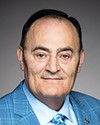
Mr. Chair and honourable members of the subcommittee, thank you for the opportunity to testify. I am pleased to offer insights about the Islamic Republic of Iran's transnational repression on behalf of the Foundation for Defense of Democracies, a non-partisan research institute in Washington, D.C., where I serve as a research fellow and senior editor.
Iran and the Islamic Republic of Iran are not the same entities. Iran, not the Islamic Republic, denotes the historic, millennia-old civilization of Persia, rooted and manifested in a nation with borders. The Islamic Republic, however, is rooted in a religious ideology whose aspirations are unconstrained by geography. In fact, the Islamic Republic's radical, revolutionary Shiite creed has broader ambitions that transcend lines on a map.
In this sense, when I speak of the clerics who lead the Islamic Republic, I choose my words carefully. I describe them as the regime in Iran, not the Iranian regime. It's a crucial distinction, for there is nothing Iranian about the regime in Iran today. In fact, I would argue, to use a more apt description, that the Islamic Republic is a foreign entity occupying the nation of Iran. It is using that occupation as a launching pad to launch a campaign of transnational repression targeting dissidents outside its borders.
As the Islamic Republic's constitution states, the Islamic Revolutionary Guard Corps, or IRGC, which leads this campaign, seeks to fulfill “the ideological mission of jihad in God's way; that is, extending the sovereignty of God's law throughout the world”. Thus, since 1979 the Islamic Republic has assassinated or plotted to harm hundreds of critics across the globe, including in Iraq, Turkey, the United Arab Emirates, the United Kingdom, France, Germany, the Netherlands, Austria and Switzerland. That's just a partial list.
In my home country of the United States, the Islamic Republic has attempted to kill Iranian American human rights activist Masih Alinejad. It has also plotted to assassinate President Trump. The regime has even sanctioned my organization, the Foundation for Defense of Democracies, and threatened violence against us. In Canada some 700 IRGC agents reportedly take residence. CSIS recently said that it thwarted numerous lethal threats against Canada originating in the Islamic Republic. Just last week, the U.S. Department of Justice unveiled court documents reportedly indicating that the regime offered a $250,000 bounty to a drug cartel to kill former Ontario politician Goldie Ghamari.
Because the Islamic Republic's ideology animates its transnational repression, and because this ideology inspires its supporters around the globe, the regime's threat to Canada extends beyond Tehran's direct agents. In recent years, and particularly since the atrocities of October 7, 2023, committed by Hamas, which is a proxy of the regime in Iran, attacks against Jews and Iranians by a range of perpetrators have significantly increased in Canada. But the views of the Islamic Republic, which helped orchestrate the October 7 atrocities, constitute an ideological heart of global Islamist sentiment, ultimately making the regime complicit in these attacks in Canada.
As such, Ottawa should recognize that because the Islamic Republic's creed constitutes its very reason for being, it will not end its transnational repression so long as the regime remains in power. Without its creed, the Islamic Republic simply would not be the Islamic Republic. That means diplomacy alone will not end the threat. For this reason, I believe Ottawa should make clear, beyond the shadow of a doubt, that it supports the U.S. and Israeli military campaign against the Islamic Republic as well as the rise of a new, democratic government in Iran. Recent calls in Ottawa for de-escalation are counterproductive, as ending the military campaign prematurely would ultimately ensure the regime's survival. In this vein, I also recommend that Ottawa take immediate action to expel all IRGC agents from Canada.
Mr. Chair, I come before this subcommittee as an American who believes in the historic special relationship between the United States and Canada. In this context, I am mindful of the tensions between Ottawa and Washington over the past year, but I believe America and Canada have a shared interest in a free Iran. The Islamic Republic threatens us both. By uniting in common cause, we advance our mutual security and shared values.
Thank you again for the opportunity to testify.