Evidence of meeting #18 for National Defence in the 45th Parliament, 1st session. (The original version is on Parliament’s site, as are the minutes.) The winning word was ukraine.

A video is available from Parliament.

On the agenda

Members speaking

Before the committee

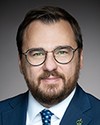
Excellency Andrii Plakhotniuk  Ambassador of Ukraine to Canada

The Chair Liberal Charles Sousa

I call this meeting to order.

Welcome to meeting number 18 of the House of Commons Standing Committee on National Defence. Today's meeting is taking place in a hybrid format, with some members attending remotely via Zoom.

Before we continue, please consult the guidelines to help prevent audio and feedback incidents and to protect the health and safety of our interpreters.

I'd like to remind you to please wait until I recognize you by name before speaking. If you wish to speak, please raise your hand. The clerk and I will manage the speaking order as best we can. For interpretation, please use your earpiece. Select the appropriate channel: floor, English or French. All comments should be addressed through the chair.

I'd like to welcome our witness, His Excellency Andrii Plakhotniuk. We appreciate you being here and appearing before us. I know we've had some discussions in the past. You've probably had discussions with a few of the members here at this table.

You have up to seven minutes, sir, to provide your opening remarks.

His Excellency Andrii Plakhotniuk Ambassador of Ukraine to Canada

Mr. Chair, distinguished members of the Standing Committee on National Defence, thank you for giving me this opportunity to speak to you.

With your kind permission, I'll continue in English.

I would like to start my briefing today by expressing once again our profound gratitude to Canada for its continuous leadership in international efforts to support Ukraine in our existential war for survival against the brutal Russian aggressor.

I wish to use this opportunity of addressing the distinguished members of the House of Commons to extend sincere gratitude to the Canadian government for the recent announcement by the Honourable Anita Anand, Minister of Foreign Affairs, at the meeting of NATO ministers of foreign affairs in Brussels, of $35 million in funding for NATO's comprehensive assistance package for Ukraine. We are confident that Canada's support will bolster the NATO multi-donor trust fund to help address Ukraine's immediate, medium and long-term security and defence needs in urgent, non-lethal military assistance, in medium and long-term capacity building and in planning and recovery initiatives.

We are also very grateful for the recent announcement by the Honourable David McGuinty, Minister of National Defence, of Canada's new purchase of a package of critical military capabilities under the so-called PURL initiative, which will amount to $200 million Canadian. These announcements, like all other previous decisions by Canada, are vital for the defence of Ukraine's sovereignty and territorial integrity, as well as for saving the lives of Ukrainians.

Distinguished members of the standing committee, let me proceed with a brief overview of the recent developments in Ukraine and the situation on the battlefield.

The situation on the front line continues to be tense, yet Ukraine continues to hold firm. Active hostilities are ongoing along a front line stretching about 1,250 kilometres. The most intense fighting is currently concentrated near Pokrovsk, in the Donetsk region, where Moscow has deployed approximately 150,000 troops from a total of 710,000 Russian troops operating on Ukrainian territory.

The search and assault operations and the elimination of the enemy in urban areas continue in Pokrovsk. In Myrnohrad, despite increasingly complicated logistics, the defence forces of Ukraine continue to hold the defensive lines, eliminating the enemy on their approaches to the city. The defence forces of Ukraine have stabilized the situation in the Huliaipole sector, in the Zaporizhzhia region, halting the enemy's advance.

Despite the intensive Russian offensives, Moscow has failed to achieve any of its strategic objectives, while Ukrainian forces retain the capacity to disrupt and degrade enemy operations along the front line. Russia's losses in personnel and equipment remain extremely high, highlighting the unsustainable nature of its military campaign.

As of December 8, since February 24, 2022, Russia has lost more than 1,182,000 soldiers. Our strategy is to exhaust the Russian army as much as possible, prevent its advance and hold our territory, while simultaneously striking the enemy in the near rear, in operational depth and deep inside Russia, with the aim of undermining its defence capabilities, military supply chains and defence industrial potential. To achieve this goal, we need a stable and timely supply of all types of weapons and ammunition in large quantities to hold the front line.

Ukraine is profoundly grateful for every package of support, but we need more. Russia is ramping up its drones and bombs production and is intensifying its offence on the front line by shelling and bombing civil infrastructure. In the first 11 months of 2025, Russians dropped nearly 44,000 guided aerial bombs on the frontline cities and positions of the Ukrainian armed forces, an average of 130 bombs per day. Throughout the week of December 1 to 7, the Russians launched over 1,600 attack drones, around 1,200 guided aerial bombs and nearly 70 missiles of various types against Ukraine. The primary targets of these strikes were critical civil infrastructure, in particular energy infrastructure.

The UN human rights monitoring mission in Ukraine has assessed that these attacks have been of a widespread and systematic nature. It was also concluded that multiple aspects of the Russian military campaign to damage or destroy Ukraine's civilian electricity and heat-producing and transmission infrastructure violated fundamental principles of international humanitarian law. Since the start of Russia's full-scale military invasion, more than 50% of Ukraine's energy capacity has been destroyed, damaged or temporarily occupied.

According to the latest World Bank report, restoring Ukraine's energy sector would cost about $68 billion U.S. We estimate that the energy sector losses at the end of 2024 amounted to $93 billion U.S.

Our long-standing top priority is air defence and missile deterrence against ballistic threats. It's so vital for Ukraine to receive 10 additional PATRIOT systems, plus missiles for the PATRIOT, NASAMS, IRIS-T and Hawk systems. We also need deep strike capabilities: Tomahawks, Storm Shadows, SCALPs, Tauruses and the joint production of deep strike drones and missiles.

Ukraine is ramping up production both domestically and in co-operation with our partners. We invite foreign companies to establish production facilities directly in Ukraine. We want to multiply the positive results of the so-called Danish model and the “Build with Ukraine/Build in Ukraine” initiative. We are also considering controlled arms exports for overproduced weapons, such as naval drones.

Thank you, Mr. Chair.

The Chair Liberal Charles Sousa

Mr. Ambassador, thank you very much.

We're going to start our first round of questions, with six minutes a round.

We'll start with you, Mr. Anderson.

3:35 p.m.

Conservative

Scott Anderson Conservative Vernon—Lake Country—Monashee, BC

Thank you very much, Mr. Chair.

Thanks for attending, Mr. Plakhotniuk, and joining us today. I'm particularly grateful.

I've been to Ukraine twice in the last couple of years: once in November last year and once in July this year. I hesitate to call what I did a tour, but we were in the eastern oblasts and went all the way down.

I'd like to mention that we, on the Conservative side, are strongly in favour of Ukraine. I know there's been some mention elsewhere that we may not be, but that's not true. The reason we are is in part that the sovereignty of nations is a principle that has been codified here since 1945, at least, and arguably since 1648 with the Treaty of Westphalia. It's the central premise of international law.

Many of the academics I've talked to about Canada and Russia are talking about a state of prekinetic war. That's the term some have used. Others have simply used the word “war” to describe the situation between Russia and Canada right now. There has been a tendency lately toward isolationism in the west. Some people look at it and say, “Well, we're Canada. You're Ukraine. What do they have to do with each other?”

I was wondering if you could explain to us why Canada's defence is necessary, what Canada has to do with Ukraine right now and why we are in danger from the Russians as well.

Andrii Plakhotniuk

First, thank you so much for visiting Ukraine. It's an important opportunity to gain first-hand information on what's going on and to see and talk to people, especially to understand how people live their ordinary lives.

When it comes to this war, this is the biggest continental war in Europe since World War II. We are facing a major, nuclear power with huge potential, be it in military defence materiel, manpower or natural resources. They are still able to receive assistance from their partner states to support their wartime efforts.

Why is it so important for all of our partners to support Ukraine? It's because it's an existential war for Ukraine for our values, freedom and dignity. What happens on the battlefield has a direct influence on what is going on not only in Europe, but also around the world. If we let the Russians win the war, it will certainly have very negative consequences in other parts of the world.

When we're talking about this war, we're talking not only about the battlefield, but also about a very intense technological race, which is happening every day. It means that if the collective west is not ready to fight in this technological race, we will all lose. These technologies the Russians will possess in the future will appear in the hands of other regimes that could use them to their benefit.

It's very important for all of us to stand united and continue to support Ukraine.

3:40 p.m.

Conservative

Scott Anderson Conservative Vernon—Lake Country—Monashee, BC

On that note, the top generals understand that 21st-century symmetric warfare has fundamentally changed because of drone warfare.

I've talked to a number of Canadian people who run companies here—some small, some large—and want to connect with people and their counterparts in Ukraine to co-operate on drone technology. Is there a central depository for that, or can you tell us how Canadian companies that want to do that can connect?

Andrii Plakhotniuk

First, we have certain international mechanisms that are working very effectively right now. I'm talking about the specific coalitions. We have the so-called Ukraine Defense Contact Group, which has several dimensions. These issues are well coordinated between the partners. That's one issue.

Another issue is that the embassy and our team stand ready to make these connections with our Canadian partners and friends if they want to start working in this specific field with Ukraine. You have your embassy present in Kyiv with the ambassador and her team, who are also ready to support this effort. We also signed an agreement during Prime Minister Carney's visit to Ukraine on August 24 that allows us to develop defence co-operation between Canada and Ukraine.

3:40 p.m.

Conservative

Scott Anderson Conservative Vernon—Lake Country—Monashee, BC

I have one last question. In November of last year, when I was in Zaporizhzhya, the Russians sent in a 3,000-pound FAB-1500, I think it's called, and destroyed the hotel I was in.

Zaporizhzhya is not on the zero line. It's not in the trenches, but it's certainly a frontline city. Have you accumulated numbers as to how many illegal attacks the Russians have made? Attacking a hotel is certainly a civilian attack and has nothing to do with the military. I saw the schools and everything else when we were over there. I'm just wondering if you've compiled a figure. It has to be in the hundreds of thousands.

Andrii Plakhotniuk

Zaporizhzhya is located close to the front line. What we see on a daily basis are constant and deliberate attacks on Ukrainian civilian infrastructure: deliberate—I want to stress that specific word—attacks. As of today, as a preliminary number, 287,000 civilian infrastructure facilities have been destroyed or damaged.

3:40 p.m.

Conservative

Scott Anderson Conservative Vernon—Lake Country—Monashee, BC

It's 287,000.

Andrii Plakhotniuk

Yes—287,216.

3:40 p.m.

Conservative

Scott Anderson Conservative Vernon—Lake Country—Monashee, BC

Thank you.

Andrii Plakhotniuk

This is a preliminary figure, because it happens every day. It happens regularly, especially with our electricity grids, with infrastructure objects, with bridges—with everything.

3:40 p.m.

Conservative

Scott Anderson Conservative Vernon—Lake Country—Monashee, BC

My understanding is that Ukrainians—

The Chair Liberal Charles Sousa

Mr. Anderson, we'll come back to you in a moment.

I'll go to Ms. Romanado.

You have six minutes.

Sherry Romanado Liberal Longueuil—Charles-LeMoyne, QC

Thank you very much, Mr. Chair. Through you, I'd like to thank the ambassador for being here today.

Your Excellency, it's a real pleasure to meet you. I understand that you were added to the post in September of this year. I think this is your first appearance at the national defence committee. Welcome.

I want to start first with respect to Canada's support of Ukraine through Operation Unifier. My older son deployed to Ukraine in 2018 to help train Ukrainian soldiers. We've trained over 47,000 Ukrainian military and security personnel in battlefield tactics and advanced military skills since 2015.

As the mission progressed, much of the direct training undertaken by Canadian Armed Forces members transitioned to members of the armed forces of Ukraine, with Canadians acting as advisers and mentors, as well as assisting in the development of courses.

Can you elaborate a bit on how Canada's military contributions, especially in training, have been helpful and integral in Ukraine's counteroffensive to date?

Andrii Plakhotniuk

You've mentioned such an important case with military training. You're so right. We have more than 46,000 Ukrainian military who were trained and continue to be trained in the framework of Operation Unifier, which started not two years ago but earlier. It's really important for us, because when we have this kind of training...and I'm not talking about basic military training. I'm talking about tactical matching. We're also talking about language training for our pilots and technicians. These are very important things that contribute to our overall resilience and to better preparedness, especially when we are trying to master the new types of defence materiel we get from our partners as generous donations.

This work, in our opinion, should be continued, and we are certainly so grateful to the Canadian government for supporting this track for continuous efforts to train more and to make our soldiers better prepared. In the long run, it's about saving the lives of our military on the battlefield, but from other perspectives, we in Ukraine are ready to share our knowledge from the battlefield.

In my opinion, I think this is a two-way road. On the one side, we get your knowledge and your experience not only when we are talking about very practical things, but also when it comes to our future NATO membership. Also, we are ready to share with you what we have received and gained from our battlefield experience. That makes our partners more resilient and better prepared.

Sherry Romanado Liberal Longueuil—Charles-LeMoyne, QC

Your trained forces are able to punch above their weight in terms of some of the drone activity they've been able to bring to the table and some of that expertise.

You mentioned in your opening remarks Canada's contribution to the PURL initiative and the recent announcement. Can you elaborate a bit on how the critical materiel you're receiving from Canada and other partners is helping on the ground?

Andrii Plakhotniuk

This initiative is so important because we are able, together with our partners—with their generous support and commitment—to get the equipment and defence materiel we do not have and that is produced only in the United States. We are talking about air defence missiles and some other things.

If we are talking about the importance of this initiative, when we are able to accumulate more money and get more very practical things on the ground, we are better prepared. We are better prepared to defend our civilian infrastructure and, more importantly, our civilians in Ukrainian cities and towns.

Sherry Romanado Liberal Longueuil—Charles-LeMoyne, QC

Canada and many of our allies will be with Ukraine until Ukraine wins this war. As you know, the Prime Minister announced recently the appointment of Chrystia Freeland as Canada's special envoy for Ukraine's recovery.

We know that Ukraine will become successful against Russia, but we will need to help Ukraine rebuild postwar. Can you elaborate a bit on what Ukraine will need for rebuilding after the war?

Andrii Plakhotniuk

According to the assessment of the World Bank—they're also not very accurate, but preliminary—the total cost of the reconstruction will be more than half a trillion dollars U.S., so it will be a megaproject for decades to come.

Certainly, we're talking about reconstruction, but on many occasions we'll be talking about creating something new from scratch. In this sense, when we're talking about this megaproject, we will need all the knowledge and expertise our partners can provide us with.

By appointing a special representative of the Canadian government for the reconstruction, we're talking about strong coordination, high authority and a very strong commitment by the Honourable Chrystia Freeland—her network of connections around the world—because once again, it's so important that this process be well and properly coordinated.

Sherry Romanado Liberal Longueuil—Charles-LeMoyne, QC

Thank you very much.

The Chair Liberal Charles Sousa

Thank you.

Monsieur Simard, you have six minutes, sir.

Mario Simard Bloc Jonquière, QC

Thank you very much, Mr. Chair.

Ambassador, I'm going to give you time to put your earpiece on and check that you can hear the interpreters' soft voice instead of my rough voice.

Andrii Plakhotniuk

Yes, now I hear.