
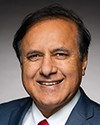
Mr. Chair, I want to take this opportunity to thank the residents of Brampton—Chinguacousy Park for putting their trust in me. I thank the incredible team of volunteers for putting in their time, day and night, to send me here. I am also grateful to the Prime Minister for putting his trust in me and appointing me to this job.
It is a pleasure to be here today to discuss proposed spending for the government, the Treasury Board of Canada Secretariat and the Canada School of Public Service, as outlined in the main estimates for the 2025-26 fiscal year.
It has been just over a month since I began my role as President of the Treasury Board, and I want to say how grateful I am for the warm welcome and professionalism I have seen across the department. I want to take this opportunity to thank the public service for their hard work and commitment in service to the entire Government of Canada and the people we serve. In my opinion, they are the treasurers of the Treasury Board of Canada Secretariat. I thank them for their service.
Allow me to provide a bit of an overview of the main estimate. The 2025-26 main estimates show how the government plans to invest public resources to meet the challenges and opportunities ahead and address the priorities that matter most to Canadians. They indicate the areas in which our new government will spend funds and the limits to how much it may spend without returning to Parliament to request more funds. Throughout the year, supplementary estimates are also presented to seek parliamentary approval for additional spending requirements that were not sufficiently developed in time for inclusion in the main estimates or were unforeseen.
Overall, the main estimates for 2025-26 present information on $222.9 billion in voted expenditures and $264 billion in statutory spending, for a total of $486.9 billion in planned budgetary spending for 130 organizations. Most of these funds are allocated outside of federal government organizations. In fact, transfer payments totalling $294.8 billion account for over 60% of expenditures. These payments provide important ongoing assistance to provinces and territories, organizations and individuals. They include benefits for seniors, the Canada health transfer and the Canada disability benefit. Funds that support the operation of the departments and the programs, activities and services they deliver for Canadians total $143.1 billion. This includes everything from national security and defence to reconciliation and housing.
As members of the committee review the estimates and supporting documentation, they will note that the government's spending plan is closely aligned with the priorities of Canadians. For example, $33.9 billion in voted funding is proposed for the Department of National Defence. The main estimates include $12.3 billion to ensure the readiness of our armed forces, $9.5 billion for military procurement and $4.9 billion for sustainable bases, IT systems and infrastructure. A further $4.4 billion is proposed for recruiting, developing and supporting an agile and diverse defence team, and $2.3 billion is planned for operations.
Another vital issue is Canada's relationship with its indigenous people. True reconciliation means more than symbolic gestures. It requires concrete actions in education, health care, governance and economic opportunity. That is why the proposed spending for the Department of Indigenous Services totals $25.2 billion. This amount includes investments in a broad range of services that support health, children, families and education.
There has been much discussion about the increase in the main estimates compared to last year. This can be explained by three key factors. First, because the main estimates are being presented several months later than normal, they contain items that likely would have been included in the supplementary estimates rather than in the main estimates. Second, the estimates contain increased spending in several key areas of importance for Canadians, including dental care, reconciliation and national defence. Third, the main estimates include increases in major transfer payments to provinces, territories and other organizations, which, as I mentioned earlier, make up the majority of proposed spending.
I would now like to discuss the historic investment in Canada's armed forces announced by the Prime Minister. This important investment is reflected in the 2025-26 supplementary estimates (A), which were tabled on June 9.
Canada is at a pivotal moment in its history, and we need the resources to protect our country and its citizens against foreign threats. We need to be strong at home with a military that is ready and capable, particularly in the Arctic and northern regions. Through the supplementary estimates (A), the government would do just that.
The spending of $9 billion would provide key investments in Canada's defence and security capabilities to help our military with recruitment, training and equipment. These investments would also support our international defence relationships and obligations.
The estimates play a wider role in supporting Parliament's scrutiny of how public funds are being spent so that it can hold the government to account. All of the estimates demonstrate the government's commitment to delivering results on the issues that matter most to Canadians.
I am happy to take questions.