
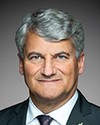
Mr. Speaker, I rise to raise a question of privilege regarding the misleading remarks made on Friday, during question period, by the Parliamentary Secretary to the Minister of Industry, the hon. member for Marc-Aurèle-Fortin.
Friday morning, the government's statistics agency, Statistics Canada, released data on the gross domestic product, or GDP, for the first quarter of 2026, confirming that Canada's GDP had declined by 0.1%. That decrease follows a 1% contraction of economic output over the fourth quarter of 2025.
The definition that economists generally accept is that there is a recession when there is negative GDP growth, that is, the economy has shrunk for two consecutive quarters. In reality, this is the third of the past four quarters to show such a contraction for the Canadian economy. I will put it simply: Canada is in a recession.
This topic naturally raised concerns during question period on Friday. It will no doubt continue to do so in the coming days and weeks as we, the Conservatives, continue to put pressure on the Liberal government to submit a plan to get Canada out of this recession, which it is responsible for.
In response to my questions about this recession, the parliamentary secretary replied, “Mr. Speaker, let us be clear: Canada is not in a recession.”
To be honest, I was bewildered by the parliamentary secretary's refusal to acknowledge this reality and I asked him about this specific point. The Liberal parliamentary secretary maintained his position, replying, “Mr. Speaker, I will say it again: Canada is not in a recession.”
The parliamentary secretary did not stop there. In fact, he added insult to injury by saying, “Statistics Canada has never said that we are in a recession.”
I would respectfully submit that the parliamentary secretary has deliberately misled the House with his comments.
To mislead the House intentionally is a well-recognized ground for contempt of Parliament. Our authorities, including paragraph 3.16 of House of Commons Procedure and Practice, fourth edition, lay out a three-part test for establishing when a prima facie case of privilege can be found in such cases.
First, the statement must, in fact, be misleading. As I just discussed, the Statistics Canada data quite clearly satisfy the consensus definition of when a country's economy has entered into recession. Of course, there is nothing technical about seniors who have to visit the food bank, unemployed Canadians fretting over how to make their next mortgage payments or hard-working parents worrying about how they will feed their kids next week.
As for the second part of the three-part test, that the member making the statement knew at the time that the statement was incorrect, I think we should recognize that the individual making the statement was not just some parliamentary secretary who happened to be in town on Friday and was available during question period to read a note prepared by someone else, who knows nothing.
The parliamentary secretary, the member for Marc-Aurèle-Fortin, is a highly respected economist. He served as finance minister for the Couillard government in Quebec and he balanced the budget. He is a serious guy.
To be frank, that is why I was personally very disappointed and even surprised and saddened to see that this man of great experience unfortunately failed to recognize the facts.
Before being elected as the member for Marc-Aurèle-Fortin, the parliamentary secretary worked as the chief economist and chief strategist at Laurentian Bank Securities. He served as the Quebec finance minister and was appointed to the board of directors of the Bank of Canada by Prime Minister Trudeau and Minister Freeland.
In other words, this parliamentary secretary knew very well that two consecutive quarters of GDP contraction is the very definition of a recession. I believe that he was fully aware that he was not providing correct information when he denied that we are in a recession.
In fact, as a leading economist at a bank, he was used to frequently commenting on economic trends.
For example, in an October 29, 2009, La Presses article about how 71% of Quebeckers are living in the past, the parliamentary secretary acknowledged that a recession is indeed defined as two consecutive quarters of contraction. He said, “It is a definition that is primarily used in the financial sector”.
Turning to the third part of the test, that the member must have intent to mislead the House in making the statement, one must look at the context of the exchange. The parliamentary secretary was rising in question period to stickhandle questions about that very day's economic headline, obviously an embarrassing story for the Liberals, whose very premise of forming the government was anchored in the supposed promise offered by the Prime Minister's résumé.
The parliamentary secretary was doing his best to defuse a political crisis for the Liberal Party leader.
Beyond that, I think it is also important to look at the additional exchange I had with the Liberal parliamentary secretary, in which I insisted on this point: “Is my colleague familiar with Statistics Canada? It just so happens that it is part of the Government of Canada. Statistics Canada states that Canada is in a recession”.
Even if, in a world where anything is possible, the parliamentary secretary genuinely misspoke in his first response, the issue was clearly and specifically brought to his attention. Still, he responded by doubling down.
It is clear that the parliamentary secretary knew full well what he was doing when he made such a calculated statement in the House of Commons, despite all the evidence to the contrary.
To sum up, the Liberal denial that Canada is in a recession was misleading, the parliamentary secretary making the claim was well positioned to know it was misleading, and his objective in making the comment was clearly to mislead the House in order to protect his fellow economist the Prime Minister. As such, I believe there is a prima facie case of privilege here. Should you agree, I am prepared to propose a motion to refer the matter to the procedure and House affairs committee for its deliberation.