
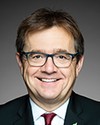
Mr. Speaker, I rise in the House today to provide some final words after almost 11 years in this place. I want to begin by acknowledging my colleagues on both sides of the aisle, as well as the many dedicated public servants and staffers with whom I have had the privilege to work during my time here.
While I know there are some people in all parties who cannot get past the, at times, partisan nature of politics, I have made many friends across the aisle during my time here, folks who are here to serve their constituents, their province and their country but who can also be open to speaking to and even having fun with people of differing perspectives. Honestly, the fact that many of us actually like each other as people across the aisle is something that Canadians should see more often.
I fully recognize that many people have devoted a significant part of their professional lives to building a better Canada and a better world.
All members of the chamber have been fortunate to have been allowed to play a role in shaping public policy in this country and internationally. It is a privilege that very few folks enjoy.
Before getting into policy issues, I want to point out that, in the House, we all give a lot, but we also receive a lot.
One of the things I am particularly grateful for is having had the opportunity to learn Canada's other official language. Although my French is far from perfect, this skill I have acquired here is a great gift.
When I left the private sector to run for office, many people in the business community thought I was mad, but it has been the most rewarding experience of my life. As an MP and as a minister at DFO, at Environment Canada and at Natural Resources Canada, I have often said I had truly the best job in Canada. As MPs, we know well that the impact we can have on constituents' lives can at times be profound, but it can also be profoundly rewarding.
I do not typically like to use the word “proud”, as the people who have worked with me know, but today I will. Over nearly 11 years in government, I am proud of several things that I, my team and departments, and government as a whole, helped to accomplish.
A few of the highlights include developing Canada's strengthened climate plan, the healthy environment and healthy economy, the first plan in Canadian history to show in detail not only how we could achieve a climate target but how we could exceed one; launching Canada's first critical minerals strategy and the investment tax credit regime to advance clean energy development; establishing what I believe will be transformational in this country, the indigenous loan guarantee program; catalyzing the full modernization of Canada's aging Coast Guard fleet; creating the B.C. salmon restoration and innovation fund to address the decline of wild Pacific salmon, which is a critical issue in British Columbia; and expanding marine protected areas from 1% to over 14% during my time as minister of fisheries.
Every member of the House will have heard many times people asking why they should engage in the political process, often saying that individuals cannot make a difference. That attitude is particularly prominent these days with young people. However, I would say, in my experience, that this is simply not true. I entered politics over a decade ago to tackle climate change in a way that creates economic opportunity and is not simply about sacrifice. Over that time, working alongside colleagues, I have had the chance to make meaningful and, I believe, lasting contributions to climate policy that builds a strong future economy.
Individuals can make a difference through their words and through their actions. That is a message I often share with young people, whether in schools, through my youth council or in communities across the country, many of whom presently feel the system does not work for them. On the climate issue that brought me into politics, while today's geopolitical climate may suggest that progress has slowed, I remain optimistic that Canada, Europe and the world will meet this challenge.
Climate change is not going away. It is a scientific reality, with human and economic impacts that are growing every year.
Climate change is a major challenge, but addressing it and building a strong economy for the future can and indeed must go hand in hand. Looking at actual global trends rather than simply rhetoric, it is clear that the world is moving to a lower-carbon future and that many countries, China in particular, have explicit economic strategies to accelerate the energy transition.
Progress is being made, albeit more slowly than science suggests we need. Growth in energy-related CO2 emissions is continuing to decouple from global economic growth. Very importantly, climate progress is, increasingly, not simply being driven by government policy. It is being driven by technology. Simply put, many low-carbon energy technologies are now cheaper and often much better than conventional alternatives, and this is something we should all celebrate. Climate change and its impacts are a matter of science, not politics. How we choose to respond remains a fundamentally political decision, one that requires foresight, thoughtfulness and courage.
The past 11 years have been enormously rewarding, and I am grateful for the opportunity to continue serving this country in a new capacity, as the Prime Minister has asked me to take on the role of Canada's ambassador to the European Union.
I accepted this position for the same reason I entered politics: a commitment to Canada and a belief that this is where I can make the greatest contribution right now.
The Prime Minister has an ambitious vision for what this partnership can become. My role will be to help implement that vision and ensure that it delivers concrete results for all parties.
I love this country more than I can fully express. Canada is the best country in the world, not because we are perfect but because we face our flaws and choose again and again to do better. Ours is a story of resilience, of expanding rights and of building a more inclusive and just society. Whether that story continues is up to us and our willingness to stand up for what we believe in, defend democracy, advance reconciliation, confront climate change and build an economy that works for everyone.
Serving as a member of Parliament and a minister has been the privilege of my life. Serving in my new role will be a different kind of privilege, one that I approach with the same sense of duty and determination.
I will conclude by waxing a bit philosophical. I think most of my staff who are here will probably find that funny. I believe we are capable as a species of enlightened self-interest. In this regard, acting on climate change is firmly in our collective self-interest. However, I also believe that many of us are also very much capable of altruism, of thinking not only about how building a better community or helping those less fortunate may benefit us in the longer term but actually also about how we are morally obligated in the direction of social justice. To all people in and outside the House, I say that we can indeed work to build a better and more just world if only we have the courage and the will to try.
In this vein, I will conclude by quoting the words of William Blake, taken from his poem Jerusalem. I freely admit that I took these lines from the conclusion of speeches by the great Tommy Douglas. As a Saskatchewanian originally, and as someone who actually watched him in person and met him as a young person, I think Tommy would think that is just fine. These lines, I think, capture the essence of a commitment to community and to public service, which is, I believe, about striving each and every day to make this country and this world a better place in which to live.
Blake wrote:
I will not cease from Mental Fight,
Nor shall my sword sleep in my hand:
Till we have built Jerusalem,
In Englands green & pleasant Land.
It has been a pleasure and an honour to get to know and work with all of my colleagues.
I look forward to seeing many of them in Brussels.