
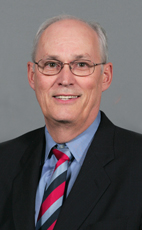
House of Commons photo

Crucial Fact

  • His favourite word was lot.

Last in Parliament September 2008, as Conservative MP for Prince Albert (Saskatchewan)

Won his last election, in 2006, with 54% of the vote.

Statements in the House

The Budget March 25th, 2004

Mr. Speaker, I will miss this member. I found him a very good combative debater in the House. We probably did not agree on very many things, but I did respect how vigorously he advanced his position and would try to undermine our position, that I know was right in most cases.

However, I did come across a story and perhaps it was not accurately reported. It was the member's observation that Elections Canada should become involved in all the nomination meetings, I presume of the national parties, to ensure that abuses are avoided and so on. I was thinking, what would that entail? We have three national parties, 301 constituencies, and a lot of nomination meetings taking place and so on.

Would this not involve a huge expansion of the bureaucracy that we already have in place to supervise elections? I would appreciate his comments or enlightenment on that in any event.

Supply March 11th, 2004

Mr. Speaker, I commend the member for Yellowhead for reminding us of a few facts. I think history will say that the approach of the current Prime Minister and past finance minister in dealing with fiscal matters was to take care of his friends and special interest groups. I think history will say how he used a slash and burn method of balancing the books by targeting things like health care, which we are paying a big price for today. People have to remember that.

I commend the member for bringing up the questions of sustainability and demographic issues. They are serious concerns.

I just read a report of the International Monetary Fund on the sustainability of our programs. It quantified and calculated every country's unfunded liabilities and added that to our existing debt level. Under its calculations, Canada moved from 40% of GDP to 400% of GDP. Look at all our unfunded liabilities: pensions, aboriginal commitments, health care commitments and so on. To me, this should be a major challenge in the forthcoming election. We should be discussing how we deal with those kinds of problems.

Has the member for Yellowhead seen any glimpse from this new Prime Minister that he is even aware of this problem, let alone proposing ways in which we can make our social programs sustainable with these huge challenges facing us, because I just do not--

Supply March 11th, 2004

Mr. Speaker, I would like the member to clarify for me the role of the private sector in the public health care system.

In my Saskatchewan riding, the hospitals were built by the private sector. The architects involved in designing the hospitals were in the private sector. The ambulance service is owned by private entrepreneurs. The doctors' offices are privately owned. The uniforms worn by the people who work in the hospital system are made by the private sector. The diagnostic equipment has General Electric, Hitachi and things along that line written on it. When we leave the doctor's office, we go to a private pharmacy to get private drugs.

It has occurred to me that if all these things were eliminated from our health care system, we would have some problems in this country. Is the member from Churchill proposing that all these sorts of things, that are clearly private sector in the existing system, be abolished, banned and eliminated from the system?

Supply March 11th, 2004

Mr. Speaker, I would like to thank the member from the Bloc for his excellent presentation. He illustrated a sound comprehension of the mathematics that is going on in this town.

I have a comment on the tax point before I put my question. Tax points have limited application to provinces, such as my province of Saskatchewan where the tax base is eroding and the fiscal capacity of the province is deteriorating. Tax points are not that great a solution. They might be good in Ontario; however, in a province that has a lot of fiscal problems, it has its problems.

I want to zero in on the waste that we have talked about in the House of Commons for the last while. We have, for example, the sponsorship program of $250 million. I have done some mathematics myself. Saskatchewan only has 10 MRIs. People are waiting 22 months to have an MRI in that province. That is a long time to wait for an appointment if the service is needed.

We also have a shortage of nurses. The sponsorship money of $250 million could pay for the training of 3,000 new nurses. We need a new bridge in my riding. It would cost about $30 million. We could build eight bridges with that money alone.

The Bloc member is very good with numbers. Does he have any idea of the volume of waste and corruption we have in Ottawa? What is the total dimension of that figure? Could he quantify that and give us an idea, out of the total $189 billion that we spend a year, how much of that is money wasted on boondoggles, corporate welfare, corruption and--

Petitions March 11th, 2004

Mr. Speaker, I have the distinct honour and privilege to present 10 petitions signed by hundreds upon hundreds of my constituents in the riding of Prince Albert. The signatories pray that Parliament passes legislation to recognize the institution of marriage in federal law as being the lifelong union of one man and one woman to the exclusion of all others.

Criminal Code March 9th, 2004

Mr. Speaker, my first comment concerns the fact that Mr. Sharpe is, apparently, quite enthralled with the legislation. He says that the loose definition in the bill would liberalize things quite a bit from his standpoint and would give him lots of grounds for reasonable doubt in a criminal trial.

I have another point I want to raise. We had a serious case in my riding this past summer where a 12 year old aboriginal girl was sexually assaulted by three men in their mid-twenties. They had their trial split. One was convicted. I do not know how the jury decided the case for the other two accused because we cannot get into that, but one of the main defences of the lawyers was that the accused believed the victim was at least 14. This just proves to me that we have a problem and the bill does not provide any protection on that matter.

I know that a lot of the Bloc members opposed increasing the age from 14 to 16. I wonder what the Bloc member would have to say about raising the age of consent from 14 to 16.

Federal-Provincial Fiscal Arrangements Act February 27th, 2004

Mr. Speaker, I noted the member's comment quoting Lorne Calvert, the premier of Saskatchewan, about the serious problems in Saskatchewan. I can concur with that. I can see a health care system in that province dying before my eyes. Doctors are leaving en masse. It is taking 22 weeks on average to get an MRI scan done.

As well, the roads are in very serious shape. Everything I look at in that province is virtually crumbling before my eyes. I know that equalization is not the cause of all of these problems; a lot of them are internally imposed because of bad policy decisions in that province.

I would like to ask the member a specific question on equalization. As a Saskatchewanian, I think the formula really punishes severely provinces that have developed their natural resources. Saskatchewan's income level is very comparable to those of Manitoba and the Atlantic Canada provinces of Nova Scotia and New Brunswick, but it receives on a per capita basis only roughly one-quarter of what those provinces receive in terms of equalization payments because Saskatchewan developed its natural resources back in the 1950s and 1960s. Saskatchewan basically gets hammered over the head for having developed its natural resources.

I wonder if the hon. member and her party are in favour of removing natural resources as a component in the equalization formula.

Government Contracts February 27th, 2004

Mr. Speaker, the President of the Treasury Board got a lot shorter.

So much for Liberal openness. Why is this very old and tired Liberal government hiding the Earnscliffe contracts from Canadians? What is it trying to hide? All we are asking for are copies of those contracts.

I will ask this question very slowly for the President of the Treasury Board. He seems to have trouble with fast questions. When will the government table the Earnscliffe contracts?

Government Contracts February 27th, 2004

Mr. Speaker, the government's promise of openness has become a useless and unenforceable promise. Its approach sounds like more of the same.

When the Prime Minister took office it only took him days to start awarding and paying off his friends at Earnscliffe.

In the interest of openness, which the President of the Treasury Board has let out a lot of hot air about today, will the government table all contracts it has given the Earnscliffe group since 1993?

Member for LaSalle--Émard February 26th, 2004

Mr. Speaker, the Prime Minister has a serious case of amnesia. He does everything to escape his past and the Liberal culture of corruption.

He says that he is innocent. He says that as finance minister, he was out of the government's loop and he did not know. He blames public servants for the problem. He says that it is not his problem, that it is his predecessor's problem and his gang of Liberals.

The Prime Minister's own actions set the tone for the culture of corruption. In respect to his business interests, there never was a blind trust. The Prime Minister was in a conflict of interest, and a very strong case can be made that he used this conflict of interest to benefit his own business interest.

No, the Prime Minister cannot escape his past. He is very much a part of this corrupt and incompetent Liberal government.