
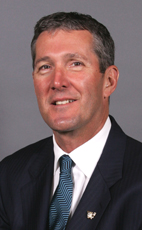
House of Commons photo

Crucial Fact

  • His favourite word was aboriginal.

Last in Parliament September 2008, as Conservative MP for Portage—Lisgar (Manitoba)

Won his last election, in 2006, with 70% of the vote.

Statements in the House

Sponsorship Program February 25th, 2004

Mr. Speaker, the Prime Minister talks about transparency.

What is transparent is the Prime Minister's willingness to stay glued in his seat and play dodge ball with this issue, simply unwilling to take accountability for the real openness that should occur, and deferring to other people to answer these questions.

Whatever happened to doctor democratic deficit? What ever happened to accountability? What ever happened to leadership? Why is the Prime Minister hiding? No one's best interests are served by secrecy here.

Will the Prime Minister commit to releasing the statements of the crown corporations offered in their defence?

Sponsorship Program February 25th, 2004

Mr. Speaker, Lester Pearson used to call the official opposition the detergents of democracy, which is pretty ironic given the Prime Minister's recent failed attempts to clean up his own mess. One cannot clean up a dirty wardrobe by hiding it in the closet and one certainly cannot clean up by sending a few suits out to the cleaners.

What is the Prime Minister hiding? Whitewashes and cover-ups do not change the fact that there is still dirt underneath.

Will the Prime Minister commit to letting the public know and see the defences filed by the heads of the crown corporations?

Employment Insurance February 20th, 2004

Mr. Speaker, it is a blatant ripoff and the member knows it.

The Prime Minister has tried to point the finger at everybody. He has pointed the finger at the bureaucracy, pointed the finger at Quebec politicians and pointed the finger at Chrétien loyalists. The Prime minister is running out of fingers.

However, I know who will give him the finger. It is the Canadian taxpayer. If he wants a finger, he should talk to them. The $44 billion is owed to them. It does not belong to the Liberal Party.

When does the government plan to stop pointing the finger of blame at everybody else and start pointing the finger where it belongs, at itself?

Employment Insurance February 20th, 2004

Mr. Speaker, so many scandals, so little time.

Lost in scandalmania over the last two weeks is the biggest scandal of them all. No, it is not the $100 million handed to Liberal friends and cronies. No, it is not the hundreds of millions for Challenger jets. And no, it is not even the billions of dollars for the failed gun registry. It is bigger than that. It is the $44 billion EI overcharge. The Prime Minister has politicized EI and has used it as his personal cash cow.

Will he commit today to restoring an arm's length, independent, rate setting process for employment insurance in Canada?

Auditor General's Report February 11th, 2004

Mr. Speaker, the Auditor General's report reads like a dime store novel. It is about con men. It is about fraud artists playing by their own rules: Liberal rules. If you are a Liberal you can belly up to the trough, you can be paid for work that you do not do, you can get everything you want and it is okay because you are a Liberal. Nudge, nudge, wink, wink, oink, oink: “You are okay, you are a Liberal”.

This kind of cronyism is what got the Prime Minister into power. The Prime Minister knew what was going on. Why did he look the other way?

Auditor General's Report February 11th, 2004

Mr. Speaker, these are sad days for Canadian democracy. The revelations made by the Auditor General strike at the very heart of the problem of the democratic deficit in this country. They strike at the reason why Canadians so distrust their public servants.

The most sickening part of the Prime Minister's response is the hypocritical and shallow attempt to deflect personal responsibility by pleading ignorance. My question to the Prime Minister is, how does he propose to address the democratic deficit when he is the democratic deficit?

Rail Crossings February 6th, 2004

Mr. Speaker, on November 14, 2003, the lives of Rick and Susan Bomack were changed forever when they lost their son in a car-train collision on the main CN line just outside MacGregor, Manitoba.

Almost every day in Canada someone is injured in a car-train accident. Every week someone dies.

The sad fact is that many of these accidents could have been prevented. Like too many of them, Derek Bomack's accident occurred at night at an unmarked crossing. Reduced visibility was a probable factor.

The government must immediately require reflectors on all train cars running on Canadian rail lines. It is inexcusable that any train car should go in for servicing and come out without a reflector attached to it. In particular, rural Canadians should not be treated as collateral damage by the rail industry in this country or by the government.

We cannot restore the life of Derek Bomack, but in his memory we can save the lives of other Canadians.

Points of Order February 6th, 2004

Mr. Speaker, just on a point of clarification that you might want to give us. If your ruling is based on the intervention of the member opposite, who rose in his place and said that he would not give unanimous consent, if that is in fact the basis of your ruling, I would like you to clarify that to the House at this point in time. If it is not the basis of your ruling, sir, then I would ask you to rise in--

Points of Order February 6th, 2004

Mr. Speaker, just as an observation. I think that would be a very dangerous precedent to set, to allow members to rise at any particular point in time when another member is bringing forward a motion and prematurely giving their personal opinion on it as to whether they would or would not give unanimous consent. It would pre-empt the ability of any member of the House to bring forward such a motion.

Of course it would be a tremendously dangerous precedent to set. I think the government House leader should consider that before he implies that it would be possible for any of us in the House to use such a tactic as a way to block the ability of any other member of the House to bring forward a motion.

Points of Order February 6th, 2004

Mr. Speaker, with all due respect I would like to make the observation that I believe someone was wanting to time the amount of time that we have spent with the interventions of the government members, with interventions from the Chair, and so on.

I think we have occupied considerably more time of the House in talking about the motion than we have in listening to the motion be read.

Personally, I would prefer to hear the motion, and I would suggest that if we are interested in the use of the House's time effectively, we listen to the member's motion.