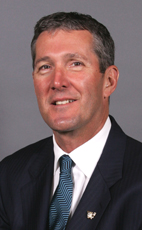
House of Commons photo

Crucial Fact

  • His favourite word was aboriginal.

Last in Parliament September 2008, as Conservative MP for Portage—Lisgar (Manitoba)

Won his last election, in 2006, with 70% of the vote.

Statements in the House

Employment Insurance February 4th, 2004

Mr. Speaker, the Prime Minister suggested earlier today that the Auditor General could vindicate his dealings with Canada Steamship Lines. The Auditor General has already commented unfavourably on his ethics in her 2003 public accounts report, when she concluded that the government is violating the intent of its own Employment Insurance Act with excessively high EI premiums.

The Prime Minister is wanting to invoke the counsel of the Auditor General on one issue but he chooses to totally ignore the counsel of the Auditor General on another. I would like him to explain to the House the total contradiction in that remark.

Employment Insurance February 4th, 2004

Mr. Speaker, yesterday the HRDC minister made the incredible statement in the House that there is no $45 billion EI surplus. Over the last decade, this Prime Minister has misappropriated $7,000 from each and every working Canadian family in extra EI premiums. He has turned EI into a vast personal cash cow.

Can he explain what right he has to dupe low income, working Canadians on their taxes when he tries to avoid paying his own?

Aboriginal Affairs February 3rd, 2004

Mr. Speaker, the minister will have trouble convincing Canadians he is clairvoyant. He has already addressed the problems that were only revealed last Friday when this audit was released.

If the minister is so confident that his controls are effectively in place and protecting Canadians, perhaps he could explain to the House how it is that Health Canada could approve Phil Fontaine's request and use $1 million of Virginia Fontaine money to fund a hockey school.

Will the minister immediately commit to launching a full public inquiry into the Virginia Fontaine debacle, or failing that, explain why he wasted $2 million on his department's audit which he is choosing to ignore now?

Aboriginal Affairs February 3rd, 2004

Mr. Speaker, last week's audit of the Virginia Fontaine Addictions Foundation revealed that Health Canada paid $1.2 million in perks, including $153,000 for jewellery purchased while on Perry Fontaine's Caribbean vacation and an additional $8,000 for two tombstones. Perhaps there was a plan for a funeral for transparency and accountability.

This audit raises serious questions of departmental incompetence. I would like to ask the minister, will he immediately call for a full public inquiry?

The Economy November 5th, 2003

Mr. Speaker, I do not know who the minister thinks he is fooling. The Auditor General is on to him. We are on to him. The Canadian people are on to him.

According to the minister's own budget numbers, he predicts a surplus this year which is less than the amount he is overcharging working Canadians on their EI premiums. By all definitions, that is a deficit.

Will the minister admit to every working Canadian that his imaginary surplus is the result of a very real overcharge on their EI premiums?

The Economy November 5th, 2003

Mr. Speaker, yesterday the Auditor General accused the government of cooking the books, again, and she is right, again. Without the EI overcharge, the government is actually in the red this year. This year's pseudo-surplus comes at the expense of working Canadians, again.

Will the minister admit that without the EI overcharge the government is actually running a deficit?

Ethics October 28th, 2003

Mr. Speaker, for many Canadians $200 is a lot of money. According to Canada's Auditor General and our chief actuary, this year Canada's working poor will be overcharged by more than $200 on their EI premiums.

Has the Minister of Human Resources Development Canada ever received an undeclared gift in excess of $200?

Employment Insurance October 27th, 2003

Mr. Speaker, the paycheque for every working Canadian has a deduction box on it for EI. People work under the assumption that the money taken off a cheque goes to EI.

If people were working under that assumption they would be wrong because over the last decade the government has taken $45 billion away from working Canadians, which, according to the Auditor General, has not gone to EI at all.

My question is for the Minister of Finance. Would he admit today in the House that the money taken off these cheques was taken under false pretenses?

Justice October 24th, 2003

Mr. Speaker, Perry Fontaine comes from a privileged background. He is the former chairman of the Virginia Fontaine Addictions Foundation, and was responsible for the care and treatment of solvent addicted aboriginal children.

Mr. Fontaine is now facing eight charges of bribery and fraud for allegedly funnelling over $600,000 from the addictions foundation and away from those very children. He is accused of stealing from the most vulnerable, the most fragile, and the most deserving of our compassion.

Because Perry Fontaine is aboriginal, he can ask the court for special treatment at sentencing. Liberal amendments to the Criminal Code and the Youth Criminal Justice Act instruct judges to place the rights of aboriginal criminals above the rights of aboriginal victims. That is wrong.

We must end race based sentencing and say yes to the equal rights of aboriginal victims to justice in this country.

Criminal Code October 23rd, 2003

Madam Speaker, justice should always be blind to race. What my private member's bill, Bill C-416, will do is achieve the removal of the references to race, both in the Criminal Code and in the Youth Justice Act. These are unique to Canada and it is sad when these references compel judges to consider in the determination of a sentence whether a convicted offender is an aboriginal person.

I have listened intently to the arguments put forward by my colleagues, some thoughtful, some less thoughtful. Certainly in some of the comments there is no evidence that people have read the actual bill, in fact. The government's argument seems to be that because there are too many aboriginal people in jail, there should therefore be special consideration to reduce the percentage of aboriginal people in jail. That is a kind of quota system. There is no logic or fairness to that. The justice system is supposed to look at the individual person in determining sentencing, and that is exactly what the judge has to do now.

What this provision does is require the judge to be a social worker and take a look at the race of the person, to peek out from under the blindfold and see what colour of skin the person has. That is supposed to influence sentencing. There is no logic or fairness in that.

There are too many aboriginal people incarcerated. That is a problem, but they have committed a crime and they have received a sentence. That is why that person, who has made that individual decision, is in jail. Sixty per cent of federal inmates in Manitoba are aboriginal, versus an aboriginal population, though younger certainly, of 13%. In Saskatchewan, fully two-thirds of young offenders incarcerated are aboriginal. There is a problem, but those figures, while shocking, are no excuse for a requirement that instructs judges to be lenient based solely on racial characteristics. There is no fairness in that. That is tantamount to providing a volume discount for crime.

It is an absurd proposition to suggest that we will reduce the rate of incarceration of aboriginal people, or any other group, for that matter, by simply sentencing them more lightly. Nor will we reduce the rate of criminal activity of such a group by doing that. The correct approach would clearly focus on preventing the crime in the first place. This is something the government has had precious little success in doing.

Members from the New Democratic Party and the Liberal Party talk about crime prevention mechanisms, but they fail to adopt common sense changes which would empower individual aboriginal people to a greater degree, such as human rights protection. These are the kinds of things the Canadian Alliance supports: human rights protection for all aboriginal people, the only group in the country that does not have it, and matrimonial property rights for aboriginal women so that they would have the security and confidence that all other women in Canada now enjoy.

These are meaningful changes that the Canadian Alliance has brought forward. The government has failed to act on them. In so doing, it has continued to perpetuate the strength of chiefs at the expense of vulnerable individuals on reserves. I grew up next to a reserve. I have spent my whole life with aboriginal people. I urge the government to take steps to prevent crime, meaningful steps, by empowering individual aboriginal people against the concentrated power of the chiefs and the elites on reserves.

The fact of the matter is that we have advanced matrimonial property rights proposals, as I mentioned, which would give aboriginal people the right to own their own homes, human rights protection, as I mentioned, and consumer equality for aboriginal people so that they could obtain credit and engage in transactions that we take for granted. There are so many proposals we have brought forward. None were adopted.

I listened to the member from the NDP, who, with his poorly researched and idiotic comments, was saying that all this is about is punishment. My God, that is pap. The fact of the matter is that we have brought these ideas forward because we believe in them strongly. We in this caucus represent more aboriginal people than everyone else in the House combined. For heaven's sake, I say, show some respect to people when they present ideas in the House and do not go with the idiotic political correctness and the poorly researched ideas. It is absurd.

Aboriginal people are diverse. There are over 600 first nations communities. Half the aboriginal population in this country lives off reserve. Aboriginal people have a complete gamut of skills, vocations and familial environments. They do not all grow up in alcoholic households, they do not all come from broken homes, and they are not all on welfare. These old stereotypes are dangerous and the government plays to them when it references group membership in the Criminal Code.

The fact of the matter is that we have to deal with this issue in a meaningful way. I believe that what the government has chosen to do is favour aboriginal criminals at the expense of aboriginal victims. That is grossly unfair. Adopting this bill will change that. I urge my colleagues to support it.