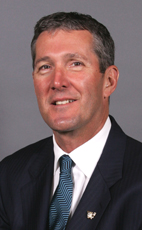
House of Commons photo

Crucial Fact

  • His favourite word was aboriginal.

Last in Parliament September 2008, as Conservative MP for Portage—Lisgar (Manitoba)

Won his last election, in 2006, with 70% of the vote.

Statements in the House

Aboriginal Affairs November 27th, 2002

Mr. Speaker, the right hand and the left hand should get introduced.

Next week the Auditor General will release a report that will again condemn the government for failing to protect taxpayers and aboriginal people.

Bureaucratic overlap, duplication and waste eat up taxpayer dollars before they can ever better the lives of aboriginal people.

When will the government realize that its bloated bureaucracy needs aboriginal people a lot more than aboriginal people need its bloated bureaucracy?

Aboriginal Affairs November 27th, 2002

Mr. Speaker, the government spends over $7.5 billion directly on Canada's aboriginal people but to do this it uses more than a dozen different government departments. This can cause waste and duplication. For example, when Indian Affairs and Northern Development replaces a chief that it claims is not competent, other government departments continue to funnel millions of dollars through that same chief.

My question is for the Prime Minister. Why does the government allow some departments to flow taxpayer dollars through the same chief that other government departments claim is not competent?

Aboriginal Affairs November 21st, 2002

Mr. Speaker, the minister's temper is flaring. He should try living on one of these reserves.

The minister has replaced dozens of chiefs with his own financial managers in the last couple of years. Then he tells the managers that they do not have to pay the bills for local small businesses. This leaves tens of millions of dollars owing to private sector, family owned businesses. That is grossly unfair to those Canadians and the government is doing nothing about it.

The minister said that the chiefs are not responsible. The minister's manager is not responsible. When I asked the minister, he said he is not responsible.

On behalf of these Canadians, I want to ask the minister, if he is not responsible for this, who is--

Aboriginal Affairs November 21st, 2002

Mr. Speaker, sadly, on more than 100 reserves across Canada residents have to boil their water or risk serious illnesses.

The government has not responded with action. It has responded with a $6 million study, the paralysis of analysis.

The government can find $44 million to build a brand new, totally unnecessary reserve in northern Manitoba, but it cannot fix broken down water systems.

These are not just bad choices. These could be fatal choices, especially for seniors and children.

I am asking the minister today, will the government put an immediate stop on the building of new reserves and start cleaning up the water systems on our existing reserves?

Health November 1st, 2002

Mr. Speaker, this has been quite a week in the puzzle palace. Farmers are going to jail for selling wheat. We have a government that opposes secret ballots. Now first degree murderers get to vote in this country. It has been a wonderful week. How do we top that? We do a research study on the last great mystery in Canada, the cause of obesity. That is incredible.

Let us see if the minister can make a commitment to the House. If the report magically concludes that a beer and pizza diet and a lethargic lifestyle cause obesity, will she give the $15 million back to the Canadian taxpayers?

Supply October 31st, 2002

And reprimanding your own members.

Committees of the House October 31st, 2002

Madam Speaker, I wish to thank the member for Brandon--Souris for that sincere speech.

The reality of the situation in the House is that there is a growing sense of frustration and it is not exclusively from the members on this side. There is a growing sense of frustration that the ability of all members to function for their constituents and in their constituents' best interests is threatened by the fact that power is excessively concentrated in the hands of the Prime Minister's Office.

This is just one example, but it is a glaring example. A number of members on that side have begun to echo the comments that have been increasingly made by members on this side, that such should not be the case.

However today we see an example of how much the power of the PMO has permeated the culture of the members opposite. We have members rising in their place today, or refusing to rise as the case may be, to express a view that they have expressed outside of the House that Parliament needs to be reformed, and power needs to be given back to the members of the House. The power that is excessively present in the Prime Ministers Office and concentrated there is a threat to our ability to represent our constituents effectively. This is well known and understood.

What the member for Brandon--Souris is expressing very eloquently is the frustration all of us increasingly feel here. He is also responding to the member for Charleswood —St. James—Assiniboia, who has in his own constituency repeatedly talked about the need for members of Parliament to represent the views of their constituents. He has said that there should be more power in the hands of MPs. He now stands in his place and defends a practice that has lessened his own ability.

It is bad enough that we have members in this chamber who would give in to the will of the Prime Minister. I do not know out of what motivation, perhaps a desire for a promotion from a man who will not be in that office at some point in the near future. I am not sure. It is one thing to be afraid of the Prime Minister's Office, it is quite another for that member to stand in his place and contradict his previously held views. What the motivation is I am not sure. Perhaps it is a desire for the majority to continue to have power over a committee. I hope not because that is actually going to have a perverse outcome.

We have a man who is running for the leadership of the party opposite who has proclaimed almost exclusively and has tried to take ownership of his support for parliamentary reform. He has made it his mantra and has said repeatedly in the news media in the country in the last number of weeks and months that he wants to see fundamental reform of this place.

It is not for me to comment on the presence or absence of a member, that I will not do. However I will say that if members were sincere in wanting to fight for parliamentary reform, if it were genuinely something they felt was important they would most certainly be here to publicly express their support for parliamentary reform. They would be here if they genuinely believed in that kind of reform, its necessity and urgency. They would not go out to the media and proclaim their support for such reform and then be absent in this place when they had a genuine opportunity to express in a real way their support for parliamentary reform.

This is just one example of the kinds of fundamental reforms that should take place here and must take place here so that we can genuinely speak for our constituents, so that we can demonstrate our support for their views in committee given the real opportunity we have there.

When members say things outside of the House that are not demonstrated by their behaviour within it then they demonstrate a fundamental weakness. The ability to be elected should not hinge on one playing to the current whims of the public. It should hinge on a sincere desire to fight for changes one believes in. When one does not believe in those changes one is absent from the House when one has the opportunity to express his or her position.

I know the member has served the people of Brandon--Souris in various capacities for a long time. I would like him to talk about his experience as the mayor of Brandon and how the mechanisms that we are espousing today were or were not followed in his administration of the city of Brandon.

Aboriginal Affairs October 29th, 2002

Mr. Speaker, it is unbelievable. Let us look at the facts. It cost $44 million to build a brand new separate reserve 10 miles away from a town that has underutilized infrastructure, a half empty hospital, a big half empty school and where we can buy a three bedroom house for $6,000, not $600,000.

Natives and non-natives have lived together in Lynn Lake for over 30 years. Could the minister explain what he is trying to accomplish by separating them now?

Aboriginal Affairs October 29th, 2002

Segregation has a human cost, Mr. Speaker. It hurts aboriginal people and it is hurting the community of Lynn Lake, Manitoba.

The government has committed $44 million to the relocation of aboriginal families from a shared community to a separate new reserve. The cost of this project is more than $600,000 per family.

How does the government justify the enormous cost of this segregation strategy?

Yukon Environmental and Socio-economic Assessment Act October 21st, 2002

Thank you, Mr. Speaker. Again, I think the inability of the members to understand the direct relevance of what I am saying makes my very point. It strengthens my point. The reality is that ethics is something that matters in all the legislation we discuss in the House. It matters deeply, so a discussion of ethics is not only relevant but central to the nature of legislation such as this Yukon assessment act.

I also notice that there is a direct correlation between the number of times that members opposite rise and declare their protestations about the relevance of members' speeches on this side and the great sensitivity they feel about the points being raised. They should recognize that the more they raise themselves from their seats and object to the relevance of my comments, the more they encourage me in them. I suggest that this is something they should consider.

Certainly I am speaking on behalf of many Canadians when I say that I believe the conduct of the government is reprehensible. I believe its ethical conduct and misconduct is directly a factor to consider as we weigh this and many other pieces of legislation in the House. There must be an ethical basis for legislation that we pass here. When the government's conduct is not such as to strengthen that, then the government weakens its own legislation. That is precisely what it has done with this. That is why we cannot support it without significant amendments.

In closing, I suggest that the government consider not only the larger and most important issue of cleaning up its act in terms of its ethical conduct, which of course is central to legitimizing any piece of legislation it comes forward with, but also that it consider to what degree the legislation will provide disincentives to potential developers to locate and risk capital in the Yukon area. The degree to which that will happen is something we should be discussing and we certainly will discuss. The Canadian Alliance will continue to advance amendments on this piece of legislation which would make it more effective in delivering on the promise of sustainable economic development to the people of Yukon.

The second consideration I would like to make sure that we drive is the issue of bureaucratic inefficiency. We want to make sure that the promise of an efficient assessment process that fully considers the socio-economic and environmental aspects of proposals is bureaucratically efficient, that it have a timeline, and that it be clear that the process cannot drag out indefinitely, as this is not in the best interests of the people of Yukon and the people of Canada.

Finally, I would like to make very sure, as we always do on this side of the House, that there is accountability present in the bill, that we are sure that the accountability mechanisms contained in the bill are strengthened through amendment and are capable of ensuring that the people of Yukon have a strong opportunity and a strong voice in every project that is advanced, but also that they have a strong presence in all the bodies that deal with the projects and a strong opportunity to be employed as a consequence of the ultimate approval of the projects as determined by these boards.

We do not want to see this act create an additional opportunity for the minister, as too many of his colleagues seem to be willing to do, to use patronage rather than representation in the mechanisms proposed by the bill. We know that the bill is six years late and is probably too little for many people and too much for others, but we recognize the difficulties in balancing those economic and environmental interests. We also want to point out that with a triple E piece of legislation, such as we have been promoting in another category for a long time on this side of the House, there are economic and environmental concerns but there is also an ethical concern, which is the one that is foremost in the minds of many Canadians today and foremost in the minds of the Canadian Alliance as we continue to advocate ideas that will make the country stronger and better.