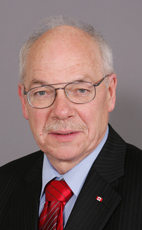
House of Commons photo

Crucial Fact

  • His favourite word was reform.

Last in Parliament September 2008, as Liberal MP for Kitchener—Waterloo (Ontario)

Lost his last election, in 2011, with 38% of the vote.

Statements in the House

Student Assistance Reform Initiative February 14th, 1997

Mr. Speaker, seven national associations in the post-secondary education sector jointly proposed the student assistance reform initiative which, if enacted, would make higher education more accessible. I urge all members to study the proposal. As an active member of the caucus committee on post-secondary education, I applaud the groups involved in preparing and releasing this document.

Right now Canada's student loans can be a problem, not only for those trying to pay them off but also for those charged with trying to collect on defaulted loans. We can address this situation and acknowledge the realities faced by graduating students by establishing an income contingent loan repayment plan. This is especially relevant to those in the early stages of their careers after graduation.

Education is of vital national interest to Canada. When we invest in Canadians we strengthen our economy and improve our competitiveness in the global marketplace.

Public Safety Officers Compensation Fund February 12th, 1997

Mr. Speaker, I am pleased to rise on Motion No. 306.

Prior to coming to this House I had the occasion to work closely with police officers in my work with Youth in Conflict with the Law. As well, when I was on Waterloo city council I had the occasion to work with firefighters in my community in Waterloo. Now, as a member of Parliament, I have in my constituency firefighters from the city of Kitchener as well as volunteer firefighters from Woolwich Township. They are one of the finest groups I have the honour and privilege of knowing.

As well, these people are on duty 24 hours a day. Be it Christmas, New Year or any other holiday, we know that firefighters, the police officers and other emergency workers are at work while the rest of us are enjoying festivities.

In many cases police officers are the only social workers, if you will, available after hours. It is quite humourous because the old line police officers did not see themselves as social workers. That is what they are and that is what they have done. These people represent a very real safety net in the case of emergency in our community.

When I was on city council I used to joke with the firefighters. I told them that they were one group of people who worked for the city whom I did not want to see work and I hoped they had no work to do. The fact is when that alarm bell rings and the call comes in,

firefighters are quickly on the move to make their way to a fire or to respond to a three tier response, where any emergency might take place where life is threatened. That might be at the scene of an accident where they will go with the jaws of life, saving lives.

What impresses me about them is every time they go on one of those calls they put their life at risk. It was about four years ago that Captain Kieswetter went to a house fire in Kitchener and lost his life when he was overcome by smoke. He gave his life in terms of service to his community.

Back in the mid-eighties there was a fire at Horticultural Technologies. Many dangerous chemicals were part of the fire. The final decision has not yet come down, since it is before the courts, as to why six firefighters a few years later died of cancer or why the first police officer at the scene died of cancer. There is an inquiry investigating the circumstances of that fire.

We know that when those individuals respond they respond to very dangerous situations.

Oftentimes I walk to the back of the Parliament Buildings to look over the Ottawa River and Hull. Sometimes I stop by the monument which is dedicated to police officers and peace officers. There are hundreds of names of individuals on the monument who gave their lives in the line of duty, serving their fellow citizens and their communities.

What this motion addresses is the need for financial compensation to take care of the families and loved ones of the people who are on the front lines and who in the line of duty give their lives.

I applaud my colleague for introducing this motion. It is something which Canadians will support from coast to coast to coast.

I would like to read something into the record which I hear every time I attend a professional firefighters function in my community. This is the firefighters' prayer all across Canada:

When I am called to duty God, Whenever flames may rage, Give me the strength to save some life, Whatever be its age.

Help me embrace a little child, Before it is too late, Or to save an older person from The horror of that fate.

Enable me to be alert, And hear the weakest shout, And quickly and efficiently To put the fire out.

I want to fill my calling and To give the best in me, To guard my every neighbour and Protect his property.

And if according to Your will, It is time to end my life, Please bless with Your protecting hand My children and my wife.

In a very real way that is what this motion is meant to accomplish. I strongly endorse it and urge that we work toward making it a reality.

Centres Of Excellence February 6th, 1997

Mr. Speaker, the Centres of Excellence program allows university, government and private researchers to join forces on cutting edge technology projects.

Networks of Centres of Excellence have won an international reputation for doing high quality research which is relevant to private and public sector activities in Canada and around the world. The networks have been praised in Europe and the United States as areas in which Canada has excelled by getting university researchers to collaborate with each other and with industry.

The Centres of Excellence have contributed to the economic growth of the country by the rapid transfer of technology, the establishment of many new companies and the training of a highly skilled workforce.

By working together to provide the transfer of knowledge, the universities, governments and the private sector have made a greater impact than individual researchers would have done alone.

The continuation of the Networks of Centres of Excellence program is essential for Canada to compete on the global scene.

Research And Development December 11th, 1996

Mr. Speaker, Canada's universities have proposed a five year $1.8 billion program to build and renew Canada's research infrastructure, and to help keep the country's top young researchers in Canada.

The federal government would pay for roughly half of the project while the rest would be provided by the universities and the provinces. The program would provide funding for top quality researchers and would help stop the brain drain to the United States and renew the network of centres of excellence program.

As technology becomes more and more sophisticated, and research more collaborative and interdisciplinary, the renovation and expansion of laboratory areas in such fields as information technology, environmental science, engineering and biotechnology become essential for Canada's ability to compete in the global marketplace.

Innovation at home means exports abroad and jobs for Canadians at home. The research infrastructure program is essential for Canada's economic growth.

Education November 27th, 1996

Mr. Speaker, the sixth annual ranking of universities in Canada by Maclean's once again confirmed the excellence of the University of Waterloo and Wilfrid Laurier University. The University of Waterloo ranked first among all Canadian universities. It was judged the best overall university, the most innovative university and in producing the most leaders of tomorrow.

Wilfrid Laurier University finished first in the primarily undergraduate category in the proportion of students who entered university with an average of 75 per cent or better and in the proportion of students who graduate.

I congratulate the two universities in Waterloo, while being acutely aware that post-secondary institutions in Canada are under stress due mainly to diminishing financial resources. Funding for our post-secondary institutions has to be a national priority viewed as an investment in our collective future as a nation.

Canada Elections Act November 26th, 1996

Madam Speaker, I would first like to say that we have some good representation coming from western Canada. Certainly the member for Vancouver East is one of those people. She has worked long and hard on the issue.

In terms of western alienation, I really have to take exception to the member for Lethbridge. Let us not forget that the member for Lethbridge, before coming to this House, was a member of a Progressive Conservative cabinet. While that member waxes eloquently in this House about all the evils of big government, let me tell him that since he has been in this House collecting a salary as a member of Parliament, he has also collected a pension of somewhere around $200,000 from the taxpayers in the province of Alberta.

All I can say to the member for Lethbridge is shame.

Crime Prevention November 20th, 1996

Mr. Speaker, last Thursday the Waterloo Region Community Safety and Crime Prevention Council released its report on making Waterloo region a safer and more secure community. The report is the result of 14 months of hard work by over 80 members of the task force who represent a cross-section of my community.

The report states that crime prevention is everyone's concern and challenges the community to imagine a community in which all members can be safe and feel safe. The report notes that while Waterloo region has a low relative crime rate, residents have an increased fear of crime.

The 50 recommendations of the report challenge the community to fight crime and be involved in crime prevention by dealing with the root causes of crime. The report notes that the offender of tomorrow is the vulnerable child of today, and that physically abused children are five times more likely to be violent adults.

I salute the council for its valuable work. It will help in maintaining Waterloo region as one of the safest and most secure communities in Canada.

Committee Of The Whole October 28th, 1996

Madam Speaker, I never cease to be amazed by the interpretations of the members of the Reform Party and also how twisted their arguments become. A minute ago, they asked me if I would support a member of the Bloc for the position of deputy speaker. I said in my statement that I support the member for Kingston and the Islands.

I told them that if they were intellectually honest and consistent in their position, they would have nominated a member of the official opposition. Then they ask me if they nominated a member of the official opposition, whether I would support it. I said: "No, I am consistent, I support the member for Kingston and the Islands". The opposition members then turn around and accuse me of supporting positions in committees that tradition dictates they hold.

It is not good enough for members of the third party to be lusting for power and lusting to be the official opposition. There is a way to do that. They had the opportunity during the byelections. They have to win those byelections. They have to do that the old fashioned way, by earning it.

Committee Of The Whole October 28th, 1996

Madam Speaker, there were a number of questions asked. I will respond to four of them.

The member said I did not answer the question. I made an observation on intellectual dishonesty. I said that is what was coming from the Reform Party by way of what it proposes to accomplish. That was an observation and I make that same observation again.

I have already said that I support the nomination of the member for Kingston and the Islands.

Second, he made reference to the appendix of the red book.

Let me commend the hon. member for reading the indexes of the red book. I presume he must have read the main body of the red book also where we talk about not pitting region against region, not pitting Canadians against Canadians. We take a national perspective, recognizing that this country has diversity in its population, diversity in its culture, diversity in its make-up. The member should go back and re-read that part of the red book. Once he finishes that part of it, we will talk about its appendices.

The other issue that he talked about is opting out of MPs' pensions. A promise was made in the red book. That promise was we would set an age limit before members of Parliament could collect a pension. We went beyond that and lowered the payouts in the pension plan. We went beyond what we said in the red book. Those members from the third party should be applauding the government because we did what we said we would do. As a matter of fact we went beyond it.

Let me also say that, in terms of fourth issue he raised, the matter of principle, on this side of the House we do not need lessons in principle from members of the third party. They would pit regions against regions, Canadians against Canadians. They would do anything to become the official opposition. They stood in the House, aiding and abetting the Bloc during the referendum when, on this side of the House, we were trying to keep this country

together. We do not need lessons from members of the third party on the issue of principle.

Committee Of The Whole October 28th, 1996

Madam Chair, I would like to thank my hon. colleague for agreeing with me about the hypocrisy of their party's position in putting forth one of their own members and then making the kinds of arguments they have.

As I said before, the motion to appoint the member for Kingston and the Island is an excellent motion. I said that he would serve the House and Canadians well.