
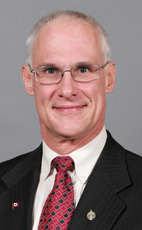
House of Commons photo

Crucial Fact

  • His favourite word was section.

Last in Parliament September 2008, as Liberal MP for Scarborough Southwest (Ontario)

Won his last election, in 2006, with 48% of the vote.

Statements in the House

Rights Of The Unborn March 22nd, 2001

Madam Speaker, I appreciate the opportunity to speak on the motion. For those who might be following the debate on television, let us be clear that this is a motion, not a bill. Before I begin my remarks I will reread the motion for the record and then comment on the remarks of the three previous speakers.

The motion is fairly simple and yet extremely complex:

That, in the opinion of this House, the government should bring in legislation defining a “human being” as a human fetus or embryo from the moment of conception, whether in the womb of the mother or not and whether conceived naturally or otherwise, and making any and all consequential amendments required.

First of all, I wish to commend the hon. member who moved the motion for doing just that. I wish to commend him as well on his concise and correct history of this issue in Canada.

I want to remind the people who have spoken and people who are watching that this is not some esoteric topic that we are trying to impose here. There already is, as the hon. member for Yorkton—Melville pointed out, a definition of human being. It is already in the criminal code.

The issue is this: are we as Canadians comfortable with the definition that is already there, or should we, based on whatever considerations we believe to be correct, amend that definition?. We are not going back to the middle ages by reviewing the question, which is already in the criminal code. The question is simple. First, where does human life begin, and second, where does society wish to protect human life?

We already know that society at least wishes to protect human life from the time stated in the criminal code, and that is, as we have heard, when the child exits the womb, whether breathing or not. The question now is do we wish to extend that protection backward, or shall we say forward, to the development of the child? That is, in my opinion, a reasonable question to ask. That is all we are doing. That is all this motion is trying to do. It is trying to bring this issue to the forefront.

The parliamentary secretary, in his remarks, which I found to be respectful, recognized the importance of some of the comments that were made by the mover. I do not want to be completely complimentary of the mover of the motion because I do not think this matter should be dealt with in a partisan way. I do not think this matter should be debated by pointing fingers to this side of the House and saying what this side of the House does and what they do not do over there, or anything like that. This is a bigger issue than a political issue. This is an issue of life and death and should not be discussed on a partisan basis.

I will remind listeners that the votes and the bills talked about by the mover were brought forward by a Conservative government. The votes were free, except for cabinet ministers, and people voted for or against the legislation for a variety of reasons.

To educate the member from the Bloc Quebecois, I can tell her that there were women on this side of the House who voted against the legislation, not because it so-called offended the rights of women, but because it did not go far enough to protect the unborn child. Of course she was not here at that time so she might not know. I was.

I found it interesting when the member from the Bloc Quebecois said that this matter had been dealt with and therefore we should not deal with it again. It is a very interesting philosophy from a party dedicated to the breaking up of the country. That matter has been dealt with. There was a referendum. What legitimacy does that person have to sit in the House and attempt to break up the country when the matter has been dealt with? We cannot have it both ways. If a matter has been dealt with, fine, then it has been dealt with, but we cannot pick and choose which matters have been dealt with and which matters have not.

I am a lawyer. I do not know if the Bloc member is, but in my view she misstated the holding of the Supreme Court of Canada. It was correctly stated that the Supreme Court of Canada found that there were technical reasons why the law that was in place was not in accordance with the constitution and it did turn the ball back to the Parliament of Canada to do whatever it wished to do in order to correct that. There is no legal right to abortion in this country, according to the Supreme Court of Canada. That is a misstatement of the Morgentaler decision.

She also mentioned the Bible. I was not going to mention the Bible because as soon as one does that, one imposes one's views. However, the member opposite mentioned the Bible. I would just like to remind her about a little story in the Bible which I am sure she is familiar with. When Mary, who was going to become the mother of Jesus, visited her cousin Elizabeth, who was carrying John the Baptist, the baby leapt in her womb, says the Bible, in anticipation of the great joy of Jesus being born. The Bible uses those words, the baby leapt in her womb. Not the fetus, not the zygote, not the embryo, but the baby leapt in her womb for joy. That is from the New Testament.

I do not want to talk about the New Testament. I want to talk about the motion. The parliamentary secretary said there is no consensus in Canada on the issue of abortion. I do not want to talk necessarily about abortion. I want to talk about the definition of human being. Of course abortion is one of the consequences, as the hon. member from the Bloc Quebecois correctly stated.

There are a number of consequences that flow from this motion. One of them is, what is the definition of human being? There is no consensus on that issue, as we have already heard in the debate, but does that mean there is no truth? There was no consensus that the earth was round. In fact I would say that the majority of people thought at one time that the earth was flat. Did that make the earth flat? No.

At one time the majority of people around the world felt it was perfectly reasonable to have slaves. Even the Bible mentions it. It is mentioned in the laws of Moses as to what the Hebrews are to do with their slaves. At one time slavery was considered to be perfectly acceptable and in some countries it still is. Does that make it perfectly acceptable? No.

The truth is that slavery is wrong and the truth is that the earth is round, no matter how many people say that slavery is acceptable and no matter how many people say the earth is flat.

Is what is inside the womb a human being? That cannot be decided by consensus. It is either a truth or it is not. Let us look at that.

As was mentioned by the previous speaker, we have a law of science. It is undisputed. It is the law of biogenesis. It is very simple and very logical and it cannot be argued, that is, like begets like, period, full stop. Two hamsters cannot produce a frog. Two dogs cannot produce a cat. Two humans cannot produce anything other than a human. That is simply a fact.

Once a fertilized egg has been conceived by the act of procreation of two humans, that is the commencement of human life according to the law of biogenesis. If that is the commencement of human life, does that life need protection? Let us look at it philosophically.

We are talking about human rights and protecting against discrimination, but we cannot talk about the discrimination that the unborn child has. It has no rights. It has an absolute impossibility of protecting itself from a decision that another person makes about its very right to breathe.

Do you not find it interesting, Madam Speaker, that on the one hand it is perfectly acceptable and legal in Canada at the present time to kill an unborn child at any point of its development, right up until it comes out of the womb, yet on the other hand we are wringing our hands about the ethics of experimentation on zygotes?

Where is the logic in that? How can it be logical to permit a third trimester abortion at eight months without blinking our eyes and wring our hands about whether or not a fertilized egg is going to be flushed down a scientist's drain?

Let us start thinking about the realities of what we are talking about. Do we discriminate on the basis of size? No. Therefore we should not discriminate on the basis of the size of the fetus. Do we discriminate on the basis of level of development? No. If someone has a lower IQ than someone else we do not discriminate. Therefore, why do we discriminate because the unborn child has a lesser level? It is the same with its environment and degree of dependency.

This is an issue of fundamental human rights. The issue should be discussed in parliament. All of the views should be aired and decisions should be made. We should not be afraid of discussing the issue. I commend the hon. member for bringing it forward.

Employment Insurance Act February 13th, 2001

Mr. Speaker, I am voting in favour of the motion.

Hungary May 10th, 2000

Mr. Speaker, for the country of my ancestors, Hungary, the year 2000 marks a special anniversary. The Hungarian state is 1,000 years old.

At Christmas in the year 1000 AD, almost 500 years before Europeans stumbled upon the new world, Stephen, the first king of the Magyars, was crowned with a crown sent by Pope Silvester II. King Stephen later became St. Stephen, canonized on August 20, 1083.

Many celebrations are planned in Hungary for this historic milestone. On May 19 and 20 in Budapest the Hungary 2000 Conference will be convened. The Canadian parliament will be represented by a delegation of the Canada-Hungary Parliamentary Friendship Group led by me.

I look forward to extending congratulations on behalf of all parliamentarians as Hungary celebrates 1000 years of statehood, the Magyar millennium.

Criminal Code May 2nd, 2000

Mr. Speaker, I seconded this motion because I support section 43. I want to discuss this motion and take the approach of a lawyer as opposed to a teacher.

I want to say for those who are following the debate either in Hansard or on television or in other reported media that this is a motion, not a bill. This motion was not deemed to be votable by the subcommittee on private members' business so there will be no vote. Indeed, the speeches this evening will end after one hour of debate and the subject matter will be dropped from the order of debate. Having said that, I think the subject matter is important. I commend the hon. member who is the mover of the motion for bringing it forward, particularly in view of the current legal history.

The motion calls for the federal government to defend the section. As I am sure the Parliamentary Secretary to the Minister of Justice will point out when he gets a chance to speak, the federal government is defending section 43 and did defend section 43 before the Supreme Court of Canada. I want to take a look at the section specifically. We are talking about section 43, but perhaps people do not truly know what it says. It is really very short, so I propose to read it.

I am referring to Martin's Criminal Code , which refers to section 43 of the Criminal Code of Canada. It states:

Every schoolteacher, parent or person standing in the place of a parent is justified in using force by way of correction toward a pupil or child, as the case may be, who is under his care, if the force does not exceed what is reasonable under the circumstances.

It is important to note exactly to whom this section applies. It applies to schoolteachers. It applies to parents. It applies to persons standing in the place of a parent. It applies to child and pupil. It does not apply, let us say, to police, coaches or others who might come in contact with children. It applies to those individuals named.

I want to read a brief synopsis of section 43 contained in Martin's Criminal Code .

This section justifies the use of force by certain persons to correct a child or pupil.

Of course “force” is not defined. Some people call this the spanking section, but there are many other kinds of force that may be used in varying degrees that are not spanking. It is important to note that we are talking about the use of force.

It continues:

The persons who may rely upon this section are schoolteachers, parents or those standing in the place of a parent. The child or pupil must be under the care of the person using the force, and the force must be applied for the purpose of correcting the child.

That is critically important. The force must be applied for the purpose of correcting the child. It continues:

Thus, if the child is too young to learn from the correction or is incapable due to mental disability, the use of force will not be justified by s. 43. The force applied cannot exceed what is reasonable in the circumstances...

In determining whether the force used has exceeded what is reasonable under the circumstances, the court must consider both from an objective and subjective standpoint such matters as the nature of the offence calling for correction, the age and character of the child and the likely effect of the punishment on the particular child, the degree of gravity of the punishment, the circumstances under which it is inflicted and the injuries, if any, suffered.

These two citations I have made specifically because to me they indicate how this section is to work. It is a very specific section, designed for very specific people in very specific circumstances. It is designed to be examined on a fact by fact situational basis. To me that is what is important. What may be reasonable use of force by a teacher in one circumstance may not be reasonable use of force by a teacher in another circumstance. It is very important that there be a combination of the objective and subjective tests.

It is also very important for the reasons we heard from the two members who spoke previously, that the use of force in appropriate circumstances in a reasonable manner be continued to be permitted. We heard a couple of the more obvious examples given by the member for Winnipeg—Transcona, in particular where the immediate safety of the child is of concern.

The people who have opposed section 43, in my opinion, have taken worst case fact situations and applied them to tar section 43 with an unnecessarily black brush. The court system is adequately designed to deal with each individual fact situation. If there is an aberrant decision by an aberrant judge, the court of appeal is there to provide guidance in a particular circumstance.

The use of appropriate force in appropriate circumstances has been part of human history since the first child was produced. It seems eminently reasonable that section 43 is there not only for the protection of the child, but also for the protection of those who apply force in reasonable circumstances for the purpose of correction.

Having said that, I really do not want to go on ad infinitum. The section is reasonable. There is no reasonable argument that I can see or accept for the abolition of the section. I think it should be maintained.

I want to say one thing, however, about the use of section 33. I think that the motion stated that if the section were to be found unconstitutional, then we should use section 33. With that I agree. That is a nuclear option that parliament has to control the courts. It should be used very sparingly and very carefully, but it can be used and should be used in appropriate circumstances to demonstrate the supremacy of parliament.

Modernization Of Benefits And Obligations Act April 3rd, 2000

Mr. Speaker, I am very pleased to address the House today, in particular with respect to the amendment which I have proposed, Motion No. 5.

However, I begin my remarks by noting in passing that the hon. member who spoke just before me began his remarks by trying to say that this bill has nothing to do with marriage, and then spent the next nine minutes of his speech telling the House why gays and lesbians should be able to marry. Clearly this bill has something to do with marriage. That of course is why people were concerned about the institution of marriage as they had always known it. That is why numerous witnesses appeared before the justice committee to express their concerns. That is why thousands of people have contacted their members of parliament to express their concerns.

What has the government done in response to that? It has addressed the concerns of the people who have contacted the House of Commons. It has done so, I would say, a bit late, but better late than never.

What has the government done? It has not done anything radical. It has not done anything unusual. It has simply restated what most people in this country know to be the definition of marriage. It has restated it in clause 1.1 of the bill, which is worth referring to. It reads:

For greater certainty, the amendments made by this Act do not affect the meaning of the word “marriage”, that is, the lawful union of one man and one woman to the exclusion of all others.

That is exactly what marriage is and that is what I would argue marriage should remain. I believe I speak for the vast majority of my constituents when I make that statement.

My amendment is a very specific amendment. It states that wherever the word “marriage” appears in Bill C-23, immediately after that word the definition of marriage should be placed in parenthesis, namely, “the lawful union of one man and one woman to the exclusion of all others”.

Why have I brought this amendment in view of clause 1.1 moved by the government in committee? I guess we are talking technicalities. This is the way I view it. Bill C-23 is an omnibus bill. The sole purpose of the bill is to amend 68 statutes of the Government of Canada.

Once Bill C-23 becomes law, as I am certain it will, the 68 statutes that it seeks to amend will be amended. In effect, therefore, the function of Bill C-23 will have been completed. All of the parts of Bill C-23 deal with other acts. They command that those other acts be amended. Once Bill C-23 becomes law, all of the sections which command that other sections of other acts be changed will be changed.

In effect, Bill C-23 will have served its purpose and will be legally spent, except for clause 1.1, which will remain all by itself, in what I term a ghost law; a law with only one section, having completed its task. That ghost law will remain a law but will soon be forgotten. It will not be reproduced in the revised statutes of Canada. It will not be before parliamentarians on a daily basis. It will not be before adjudicators, administrators, functionaries, bureaucrats and, most importantly, it will not be before judges on a daily basis.

However, if we add the definition that is in clause 1.1 as a parenthetical definition after the word “marriage” wherever it appears in Bill C-23, then as Bill C-23 amends each of these acts that definition will be carried into each of those acts, so that judges, administrators and parliamentarians, when they are dealing with specific sections of a pension bill, the Income Tax Act, the Judges Act, the Members of Parliament Retiring Allowances Act, or whichever act it is of the 68 statutes involved, that definition would be front and centre before these people who are dealing with these acts on a daily basis. Otherwise, it would be out of sight, out of mind.

My amendment adds the exact words from clause 1.1 as a definition after the word marriage in each and every place where it appears in Bill C-23. It does nothing more.

I noticed the member who spoke before me used his familiar tactic, in that he attempted to demonize those who disagree with him. He used his usual pejorative words such as “dinosaurs” and “unholy alliance”. This is a favourite tactic of those who have no real argument; it is not to attack the argument but to attack the person making the argument.

I cannot say it any better than Hartley Steward who wrote a column in the Sun on Sunday, April 2. I would like to read his take on this kind of attempt to demonize those who disagree with the legitimization of same sex marriage:

The shame is threefold.

First, in this fashion, extremists steal from all Canadians the agenda of political campaigns and make impossible a thoughtful and useful discussion of a broad range of issues. In their mindless way they take from us the ability to address the issues, like health care, which need our attention.

Indeed, they make it impossible for us to enjoy the practice of democracy.

This is not an accident. It is by design. It is vital for them to make primary only issues on their agenda and to attach despicable motives to those who hold honest beliefs on the side opposite theirs. It is a victory for their side if they can demonize those who hold different views; if they can characterize them as bigots, tyrants and dangerous people.

Then they need not debate the issues. Listen to the juvenile chants and you will realize how futile it would be for them to engage in debate with people who can actually think in sentences and employ logic in their arguments.

Homosexuality and how a society can and should deal with it is a debatable issue. Homosexuality itself, its cause and effect, is still a debatable issue. It has been since the time of Socrates. It is not good enough, nor does it serve society well, to demonize anyone who asks a question or holds a contrary view.

But if you can demonize someone, convince the world he asks the question because he is an evil person, why the argument is won.

To chant, red-faced and hysterically, “anti-choice” at someone who is against abortion is again the tactic of those who care nothing for democracy, and would frustrate it in a moment to gain their ends.

That is what we see when people do not like to hear the kinds of comments for example that I am making. I allow that in a democracy everybody has the right to make the comments that they wish to make without having to be called names. It is ultimately up to the people of Canada in the House and through elections to decide what direction they want their country to take. Enough of this name calling. Let us just deal with the issues.

For my part, I advised the government that in my view the best way to have approached the protection of marriage as we have always known it was to amend the Marriage Act and the Interpretation Act. Unfortunately that advice was not followed. Rather we have this unfortunate way of introducing it as an afterthought in Bill C-23, but as I say, better late than never.

I ask the House to support my amendment which is that the definition of marriage be carried as a definition wherever marriage appears in Bill C-23. That definition is the common law of Canada. It is the position of the Government of Canada. It is the position of the House of Commons as decided on June 8, 1999. It is the position of Bill C-23. For those reasons, I ask that my amendment receive favourable support.

Modernization Of Benefits And Obligations Act April 3rd, 2000

moved:

Motion No. 5

That Bill C-23, in Clause 2, be amended a ) by replacing line 14 on page 1 with the following:

“(ii) marriage (being the lawful union of one man and one woman to the exclusion of all others)”, in the sense that one is” b ) by replacing “marriage” with “marriage (being the lawful union of one man and one woman to the exclusion of all others)”, wherever it occurs throughout the Bill after Clause 2, with any changes that the circumstances require.

Modernization Of Benefits And Obligations Act April 3rd, 2000

Madam Speaker, I rise on the same point of order. I have some further citations to perhaps help the Chair. I am referring directly to Beauchesne's sixth edition, Rules & Forms of the House of Commons of Canada with Annotations, Comments and Precedents , and specifically to page 211 thereof, paragraph 714:

A Note to Standing Order 76(5) adopted in 1987, instructs that the report stage is not meant to be a reconsideration of the committee stage of a bill. Instead, it is intended to be an opportunity for Members who were not members of the committee to propose specific amendments not dealt with by the committee.

In this case the hon. member for Burnaby—Douglas was a member of the committee. His motion was dealt with by the committee. I would suggest that paragraph is definitive in ruling his motion out of order.

Petitions March 30th, 2000

Mr. Speaker, I have a petition signed by numerous people from the province of Ontario.

It points out that Canada has the second highest incidence rate of breast cancer in the world, second only to the United States, and that the United States has had mandatory mammography quality assurance standards since October 1994.

Therefore the petitioners call upon parliament to enact legislation to establish an independent governing body to develop, implement and enforce uniform and mandatory mammography quality assurance and quality control standards in Canada.

Petitions March 2nd, 2000

Mr. Speaker, my second petition pertains to the Falun Dafa also known as the Falun Gong in China.

The petitioners, primarily from my area of Scarborough, Ontario, appeal to the Parliament of Canada to continue urging the Chinese government to release all arrested Falun Dafa practitioners in China immediately, to lift the ban of Falun Gong practice, to withdraw the international arrest warrant for Mr. Li Hongzhi, and to achieve a peaceful resolution through open dialogue.

Petitions March 2nd, 2000

Mr. Speaker, I have two petitions to present. The first one contains signatures on some 20 pages and pertains to child poverty.

Petitioners from all across Canada call upon parliament to use the federal budget 2000 to introduce a multi-year plan to improve the well-being of Canada's children. I am glad to notice that the government has listened.