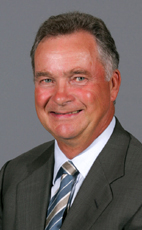
House of Commons photo

Crucial Fact

  • His favourite word was industry.

Last in Parliament November 2005, as Conservative MP for Peace River (Alberta)

Won his last election, in 2004, with 65% of the vote.

Statements in the House

Agriculture December 4th, 1998

Mr. Speaker, on December 6 American farmers will be blockading the Canada-U.S. border. This will only add to the economic problems faced by Canadian farmers.

For the past two months the government has been telling us that its trade working panel will resolve all these issues. We find out today that it is a total sham. It is resolving nothing.

Will the minister finally get out from under his desk, talk to the Americans and tell them that we will not take this harassment any more? Or, does he have to ask the Minister of Canadian Heritage for permission to do that?

Agriculture November 30th, 1998

Mr. Speaker, I will be splitting the remaining 20 minutes with the members for Lakeland and Kootenay—Columbia. I am happy to take part in the debate this evening because it is of great importance to my riding of Peace River, Alberta which is mainly an agriculture producing riding. Farmers in Peace River country know full well the impact of the agriculture trade wars that have taken place in the past.

In order to talk about this issue we have to talk about the massive trade war that was taking place as a background to the Uruguay round negotiations in agriculture. Agriculture has been one of those mavericks that have not been under trade rules in the past. For over 50 years we have had trade rules with regard to industrial products and some services around the world. But agriculture was not brought under those trade rules until 1992 and only then it was a modest start. The backdrop was the massive trade war that was taking place during the 1980s. I know from my own experience, having farmed during that period, I certainly do not want to go back there again and be subject to those massive European and American subsidies. I do not want to, nor does my son, to go back to the situation where we have farm programs where we have to jump through all the hoops in order to qualify, in other words farming the program, growing wheat year after year with crop rotation which really it did not call for it at all. It was not a good agricultural practice.

We do not want to go back there. That is the setting for the Uruguay round that took place with the signing in 1992.

I have to remind the House that it was only a modest start. All farm countries recognize it was a modest start, that we had to at least get agriculture started. They used 1986 as the base year for calculating subsidies, one of the highest years in the history of agriculture subsidies in the world.

The idea was to get agriculture started, reduce some tariffs, reduce export subsidies by a modest amount, build in a future round which is the one we are talking about for 1999-2000 in order to make great progress. I guess I would have to say it is understandable that we are in the situation we are today.

Over 85% of the world trade in agriculture is still not subject to controls through rules. In addition, this has brought about a very stagnant farm net income situation. For the last 10 or 12 years we have had stagnant farm net income in Canada. The east Asian situation has hurt us further.

Here is the present situation. Farmers are hurting, net farm income has decreased and there is the continued big use of European and American subsidies, although they are staying within their limits on their program. That brings me to what we need to do to correct the situation.

We are talking about some kind of short term program, but that is not the answer for farmers in the long term. I would make the case that we have to work together with like minded countries to advance this farm negotiation that is going to be taking place at the World Trade Organization.

The Cairns Group has been very active in looking for trade liberalization. I would make the case that we have to also include the United States as an ally in reducing massive European subsidies. The reason I say that is I believe they are only basically responding in the United States to European subsidies, not really wanting to do it themselves, but Europe has the systemic problem of trade and agriculture subsidies. I believe it has the problem for a number of reasons such as a couple of world wars where it was short of food.

That does not excuse the European Union for producing beyond what it requires itself. That is what is happening these days. It is overproducing. Last year world wheat demand was down by 8% but what did we see from the European Union? A 30% increase in production. That is because farmers are getting these massive subsidies.

I suggest we have to co-operate with the United States. It is one of the world's biggest grain producers. I think it is in our interest to work together to try to convince the European Union to phase down these subsidies in the next round of the World Trade Organization talks to be taking place within the next year.

I suggest we might have to move outside the agriculture box in order to do that. We have to put some pressure on these people. We might have to talk about industrial tariffs. We might have to talk about security in things like NATO, intellectual property, services, all things the European Union would probably want. I think we have to be very forceful because our farmers simply cannot compete against the treasuries of the other countries. We can compete on the basis of production with anyone in the world but we cannot compete with the treasuries of the United States and Europe. It is in our interest to try to get some trade liberalization.

Trade November 30th, 1998

Mr. Speaker, why are we jeopardizing important trade relations with the Americans for a bill that not even the minister's backbench supports?

When will the Prime Minister rein in the heritage minister and her cultural cops and look after the interests of our farmers? Should that not be our top priority?

Trade November 30th, 1998

Mr. Speaker, today the Minister of Foreign Affairs has gone to Washington cap in hand to try to quell another agriculture blockade. The problem is the heritage minister has poisoned any goodwill with the Americans with her protectionist split-run legislation.

Who let the heritage minister loose and how is this going to help Canadian farmers?

Special Import Measures Act November 26th, 1998

Mr. Speaker, Motion No. 7 would introduce an entirely new concept into the SIMA legislation. It really has to do with the retroactivity that we have a serious objection. I do not understand how this would work. It would cause a lot of confusion for businesses which need to know what kind of ground rules they are operating under. Therefore we would not support this motion.

Special Import Measures Act November 26th, 1998

Mr. Speaker, we support Motion No. 3. I understand this brings the French text into line with the English text.

However, we have a more difficult problem with Motion No. 4. Although I certainly sympathize with my colleague from the Bloc that the French part on material harm does not translate and therefore needs some clarification, material harm in English has a very precise meaning in law. It is a stand-alone section. It does not need to be defined any further. Instead of material harm, it would now mean that material harm means more than harm that is negligible, immaterial or trifling. It becomes almost silly in English.

If there is some way to resolve that I would not have a problem. But as it stands, if it is not resolved, then we will not support Motions Nos. 4, 5 and 6.

Special Import Measures Act November 26th, 1998

Mr. Speaker, I want to say from the outset that Reform is opposed to this clause largely because it contains the public interest portion in the SIMA legislation that is so important.

There are cases before the panel right now that have to do with public interest perhaps not being served by duties that were applied to baby food supposedly being dumped into Canada. The result of those duties essentially has made one company into a monopoly supplier of baby food. We think it is important to have competition. Therefore, we need the public interest section and the lesser duty aspect of it in order to maintain competition.

Speaking of the lesser duty itself, the question is, why would we want a duty above and beyond what is required to actually stop the flow of goods when they are being dumped?

My understanding in some cases is that duties as high as 40% are being applied when it would only take 5% to stop the product from coming in. Therefore, we think the lesser duty idea is a good improvement and we would like to see the public interest portion of this bill actually reviewed after a few years to see if it is serving Canadian consumers to the extent that it should.

A joint committee of finance and foreign affairs and international trade reviewed the SIMA legislation. They received a number of representations from companies that asked for a lesser duty. This change is a result of those representations.

While overall we are supportive of Bill C-35 and the need for some kind of rules regarding countervail and dumping, in this case the public interest component is a very important component and we would not want to lose it. Therefore, we will not support Motion No. 2.

Special Import Measures Act November 26th, 1998

Mr. Speaker, I am happy to participate in the debate on Bill C-35 at report stage. This has to do with Canada's Special Import Measures Act and the legislation that would represent. Essentially it is countervail and dumping duties.

In a perfect world I do not think we would require either of these, but as we know it is never quite perfect. I think we simply have to keep this kind of legislation at our disposal if we need it.

With the advent of the Canada-U.S. Free Trade Agreement and then the expansion into NAFTA many integrated industries have developed. The auto pact was one that developed prior to the free trade agreement but there are others now. The steel industry has become quite an integrated industry in North America. I am thinking of the cattle industry where there are two way flows of product.

In many of our industries there really is no dumping in the true sense. There is movement across the Canada-U.S. border every day with trucks bringing in products. But there are other countries that dump into Canada. In some cases it is shiploads of steel and other types of products.

I think we want to keep this legislation at our disposal. There has been an important development in recognition of a public interest component in Bill C-35 to be discussed today as well. I welcome that.

I think we have to look at public interest especially where Canadian industry sometimes is in a shortage situation for a period of time when Canadian suppliers cannot supply products and Canadian importers need to purchase on a short term basis in order to fill their needs.

In the public interest section as well I think we have to look at where Canadian producers are inefficient and do not supply much of the market. Perhaps dumping is not such a big problem because the Canadian public consumer can benefit a great deal.

In particular I want to deal with Motion No. 1 which we are discussing today. If a Canadian industry or company decides it is being harmed by a dumping action, the process starts by filing a complaint. If it can document and prove its case there is a process that kicks into gear to determine whether there is injury as a result of that and whether there need to be duties applied to stop that dumping process. At the end of that process the public interest hearings could kick in if there is a requirement for that.

But the case being made today is that only the complainant should provide the documentation material and the appropriate government department would consider whether it is adequate documentation. No third party should be able to interfere in that process. The Reform Party agrees with the motion being proposed by the Bloc to correct this.

Manitoba Claim Settlements Implementation Act November 26th, 1998

Mr. Speaker, I listened intently to my colleague from Skeena in this debate. He raised the very important issue of making sure elections are conducted in a proper and fair manner.

Canadian people have a proud tradition of fair elections in our democratic process to elect members of parliament, members of legislatures and members of councils across Canada. We also travel to other countries throughout the world, countries such as the newly emerging democracies of eastern Europe and third world countries, to help them in the democratic process and to try to guarantee some kind of fair process. At the same time we see that the Canada elections process is not applied to things like the Canadian Wheat Board ballots or in areas like the land claims my colleague has spoken about.

Does it not seem contradictory to be going around the world telling people how to conduct elections when we are not doing it fairly at home?

Agriculture November 26th, 1998

Mr. Speaker, our Canadian farmers can compete with any farmers around the world on the basis of production but they cannot compete on the basis of foreign government subsidies and massive treasuries.

If the minister has phoned his U.S. trade counterpart, can he tell us today one positive result of that phone conversation?