
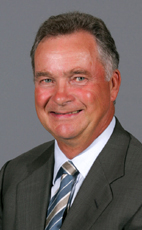
House of Commons photo

Crucial Fact

  • His favourite word was industry.

Last in Parliament November 2005, as Conservative MP for Peace River (Alberta)

Won his last election, in 2004, with 65% of the vote.

Statements in the House

Agriculture October 8th, 1998

Mr. Speaker, again this year Canadian farmers have shown that they can produce a big crop of high quality grain and oilseed. This year's crop of over 23 million tonnes is high quality wheat, 80% of which will be exported.

Canadian grain is recognized around the world for its quality. Yet in spite of this impressive performance Canadian farmers are facing a severe economic crisis. Commodity prices are at the same levels they were some 30 years ago while crop inputs continue to rise.

What is responsible for this serious deterioration in prices? We do recognize the problems Southeast Asia has had and the impacts. However, I believe the major reason for these low prices is due to the massive subsidies by both the United States and the European Union. These subsidies distort world markets by driving down grain prices.

Farmers are asking what this government is going to do to correct the situation. Where are the minister of agriculture and the Minister for International Trade? What are they doing to combat these big $50 billion export subsidies by the European Union?

Petitions September 30th, 1998

Mr. Speaker, the third petition asks parliament to enact Bill C-225 so defined in statute that a marriage can only be entered into between a single male and a single female.

Petitions September 30th, 1998

Mr. Speaker, the second petition notes that children have a need to be loved and nurtured by both parents and the right to be economically supported by both parents.

The petitioners call on parliament to pass legislation incorporating the rights of children and the principles of equality among parents.

Petitions September 30th, 1998

Mr. Speaker, I have three petitions to present today.

The first is signed by 73 people from my riding and requests that parliament support laws which severely punish all violent criminals who use weapons in the commission of crimes, support the new Criminal Code firearms control provisions which recognize and protect the right of law-abiding citizens to use recreational firearms, and would repeal existing gun control laws.

Candu Reactors June 11th, 1998

Mr. Speaker, that is not what the House understood on Monday. It understood that this government did not have much involvement with this deal, that it was basically EDC that put this deal together.

EDC official Rod Giles said that the loan had to be approved by cabinet before it could go through because it was a Canada account loan.

Will this minister now admit that cabinet had full knowledge of this deal before it went through?

Candu Reactors June 11th, 1998

Mr. Speaker, on Monday of this week the Minister of International Trade told this House that his government had little to do with the $1.5 billion contract of Candu reactors and the loan guarantee.

Now we learn that there has been a letter released that quotes David Dodge, the former deputy minister of finance, as saying that there were negotiations between finance and EDC for months to put this deal together.

Will the minister now admit that the cabinet knew full well the extent of this deal and ultimately had to sign it before it could be approved?

Supply June 9th, 1998

Mr. Speaker, I listened to the question from the member for South Shore. I noticed there was not an answer given to that question. I think it deserves an answer.

We have had hand gun registration in Canada since 1935. We have a long gun or rifle and shotgun registration system based very much on that same principle. We know there are more hand guns used in the commission of crimes than ever.

Looking at that model I am wondering if the member for Waterloo—Wellington can tell us how registering rifles and shotguns will improve that situation based on the knowledge we have that it has not improved the situation by having hand guns registered all this time. I think the member for South Shore made a very important point.

We know criminals are not going to register their long guns. They did not register their handguns either, we know that. In rural areas like I represent, it is a real inconvenience. It is a high cost for people to register their guns.

It is not going to be as simple as some member suggested, a postcard style registration mailed back in. We know over 20% of guns do not have proper serial numbers or duplicates. It is going to be much more expensive.

The question bears repeating. How is Bill C-68 going to cut down on crime by causing the registration of riffles and shotguns?

Supply June 1st, 1998

So why is there 4% more unemployment?

Supply June 1st, 1998

They all have jobs.

Supply June 1st, 1998

Madam Speaker, I listened with interest to the member for Elgin—Middlesex—London talk about the EI fund and the money that was in there and how well the economy is doing.

The discussion today about the $15 billion or $16 billion surplus in the EI fund reminded me a little bit about the famous Jim Carey, a Canadian of course who has done very well. In one of his movies, called “Dumb and Dumber”, they found a briefcase full of money. They were in the process of returning it to a lady in Colorado Springs, travelling across the United States, and when they discovered what was in it they decided to borrow a bit to finance expenses along the way. By the time they got there and returned it, it was full of IOUs.

That seems to me a good analogy to use for the EI surplus. Supposedly we have a surplus in the EI fund, but there is nothing there at all. It is just a line entry in general revenue and there is nothing there. The analogy I think is pretty good, “Dumb and Dumber”.

The member talks about how well the economy is doing. We have an economy where we export a lot of product to the United States. Forty per cent of our GDP comes from exports. But I notice in the last 30 some years that our unemployment rate has been about 4% higher through good times and bad than that of the United States. We can actually chart it. In the 1980s we can see the 4% spread. In good times and in bad times it is always there.

I wonder what the hon. member's explanation would be as to why Canada is in the position where it always has an unemployment rate which is 4% higher than the United States which is one of our major trading partners.