
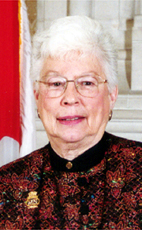
House of Commons photo

Crucial Fact

  • Her favourite word was saint.

Last in Parliament May 2004, as Progressive Conservative MP for Saint John (New Brunswick)

Won her last election, in 2000, with 51% of the vote.

Statements in the House

Veterans Affairs November 6th, 2001

Mr. Speaker, it is an honour and a privilege to rise in the Chamber today on behalf of my caucus to pay tribute and give thanks to our war veterans as Veterans Week begins. I will start by thanking the Minister of Veterans Affairs for his comments and indeed for the deep sentiment and strong patriotism that underlie them.

This is not the first time I have had the privilege and honour to rise in the House to pay tribute to our most courageous citizens. Indeed, since coming here in 1993 I have done my best to speak out for our veterans and their needs. That said, this is the first time I have done so in a time of war. It is only in the aftermath of the September attack on the U.S. and our subsequent war on terrorism that we are able to remember the September attacks on Poland and the war against tyranny waged by our best and brightest two generations ago.

When I think of the men and women in uniform who have been committed and dispatched to our current campaign I am always reminded of the day when my brothers came home to tell my mom and dad that they had signed up to fight in the second world war. They signed up in Saint John, New Brunswick to fight the Nazi threat in Europe. While thinking of them I am again brought to terms with those compelling feelings of hope, fear, pride and humility.

We owe so very much to our veterans and I fear that through the passage of time and the relative peace and tranquility in which we were blessed to live, much of their selfless sacrifice has been forgotten. On September 11, however, we were given a vivid and vicious reminder that the defence of freedom is both difficult and never ending. We were reminded in the cruellest way possible that our country needs its heroes and, though there was never any question in our minds, Canada's armed forces have answered the call. The best of this generation have, like their parents and grandparents before them, put their lives in harm's way in the defence of all things truly Canadian.

It is in many ways perhaps ironic that the two month anniversary of the terrorist attack in the U.S. will fall on November 11. As we gather at cenotaphs all across the country, we will remember the losses not only of the last century but those of the last few months. It might even be said that there has never been a more symbolic or significant Remembrance Day. This week as we honour those who have fallen let us remember those who stand on the front lines of freedom a world away. This week as we consider our contribution and commitment to the principles that have served us so well since Confederation, let us remember those who have always stood to protect those principles in times of peril and those who do so as we speak.

Above all else, let us pray under the watchful eye of our protective God that we are victorious in this campaign as our great veteran heroes have been in the wars of the past. We will remember them.

Seniors November 5th, 2001

Mr. Speaker, it is my duty to remind the House that this week is National Seniors Safety Week. While in these changing times issues of personal safety and security are foremost on all our minds, we must recognize that for our aging population there are even greater concerns requiring even greater care.

We must take seriously our responsibility to our senior citizens by ensuring that they have within their reach all the necessary means by which they can make their lives and homes safer.

In our efforts to help Canada's senior citizens we must always take steps that not only prevent accidents but also enhance independence. Simple home renovations that provide better lighting and clearer instructions on prescription medication are just two simple ways that our seniors can protect themselves.

I urge all members to work toward ensuring that seniors and seniors' issues are not pushed aside but rather that they are dealt with in a swift and decisive fashion.

In that spirit I renew my call on the government to appoint a minister of state responsible for seniors' issues to ensure that our seniors have a clear and focused voice in cabinet.

Air Canada Public Participation Act October 31st, 2001

Mr. Speaker, I congratulate my hon. colleague for his presentation but I want to ask a question. In Saint John, New Brunswick, as I was leaving to fly to Ottawa this week, one of the men who had been working at Air Canada for 23 years received his notice that he was being laid off. He needed a little more time to get his retirement pension.

When we are bringing in legislation and talking about things like this we must somehow have protection for people like him. That must be part and parcel of the legislation.

I then went to the ticket agent who had been there long before I started flying to Ottawa. She got her notice that day.

This is what is happening. Many people are being hurt right now. We gave the airline $160 million and it went out and bought another carrier instead of looking after those employees. How does my hon. colleague feel about this?

Air Canada Public Participation Act October 31st, 2001

Madam Speaker, in my hon. colleague's presentation she referred to regional carriers. Since September 11 we have seen many changes with regard to regional carrier service. It has been cut dramatically. We need that regional service in smaller areas if we expect municipalities to grow. How can we guarantee that the municipalities will be able to keep their people and the companies that employ the people if there is no regional carrier?

I will give one example. Because of the changes since September 11, next week I will have to fly from Saint John, the largest city in the province of New Brunswick, to Fredericton, then back from Fredericton over Saint John to Halifax, then from Halifax back over Saint John and Fredericton to get up to Ottawa. That is absolutely ridiculous.

I ask my colleague, what can we do to protect the regional carriers and the municipalities and make sure the quality of life the people have had is there for them and that it will continue to grow?

National Defence October 31st, 2001

Mr. Speaker, last March the Minister of National Defence confirmed that there was a pressing need to increase the number of men and women in our armed forces reserve. The minister then confirmed that the pay formula for reservists was, and I quote, “a locked in formula” at 85% of the regular forces pay rate.

Yet we now know that the minister has approved a 15% pay cut for some of our reservists and they were informed of it yesterday.

How can the minister possibly justify these cuts at time when we must recruit more reservists and when their help is needed more now than ever?

National Defence October 30th, 2001

Mr. Speaker, with the peacekeeping commitment we have made in Bosnia and around the world, our Canadian forces are stretched to the limit. This being the case, we may require our reservists to serve and provide backing for our forces. It is projected that up to one half of our reservists may not even report for duty if called. Why? Because we do not provide them with job protection like other countries do.

When will the Minister of Defence and the government take action to provide our reservists with job protection when they are called for duty?

Trade October 30th, 2001

Mr. Speaker, two sugar refineries have closed in Canada and more will be closing out west if action is not taken now.

Bill C-32, the act to implement the free trade agreement with Costa Rica, cannot be viewed in isolation of the North American and global context since it would provide Costa Rica with substantial immediate duty free access and a phase out of Canada's refined sugar tariff.

The reciprocal provisions in the agreement would not provide Canadian sugar with any commercial export opportunity. Sugar should be excluded from such regional negotiations to prevent further job losses and refinery closures in Canada. The sugar deal with Costa Rica will set a precedent with upcoming negotiations with Central America.

Canada's sugar market is already the most open in the world. Our sugar industry does not depend on any domestic or export subsidies or other trade distorting policies. Our modest 8% tariff is important until the big players including the U.S. and EU reform their sugar policies. What is in question is not free trade but fair trade.

Retail Industry October 23rd, 2001

Mr. Speaker, this week the chambers of commerce across Canada are celebrating the success in retail business in Canada.

The retail sector in Canada is big business. There are 1.7 million Canadians working in retail. Retailers sell over one quarter of a trillion dollars of goods every year. That is more than $9,000 for every man, woman and child in the country.

The retail sector is the very fabric of our national economy. At a time when Canadians are feeling less certain about events related to September 11 we must ensure that we reach out and support this important sector.

I salute the retailers of every community from the one store towns to the corporate businesses of our large cities. I would like to provide a warm welcome to the members of the Retail Council of Canada who are with us in the House today for its special “Retail Connects with Ottawa Day”.

Canadian Forces October 22nd, 2001

Mr. Speaker, there may be a role for Canadian peacekeepers in Afghanistan as part of any United Nations mission to rebuild that country. Canada will not be able to keep that commitment if our forces currently deployed complete their full missions.

Could the Minister of National Defence inform the House today what current commitments we will have to drop to put soldiers into Afghanistan as peacekeepers?

Business of the House October 18th, 2001

Mr. Speaker, I rise on a point of order. I would like to know when the hon. House leader for the government will be tabling supplementary estimates for the Office of Critical Infrastructure Protection and Emergency Preparedness.

In view of the fact that there could be terrorist attacks with regard to nuclear, biological and chemical incidents, there is a need for more money for that department. We truly need time to examine the estimates, so we would like to know when he will table supplementary estimates.