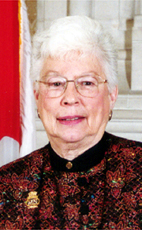
House of Commons photo

Crucial Fact

  • Her favourite word was saint.

Last in Parliament May 2004, as Progressive Conservative MP for Saint John (New Brunswick)

Won her last election, in 2000, with 51% of the vote.

Statements in the House

Ethics Counsellor June 21st, 1995

Mr. Speaker, I appeal to the Prime Minister to have his ethics counsellor investigate the awarding of a contract for legal services for the Saint John Port Corporation to a lawyer in a law firm in Saint John, New Brunswick, which is owned by the brother of the executive assistant to the Minister of Transport and in which a government member of the House continues to practise.

This is a straight conflict of interest. The awarding of this contract calls into question the integrity of the government. It is against the policies of the red book.

Criminal Code June 14th, 1995

Mr. Speaker, I am pleased to have the opportunity to address the issue of the statement of purpose and principles in Bill C-41.

I fear the government is misguided on this issue. The bill instructs judges to consider as aggravating circumstances in sentencing any evidence the offence was motivated by bias, prejudice or hate based on the race, nationality, colour, religion, sex, age, mental or physical disability or sexual orientation of the victim.

Judges have latitude already in sentencing. They have been known to use it to hand out harsher sentences for crimes they consider particularly harmful to society. Why pass a law that asks them to be tougher in a few select categories? All crime and violence should be condemned and the punishment should be in proportion to the crime.

I agree with my colleague from Central Nova that respect for our justice system stems from the notion we are all equal before the law. I do not see that principle reflected in the statement of purpose and principles of Bill C-41.

I hope none of us disagrees that it is completely unacceptable and abhorrent that anyone should be the object of violent attack for any reason. Why should one form of assault be judged or condemned as more unacceptable than another?

In my mind any assault is completely unacceptable and should not be tolerated regardless of motivating factors. It is the crime that needs to be judged, not whether the accused held a personal bias toward the victim.

Any type of act based on hatred for a group for whatever reason should be recognized as something intolerable in society. Section 15(1) of the Constitution Act, 1982 states that every individual is equal before and under the law and has the right to equal protection.

I believe Bill C-41 will to change this. It will say certain crimes against certain victims are worse than the same crime against any other victim. That is against the fundamental principles of the charter of rights, that every Canadian has the same equal right to protection under the law of Canada.

I also fear the inclusion of the words sexual orientation in the statement of principle is a back door attempt at eventually legalizing same sex benefits and same sex marriages. It has been reported that on March 30, 1995 in New York City at a UN meeting the top Canadian officials at the United Nations were pushing for homosexual rights internationally so they can

compel domestic compliance in Canada and justify the route they are taking with Bill C-41.

The government should be up front about its agenda and should also listen to Canadians. The hon. member for Scarborough West recently shared some telling information with other members about the statement of principles on Bill C-41 and the government's intention to amend the Canadian Human Rights Act. According to the member for Scarborough West 631 petitions have been presented in the House on the issue of sexual orientation. Of these petitions 87 per cent were against the sexual orientation amendment to the CHRA and/or against including the phrase sexual orientation in the statement of purpose and principles of bill C-41.

My feelings on this matter are the same as those of the members for Scarborough West and Central Nova. In the face of this overwhelming opposition why is the government not listening to Canadians, for this is a slippery slope for Canada, a slippery slope the government is taking for the traditional family unit, and it is a dangerous route that will eventually become an avalanche if it is adopted in the House.

Ontario Election June 14th, 1995

Mr. Speaker, it is usually not my style to rub salt in a wound, but after sitting in the House last week listening to all the Ontario Liberal MPs state how they were going to sweep the provincial election and wipe out the Conservatives, I feel it is time for me to have my say. Therefore, first and foremost, I am serving a special lunch tomorrow in my office. I invite all of them to come. They will eat crow as the entrée.

Also, it is truly sad to hear the Reform members taking credit for the Conservative party win when they did not get a single solitary Reform member candidate elected.

Let us give credit where credit is due. Let us congratulate Premier-elect Mike Harris and the PC party on such a decisive victory.

All I have to say to the Liberals and the Reformers is that in 1997 I will see them once again. I will be serving the entrée of crow.

Poverty June 6th, 1995

Mr. Speaker, numerous studies have shown that poverty is the biggest cause of poor health. By ending national standards for social welfare and by cutting financial support for all major social programs including UI and social housing, the federal government will not only create more poverty but will put more pressure on the health care system. Bill C-76 moves us closer to the model which is being followed in the United States.

One only has to visit any relatively large urban centre and see the many homeless people, the level of poverty, to realize that cutting social programs and giving more power to the provinces will not work without consultation.

We have always believed that Canada was a country where people cared about their neighbours, where we work toward equality and where universality meant that everyone had access to social programs.

I ask my colleagues on both sides of the House to consider these negative impacts of Bill C-76 when they vote.

Fisheries May 31st, 1995

Mr. Speaker, my question is for the Minister of Fisheries and Oceans.

As there is an upcoming NAFO meeting in Toronto, can the Minister of Fisheries and Oceans provide the House with any new information on the status of the enforcement and quota measures that were agreed to in April? Could he also tell us what Canada's position will be at this meeting?

Royal Canadian Mint Act May 30th, 1995

Mr. Speaker, I vote nay.

Business Development Bank Of Canada Act May 30th, 1995

I vote yea, Mr. Speaker.

Privilege May 30th, 1995

Thank you, Mr. Speaker.

The Minister of Health released the report two weeks ago. Over 1,300 copies were given to the press in the National Press Gallery. It contained eight pictures used in a visual impact study. To my astonishment, my picture was one of them. In the report I was stereotyped as a smoker, which I am not, grossly overweight, which my doctor says I am not, and I guess they have me almost as an 80-year-old woman, which I am not.

At no time did I give permission for the photo to be used nor did anyone from the Department of Health consult me. This type of stereotyping is an assault on my dignity as an individual and as a member of the House. It opens me up to ridicule and thus may impede my ability to perform my duties effectively.

To facilitate your work, Mr. Speaker, I would like to draw your attention to a ruling by your predecessor, Speaker Bosley, on a similar case in 1985. The issue involved an advertisement in a newspaper that identified a member of Parliament as someone else. Speaker Bosley said:

Anything tending to cause confusion regarding a member's identity creates the possibility of an impediment to fulfilment of the member's functions and constitutes a breach of privilege.

Speaker Bosley ruled that it was a prima facie case and referred the matter to the Standing Committee on Privileges and Elections. That case is similar to mine because a member of Parliament was misrepresented.

That is essentially the issue in this case. I have been identified and stereotyped in a manner that misrepresents me, not to mention the photo was used without my permission.

I have asked the Prime Minister for a public apology for the unauthorized use of this photo in a public document and a full accounting and explanation of how the health minister could have allowed this to happen. I have yet to receive a response.

Mr. Speaker, respectfully, I ask you to rule on this question of privilege.

Privilege May 30th, 1995

Mr. Speaker, I rise on a question of privilege today because I feel that my privileges as a member of Parliament and my privacy have been severely undermined by the government through its report on plain and generic packaging of tobacco products.

Because of the House recess last week, I have not been able to bring this matter to the attention of the House until today. The Minister of Health-

Business Of The House May 18th, 1995

Mr. Speaker, on a point of order, pursuant to the Thursday statement, I would like to ask the government House leader if the government intends to bring back Bill S-7, a private member's bill dealing with operating government vehicles with alternative fuels. Will he be bringing the bill back to the House for third reading to determine passage before the summer recess on June 23?