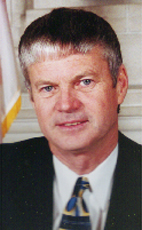
House of Commons photo

Crucial Fact

  • His favourite word was industry.

Last in Parliament May 2004, as Liberal MP for Prince Edward—Hastings (Ontario)

Won his last election, in 2000, with 50% of the vote.

Statements in the House

Agriculture November 22nd, 2001

Mr. Speaker, some months ago I asked the department to evaluate how research was balanced within our department, and we are in the process of rebalancing the research. One of the groups that brought that to my attention was the pulse industry. I have met and discussed this with them on a number of occasions in the past.

The answer to the hon. member's question is, yes. We are and will be paying more attention to research in areas such as pulse.

Agriculture November 20th, 2001

Mr. Speaker, we are constantly working on the safety net package that we have. For example, the improvements that have been made over the last two or three years are demonstrated this year when $3.9 billion in program payments between the federal government and the provincial governments in Canada will be made to Canadian producers this year.

We will go forward and build on those programs to improve them and to strengthen them at the same time that we are negotiating around the objectives that were set last week at the WTO, in order to level the playing field in the future.

Agriculture November 20th, 2001

Mr. Speaker, as the Minister for International Trade said yesterday, we did reach our objectives at the WTO meetings in Doha last week.

There are clear objectives in the ministerial text which will now allow Canada to go ahead and pursue our objectives of the elimination of export subsidies, increased market access for agriculture and agri-food products and substantial reductions in trade and production distorting domestic subsidies.

I want to thank the officials, the industry people and the MPs who were there with us and supporting us.

Genetically Modified Wheat November 7th, 2001

Mr. Speaker, those kinds of decisions will be based on science. There has not been an application for such a wheat to be registered in Canada. If there is an application at some time there is a process in Canada, which is admired by other countries in the world, in which we review the science around it. Decisions are made based on that.

Genetically Modified Organisms October 29th, 2001

Mr. Speaker, the hon. member is fully aware of the fact that four ministers on this side have written the chair of the health committee to ask her to bring in members from a number of different committees to have a discussion around the topic of food labelling in Canada. We look forward to the results and the comments of that committee.

Agriculture October 29th, 2001

Mr. Speaker, at the June federal-provincial-territorial ministers meeting there was unanimous agreement by all ministers present, all the provinces, all the territories and the federal government to move forward with an agricultural action plan, a policy framework for agriculture to move in a direction, as we said in the last throne speech, beyond crisis management.

I can assure the House that with the consultation with the industry, with the provinces, with colleagues on this side of the House and with the support of colleagues on the other side of the House we will move in that direction.

Question No. 70 October 25th, 2001

First, the government would like to express appreciation for the patience, co-operation and flexibility shown by producers, processors and distributors during this time of disruption following the terrorist attacks. Canada’s overreaching priority must be the safety and security of our borders and citizens. In view of the acts of terrorism, customs authorities in both Canada and the U.S. are more vigilant at ports of entry.

The government recognizes the importance of maintaining trade, while at the same time mitigating the risks related to the health and safety to the public. In the case of agricultural commodities, the Canadian Food Inspection Agency, CFIA, works with customs officials by inspecting products for health and safety requirements, which facilitates the movement of all commodities, especially perishable shipments and live animals.

During the early days following September 11, when large backlogs existed, initiatives such as expediting shipping lanes for the above commodities were employed. Through the dedicated work and co-operation of customs officials, CFIA and other departments, delays at the border have now been largely eliminated and presently we are not experiencing undue delays. CFIA continues to work closely with U.S. counterparts to focus resources on high risk products and carriers as a first priority.

The CFIA’s web page http://www.inspection.gc.ca/ links to Canada Customs and Revenue Agency’s web page, which provides an estimate of border delays to assist exporters in planning their shipments.

Question No. 68 October 25th, 2001

Communication branch budget for the fiscal year 2000-01 A-base budget was $5,260,000.

The cost of the April 6, 2001, Ekos Inc. research contract cost $77,688.63 for 12 focus groups held across Canada.

Agriculture October 23rd, 2001

Mr. Speaker, I do not know when the hon. member is going to realize that Canada has the safest food system in the world.

The Canadian Food Inspection Agency has shown its vigilance and diligence through the use of its resources and personnel. For example in cases such as the foot and mouth disease situation this year, those resources are there. The emergency preparedness plans are there. We do not always have to spend more money to do a good job.

Agriculture October 23rd, 2001

Mr. Speaker, there has always been an emergency preparedness plan in case there is agricultural terrorism or a danger to our food supply, whether it be accidental or intentional. That plan has been reviewed since September 11. It is in place in case that unfortunate situation takes place so we can be prepared to act accordingly.