Mr. Speaker, in every case the methods of transportation are looked at. What I and the government can assure the hon. member is that the safety of Canadians will be number one.

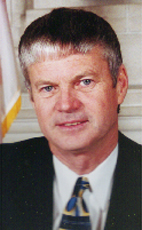 House of Commons photo
Won his last election, in 2000, with 50% of the vote.
Importation Of Plutonium May 12th, 2000
Mr. Speaker, in every case the methods of transportation are looked at. What I and the government can assure the hon. member is that the safety of Canadians will be number one.
Importation Of Plutonium May 12th, 2000
Mr. Speaker, the methods of moving MOX fuel are being examined. Anyone who would be subjected to the presence of that are being consulted on this.
I and the government assure the hon. member and all Canadians that all international guidelines, all laws and all safety aspects in the movement of MOX fuel will be followed.
Athabasca River May 12th, 2000
Mr. Speaker, there is no question that the level of the water in the Great Lakes, particularly in Ontario, is at an all time low and that something needs to be done there.
I remind the hon. member to go back into his files and read a letter that he received from the parliamentary secretary back in June 1999 wherein it was stated clearly that an alternative resupply route for the communities on Lake Athabasca has been found and that those communities can and will be served in that way.
Western Grain Transportation May 10th, 2000
Mr. Speaker, the announcement made earlier today by the Minister of Transport, the minister responsible for the Canadian Wheat Board and myself is a very good announcement for Canadian farmers and for all those in the grain industry in western Canada. It will mean $178 million in savings in transportation grain costs to farmers in western Canada this year. It will also mean that the federal government will contribute $175 million over five years toward the improvement of grain transportation in western Canada.
The industry has said, and rightfully so, that we needed to make some changes to the system to make it more efficient, more competitive and less costly.
Genetically Modified Organisms May 10th, 2000
Mr. Speaker, as I have stated before in the House, there is no question that Canada has one of the best regulatory systems in the world in registering food products, the products from advancing technology, including those of biotechnology.
The Minister of Health, the Minister of the Environment and myself have put in place a blue ribbon panel of very esteemed people to review the regulatory capability of our government in order to ensure that we are able to continue to do that and to continue to ensure Canadians that we have the safest food in the world.
The Environment May 9th, 2000
Mr. Speaker, I am certainly pleased by the program the Ottawa-Carleton region has put in place for sustainable agriculture. It follows the work that the Minister of Agriculture and Agri-Food does on sustainable agriculture and environmental soundness.
The land to which the hon. member refers is about 300 acres of land used for doing corn research. On that land they practise all sound management practices to reduce erosion, to minimize use of fertilizers, to get maximum crops and to detain runoff of anything from that property.
Supply May 2nd, 2000
Mr. Speaker, as I said in my comments, there may very well be other jurisdictions in the world that have a system, but to date none of them have been able to make it work. It is one thing to pass laws and to have regulations, but we want to make sure that when we do it in Canada it is one that is enforceable. When that is done in any country of the world, the role of Codex Alimentarius is very important because they set the international standards for the labelling of foods.
Even in Canada, with all the incredible ability we have to produce a diversity of different food products, we import nearly one-third of our food. Food is moved from one part of the world to the other. When any country determines that there must be a mandatory something, and I am not saying it should not, as long is it meets those other criteria, in this case the labelling with regard to GMO or the labelling with regard to the level of protein, fat or carbohydrates, there must be a world standard so that if a product comes into a country, that country is assured that the process in the country of origin is one that is credible, meaningful and enforceable. If this is not done, then it is very meaningless and could be misleading to the consumers. That is the importance of the discussions around Codex Alimentarius. Everybody must know that what is happening in another country is meaningful to them and vice versa. Everybody must know what is expected when they ship or sell a product into another market and be able to demonstrate that there is testing, et cetera, for that product.
At the present time a number of questions need to be answered. The challenge we all have is that if it cannot be tested then how meaningful is it to consumers. If consumers see something, bring it to the authorities, point out what it says on the packaging, ask whether it is right or not and there is no ability to take the product and say it is or no it is not right, then the consumer is no better off. If it is not right, then the consumer may be even more misled than before. We cannot and do not want to go there.
Supply May 2nd, 2000
Mr. Speaker, this is within the jurisdiction of the House leaders. It is my understanding, and I could stand corrected, that the issue of labelling will be before the Standing Committee on Agriculture and Agri-Food.
As the member mentioned, there was a desire to have a joint committee but it is my understanding that in order to have a joint committee there has to be full agreement of all parties in the House.
I personally think that a better way to discuss this would have been a joint committee of Health Canada, which sets the regulations, and the Canadian Food Inspection Agency, which is responsible to the Minister of Agriculture and Agri-Food for doing, enforcing and monitoring the labelling. However, it is my understanding that the Bloc Quebecois would not agree to that and therefore there will be one committee, the agriculture committee. The discussion will be around the labelling of food. I do not know whether it will get into a discussion of the role of the Ministry of Health.
As far as safety to humans, the Ministry of Health reviews all food products, including those which are the results of biotechnology. The Canadian Food Inspection Agency reviews those with respect to the safety of animals and to the safety of the environment.
Supply May 2nd, 2000
Mr. Speaker, the hon. member may want to clarify this later, but I believe she referred to some countries of the world, probably meaning those forming the European Union, which have put in place regulations which suggest that any food product that has over 1% of content which comes from a crop that has been genetically modified should be labelled as such.
I pointed out in my speech, and I have done so many times in response to questions from this hon. member and others, that even though these countries have done that, no one has yet found a testing process that can assure it. That is the type of thing that needs to be done.
The government is not opposed to labelling, but it has to be credible, meaningful and enforceable. It is not enforceable. If we are going to be fair to the consumer, all of those criteria have to be met.
The hon. member referred to the difficulty in finding product, and I am not sure what she meant. If she is talking about the availability of seeds and plants to the individual producer, that choice is there. They can make that choice. If they wish to plant products that have been genetically modified for whatever reason, then that opportunity is there for those producers. They will have to make that decision. They are very capable of making decisions on which ones to plant and which ones to grow, and I am sure that they will do so.
Supply May 2nd, 2000
Mr. Speaker, it is a pleasure to stand in the House today to respond to the hon. member's motion concerning the labelling of foods derived from biotechnology.
Canada has an enviable reputation around the world for the safety of our food and the rigour of our food inspection system. We have not had the same situations of food contamination and poisoning that have occurred both in Europe and in other less developed countries. Canadians rightly trust the regulatory system, which has been vigilant in ensuring that our high standards are maintained.
I would like to point out that the safety assessments of conventional products and of products derived from biotechnology are both subject to stringent health and safety requirements under Canada's food safety system. Health Canada maintains responsibility for establishing policy and standards related to the safety of food sold in Canada. Health Canada sets the data requirements for the safety assessments of all foods and undertakes comprehensive pre-market reviews of new foods, including those derived through biotechnology.
The Canadian Food Inspection Agency carries out inspection and enforcement activities related to food safety standards set by Health Canada. The Canadian Food Inspection Agency also has the responsibility for the environmental safety assessment of a number of agricultural products derived through biotechnology, including plants and animal feeds. In fact, every new food goes through a rigorous and thorough review process before being allowed on the market.
Health Canada and the Canadian Food Inspection Agency require that new foods go through both laboratory and field testing. They must then be further tested in controlled, small scale field tests to generate additional data for health and environmental safety assessments.
In terms of labelling, Canadian federal legislation calls for Health Canada to set the requirements for mandatory labelling. Current labelling regulations in Canada require that all food products, including those developed through biotechnology, be labelled where a potential human health or safety issue has been identified or foods have been changed in composition or nutrition. Therefore, based on its safety evaluations of food, Health Canada determines if and when labelling is required.
I would like to give an example. Any food product that has undergone a compositional or nutritional change or that presents a possible safety concern as identified by Health Canada, such as the presence of an allergen like nuts, requires mandatory labelling in Canada under the provisions of the Food and Drugs Act.
The commitment of the Government of Canada is always to safety first; safety for the protection of Canadians, safety for animals and safety for our environment. In Canada we believe in labelling that is credible, labelling that is meaningful and labelling that is enforceable. Canadians expect that their government will consult with them on how they want their foods to be labelled and the government is doing just that. The government is committed to exploring how labelling can best serve the public. As such, we are responding to the public's interest in this area. We have announced and strongly encouraged the establishment of a Canadian standard for the labelling of foods derived through biotechnology.
This standard is now being developed by the Canadian General Standards Board under the sponsorship of the Canadian Council of Grocery Distributors. The standards board is an accredited standards development organization within Public Works and Government Services Canada. Its expertise is recognized throughout Canada and internationally.
A committee composed of representatives and individuals from a broad range of Canadian interests has been established. Under the chair of Dr. Lee Anne Murphy from the Consumers' Association of Canada, the committee has already met for three intensive working sessions since the inception of the committee in November of last year.
The committee has established four working groups to look at areas such as definitions, labels, claims in advertising, and compliance measures. Representatives from consumer groups, producers, distributors, health care professionals and representatives from other levels of government, as well as from the federal level, sit on the committee. These are regular Canadians on this committee, Mr. Speaker, people like you and I and members of the House.
This committee has already fed information back to other Canadians on the progress it is making as it goes through its deliberations through its website. A completed standard is expected within the next six to twelve months.
By initiating such an open and inclusive process to develop a labelling standard, my hon. colleagues should be aware that Canada is indeed a leader worldwide.
There is no other country in the world that is actively engaging such a broad range of stakeholders on this issue. Other countries have announced their intention to implement mandatory labelling policies, but so far they have not been able to figure out how to effectively do so.
Canada, on the other hand, is fully engaged and speedily developing its own national standard in full consultation with stakeholders, in a way which is open and transparent to all Canadians.
I would also like to point out that the development of this labelling standard is very similar in nature to that of the national standard for organic agriculture. This organic standard was ratified in April 1999 by the Standards Council of Canada and outlines principles for organic agriculture which endorse sound production and management practices to enhance the quality and sustainability of the environment and ensure the ethical treatment of livestock.
This project was managed by the Canadian Food Inspection Agency and was funded largely through Industry Canada's standards initiative program.
Another example of the government's leadership is evident in its request to the Royal Society of Canada to appoint an independent expert panel to examine future scientific developments in food biotechnology. This forward thinking body will advise Health Canada, the Canadian Food Inspection Agency and Environment Canada on the science capacity the federal government will need to maintain the safety of new food products being developed through biotechnology in the 21st century.
Too often we hear from the other side of the House that the government acts unilaterally, that it imposes its view of what should be done on Canadians without due consultation. The government is adapting a balanced and consultative approach, not only to the labelling of foods derived from biotechnology, but also around a broader set of issues involving consumer choice.
That is why the federal government has created the Canadian Biotechnology Advisory Committee as a key group which will help raise the public's awareness of the regulatory process and provide an ongoing forum for the Canadian public to voice views and opinions.
The development of a comprehensive Canadian standard for the labelling of foods derived from biotechnology allows consumers, health care professionals, other levels of government, processors, distributors and producers all to work together in establishing a single national standard.
It will also ensure that the standard which is developed provides for labels and messages which are understandable and not misleading to Canadian consumers. Procedures and guidelines will also be set up to verify the truthfulness of food labelling, truthfulness in advertising and the truthfulness of claims.
I believe the government is doing the right thing by taking this approach. As consumers, Canadians have the right to clear, concise and accurate information that allows them to make informed choices about the foods they eat.
The government believes that it is important to respond to the public's desire to understand biotechnology and the safety of its products. The government has done a good job in developing widely used materials, such as Canada's Food Guide and the recent Food Safety and You brochure which was sent to every Canadian household across the country. We remain committed to addressing the concerns of Canadians and to developing means to provide Canadians with the information they need.
While working quickly on a consensus approach to a national labelling standard, the government is continuing to maintain the stringent requirements of the food safety system in Canada. Around the world Canada is regarded as a leader on this issue. For example, we chair the prestigious Codex Alimentarius committee on food labelling. Over 160 countries are on that committee. We are also leading a subcommittee of Codex that has worked over the past year to draft recommendations for the labelling of foods derived from biotechnology.
Governments, consumers and industry are working together to achieve the approach that is right for Canada and one that will work for all Canadians.