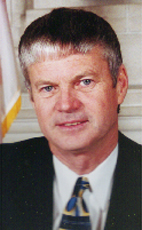
House of Commons photo

Crucial Fact

  • His favourite word was industry.

Last in Parliament May 2004, as Liberal MP for Prince Edward—Hastings (Ontario)

Won his last election, in 2000, with 50% of the vote.

Statements in the House

Genetically Modified Organisms April 4th, 2000

Mr. Speaker, I have reminded the hon. member in the House before that there is a process in place with the Canadian General Standards Board and many organizations, including the federal government, consumer organizations, producers and provincial governments, working to set the criteria for a labelling process in Canada.

Before it can be available in any country, whether it is Canada or elsewhere, it has to be meaningful, credible and enforceable.

Questions On The Order Paper March 29th, 2000

There has been limited, if any, economic loss to Canadian farmers due to restrictions on the use of strychnine based rodenticides for the following reasons: strychnine based poisons are available to licensed applicators; anti-coagulants are readily available; strychnine poison alone is not an effective control measure; and an integrated strategy for controlling pocket gophers is recommended and is the most effective method.

Each province has regulations for the use of strychnine. In Saskatchewan, for example, the sale of strychnine is restricted to pest control operators, farmers and persons authorized in government approved pest control programs where the vendor maintains a record of sales including the name, address and signature of the purchaser along with the quantity of product purchased. The vendor, who in this case is Saskatchewan Association of Rural Municipalities, may have further restrictions.

The annual losses in yield reductions and equipment breakdown from pocket gophers for the province of Alberta has been estimated at $14 million to $30 million annually. For the province of Manitoba losses are estimated at $15 million annually. No published data could be located for economic losses Canada-wide. In 1997, 3.5 million to 5 million hectares of forage, primarily alfalfa, in western Canada was infested with pocket gophers. The reductions in productivity and damage to equipment are significant and control is necessary.

Control of pocket gophers requires an integrated approach. There are various types of control methods to reduce pocket gopher populations. Control methods include trapping, gassing, flooding, exclusion, encouraging natural enemies, and poisoning. Trapping has proven to be an extremely effective control but is labour intensive and is limited in the area one can control. Physical control can include removing the food source, using pets to discourage entrance into a yard, and noises, disturbing noise placed in the burrow. Buffer zones are effective in isolating certain areas from pocket gophers. An example of a buffer could include spraying the surrounding area with a broadleaf herbicide which would eliminate the pocket gopher's food source. Natural predators such as owls and snakes will assist in control of pocket gophers, providing their existence is promoted and encouraged.

There are three types of rodenticides available on the market to control pocket gophers: strychnine based, zinc phosphide based and anti-coagulants. Strychnine and zinc phosphide are both restricted and generally limited to use by licensed pesticide applicators. Anti-coagulants are readily available to everyone. Pocket gophers are very sensitive to the taste of poisons and readily reject or limit intake of many poisons. They also have an ability to metabolize certain amounts of these poisons and there have been reports of resistance to poisons if provided in sub-lethal doses. Field studies have shown that using strychnine or zinc phosphide based poisons controlled 35% or less of treated pocket gopher populations.

The recommended method of controlling pocket gophers is called a border control strategy. This is used on fields which were seeded in the last three years. This strategy requires the trapping of gophers in the center of the field—new fields are recommended as populations of gophers are low—and setting up permanent control around the perimeter of the field using traps alone or a combination of traps and bait set in existing burrows. This strategy prevents pocket gophers from entering a clean field.

Agriculture March 21st, 2000

Mr. Speaker, we recognized Mr. Parsons' efforts in a number of ways.

I personally spent an hour with Mr. Parsons yesterday, commending him for his initiative and the awareness he has brought to all Canadians of the importance of the family farm and the agricultural industry across the country. We shared thoughts and ideas about how we can do even more.

Even better than meeting with me, he met with our Prime Minister, and they too shared thoughts. The Prime Minister stressed the importance of the many things we have done for Canadian agriculture and that we are looking at doing even more.

Agriculture March 17th, 2000

Mr. Speaker, this government has demonstrated very clearly that it will be there to assist farmers as much as it possibly can.

In closing, I thank the hon. member for his interest in the Liberal convention this weekend. I know he is looking for a place for a home and we would welcome him.

Agriculture March 17th, 2000

Mr. Speaker, I will tell the member one thing we will not be discussing at the convention this weekend and that is the fact that we will not be putting the agriculture department in with other departments. The hon. member should look back at his platform before the last election. They were even going to do away with the Department of Agriculture and Agri-Food.

Agriculture March 15th, 2000

Mr. Speaker, I appreciate the hon. member's question. It gives me a chance to remind everyone of the government's commitment to agriculture.

Not only is there the $600 million a year to support farmers but there is also the $2.3 billion we put out in support in the last 18 months to farmers. A week ago I announced another $83 million to cover the debts and to allow the Canadian Grain Commission to freeze its mandatory fees until 2003.

I am pleased to announce today that Agriculture and Agri-Food Canada and the Canadian Food Inspection Agency will freeze mandatory fees until at least the end of 2002.

Agriculture March 13th, 2000

Mr. Speaker, farmers could have applied for an interim application on their 1999 business year as far back as September, last fall. Only about 500 or 600 of the farmers chose to do that. The rest of them obviously have chosen to wait until they finish their business year, their book work and paperwork as a result of the 1999 business year and submit that. I can assure the hon. member that as soon as they do submit those, we will deal with those forms very quickly.

Agriculture March 13th, 2000

Mr. Speaker, I know the hon. member is a slow learner, but the applications after the 1999 business year have to be submitted by the farmers. As soon as those applications are submitted, we will begin processing them so that the farmers can get the cash.

Agriculture March 2nd, 2000

Mr. Speaker, Canadians know this government is there as much as we possibly can be to assist Canadian farmers.

The Canadian Grain Commission has a world-renowned reputation for ensuring the quality and reputation of Canadian grains. Over the last number of years, the volume of grain has decreased and, in spite of efficiencies that have been put in place, a deficit has accumulated.

I am pleased to announce today that the Government of Canada is coming forward with $20 million to cover that debt and $63 million over the next four years to ensure that the mandatory fees are frozen for another four years on top of the ten years for which they have already been frozen.

Agriculture February 25th, 2000

Mr. Speaker, the hon. member knows that there has been an ongoing consultation and discussion process with Justice Estey, with Mr. Kroeger, with the industry and with everyone involved in grain transportation across the country.

The government's intention is to make some positive changes to strengthen again in another way western agriculture on farms and in rural communities.