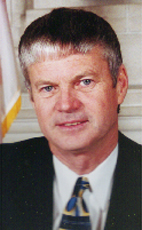
House of Commons photo

Crucial Fact

  • His favourite word was industry.

Last in Parliament May 2004, as Liberal MP for Prince Edward—Hastings (Ontario)

Won his last election, in 2000, with 50% of the vote.

Statements in the House

The Environment December 17th, 1999

Mr. Speaker, the fisheries minister knows that every situation has to be addressed on its own merits and its own conditions.

He is working with the municipalities. He is working with the Ministry of the Environment in order to come up with the best solution and the best way to treat this very important issue.

Agriculture December 17th, 1999

Mr. Speaker, the hon. member knows very well that the government put forward nearly $1.1 billion in a two year program. It was estimated at the beginning that an amount of that would be required as a result of the 1998 business year and, therefore, with the targeted approach that everybody asked for, it would go to producers in 1999. As a result, in the 1999 business year the remainder of the money would go to the next year.

I can assure the hon. member that all of the money will go to the producers.

Questions On The Order Paper December 16th, 1999

The farm improvement and Marketing Cooperatives Loans Act, FIMCLA, can provide assistance to fruit growers with the purchase and planting of fruit trees for new varieties. Conditions of the loan are summarized as follows: the maximum term is ten years; the cost of loan is either prime rate plus 1% or at a fixed rate equal to the residential mortgage rate plus 1%; loans must not exceed 80% of the value of the asset being financed; the maximum loan is $250,000.

Fruit growers can plant now, pay later through an FCC loan.

Farm Credit Corporation, FCC, has expanded the plant now pay later loan to include all fruit and berry varieties grown for commercial production across Canada. This unique loan was originally introduced in 1996 to help vineyard expansion projects in Ontario and British Columbia. Fruit growers can use the loan to renovate or expand orchards, vineyards, berry farms or other types of production that take several years to yield a comercial crop. The loan allows clients to better manage their cash flow. It offers flexible terms and conditions to match production cycles and an amortization period that matches the life cycle of farms.

Repayment options include total payment deferral for up to three years or interest only payments for the first five years. With the deferral option, no payments are required in the first three growing seasons including the replant year. Interest that accrues during this period is capitalized at the end of the third growing season. in year four, an interest only payment is made and in year five blended payments begin with up to 20 years to repay. For example, a loan of $25,000 accrues approximately $5,000 of interest in three years. Thus at the end of three years, the loan becomes $30,000. Payments are then based on this loan amount and may be made annually. The loan covers all planting costs including the costs of drainage, land improvement, plants, planting costs, trellising, irrigation and maintenance in the first three years.

Those eligible for the loan include producers of grapes, apples and pears, tender fruit trees, including peaches, nectarines, apricots, cherries and plums, and all berries, including rasberries, blueberries, saskatoon berries and cranberries.

The plant now pay later loan was initiated through consultation with primary producers and agricultural groups to develop an innovative lending product that addresses specific financing needs.

Question No. 18—

Agriculture December 15th, 1999

Mr. Speaker, the hon. member should get his numbers right. The calculation that was used by the industry, by all the provincial input and with the safety nets advisory committee was $600 million for the 1998 farm business year, the remainder for the 1999 business year.

I can assure the hon. member that all of that money will be in the hands of the producers at the end of those two years.

Agriculture December 15th, 1999

Mr. Speaker, the hon. member knows that the AIDA money announced by the government a year ago was for over two years. A portion of that money was allocated and it was assumed it would be sent out to the farmers after their applications were reviewed as a result of their 1998 business. By far of the majority, there will be very few of those. When the information is all in from the producers, there will be very few applications that trigger a payment as a result of 1998 that will not be in the hands of the producers.

Agriculture December 14th, 1999

Mr. Speaker, the hon. member knows that well over 20,000 farmers in Canada have received assistance from AIDA. We understand that not everyone who applied for AIDA met the criteria. We have made changes to AIDA and the net income stabilization program. For 1998-99, the federal government alone has put nearly $1.1 billion, more than was available a year ago, into their hands.

Agriculture December 13th, 1999

Mr. Speaker, I remind the House, farmers, and all Canadians of the opposition party's election promise that it would take some $600 million out of support to agriculture. In the last 12 months we have added $1.1 billion.

Agriculture December 13th, 1999

Mr. Speaker, the hon. member knows that I was meeting with the ministers of agriculture from across the country last week. I wish we could have reached consensus at that point. We still have more work to do. I am working with the safety nets advisory committee to improve the situation, to find other ways, new ways and better ways to assist Canadian farmers. We know they need the help. We know the importance of the industry and we will do all we can.

Agriculture December 10th, 1999

Mr. Speaker, the Minister of Finance and the government have already put $1.1 billion into assistance for farmers in the last year.

The government continues to look at many different ways in which to assist the producers. We will continue to do that. We know how important the producers are to this country and what their needs are.

Supply December 10th, 1999

Mr. Speaker, I understand what the hon. member is asking, but I also understand that in the last few years the province from which he comes has drastically cut back its support to the agricultural industry. The federal government did so too because of fiscal realities.

Because of what we did we are now able to put $1.1 billion back in. We are now able to talk about a long term program based on the experiences of that program, the needs, the realities of today, and the everyday changing and rolling, if I could use that term.

I remind the hon. member of the incredible difficulty we had as a government to get the Government of Saskatchewan in particular to come forward. We had to beg. We had to push. We had to pull. I could use words stronger than those in order to get it to to support that major industry in that province.

Agriculture is a shared jurisdiction between the federal government and provincial governments. Shared usually means 50:50. In the safety net program over the last number of years the federal government has paid 60%. I had to do a lot of levering to get the hon. member's provincial government to come forward with its 40%.

When we came forward with another change to the program to cover negative margins, the province did not want to do it. It wants to take some money and mail a cheque out to every farmer in Saskatchewan. I understand there are farmers that the IDEA program did not reach. We are trying to fix that in the future, but in order to get money to farmers that need money that provincial government wants to give money to those that do not.

In the last 12 months the federal government has put in $1.1 billion. When we combine that with what we have finally convinced the province of Saskatchewan to put in, it means that $575 million more than what there was a year ago are going into the hands of farmers of the province of Saskatchewan who are hurting. Only the New Democratic Party would say that $575 million were insignificant.