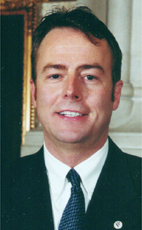
House of Commons photo

Crucial Fact

  • His favourite word was quebec.

Last in Parliament May 2004, as Bloc MP for Berthier—Montcalm (Québec)

Won his last election, in 2000, with 57% of the vote.

Statements in the House

Drug Legalization March 21st, 2001

Mr. Speaker, it is believed that at the Summit of the Americas Uruguay may raise the issue of drug legalization. In fact, Mexico's president, Vicente Fox, feels that legalization is the only way to lead an effective international war against organized crime, as it relates to the trade of illicit drugs.

Could the Minister of Justice tell us whether Canada intends to support the approach advocated by the Mexican president?

Canadian Police Association March 20th, 2001

Mr. Speaker, today, for the seventh year in a row the members of the Canadian Police Association are meeting with parliamentarians to discuss issues of concern to them.

I take this opportunity to salute their determination and the professionalism with which they present their views.

You, the people in the front line, are the ones we need to listen to.

The Bloc Quebecois shares the majority of your concerns, and we will continue, with you, to seek to make our society still safer than it is at present.

Like you, the Bloc Quebecois has been concerned about biker gang wars and organized crime in all of its forms for some years now.

Like you, the Bloc Quebecois proposes legislative measures that are aimed at prohibiting membership in a criminal organization and make it more possible to get at those in charge.

Like you, the Bloc Quebecois also wants to see more federal government funding put into an effective battle against organized crime.

We hope that the Minister of Justice of Canada will, like all of us, have the firm intention of putting a stop to organized crime and of doing so very soon.

Privilege March 19th, 2001

Mr. Speaker, the member for Rimouski-Neigette-et-la Mitis, who just spoke, is very perceptive.

In fact, this is a government which is far more likely to gag the opposition than itself, so to speak.

Of course this is not a real gag but a deadline to force parliamentarians to submit a report. Once again, if more time is needed the House has always given its agreement in the interests of a comprehensive report.

Even though there is a rule of law which says that there is a presumption of good faith, it looks like bad faith on the part of the government not to want to set a date that would force parliamentarians to work quickly and effectively on this report.

This report must be tabled in the House so that all parliamentarians, regardless of party, government or opposition, have all the tools they need to do their work.

Mr. Speaker, I am sure you will recall that when the Liberals were in opposition, they had much less to say in this regard. At the time, the present government House leader had some strong criticism for the Progressive Conservatives when they imposed time allocation or did not wish to introduce a particular bill or tale a particular report.

I suggest they take a look at what they were saying when they were in opposition and be consistent today. Although they form the government, they should ensure that members of the House have all the tools they need to do their work properly.

Privilege March 19th, 2001

Mr. Speaker, I think the member who has just spoken knows the rules of the House as well as I do. She knows that, just because the government has set a cut off date to force parliamentarians to at least seriously study this whole question as quickly as possible, if on the day before or two days before the cut off date the report is not ready, the House can still allow more time to enable the House to prepare and submit the report effectively.

What I was pointing out to the House is that the opposition wanted to set a date but the government refused. I think the member said it clearly. In rising and trying to justify it, she is slightly wrong.

Let us set a date, for example the first of June, for the amendment. Let us set that as the date. Then, if the committee has not concluded its work, the government will give it more time. At least there is a cut off date to oblige parliamentarians to work on it and especially to oblige the government to raise this whole issue, take a responsible approach in questioning witnesses and table its report as soon as possible. However with no date set this would not be the first matter that got shelved and covered with dust before seeing the light of day.

I think my earlier remarks were quite relevant. Once again the government is refusing to set a cut off date so that the work gets done quickly and parliamentarians have all the tools they need to do an effective job.

Privilege March 19th, 2001

Mr. Speaker, I find it most unfortunate that the government did not approve this amendment, which would have given us an extremely important deadline, that is June 2001. I realize that the government is not interested in clarifying these rules, considering how it has been operating since 1993.

I will be brief. First, I want to congratulate the hon. member for Provencher for his vigilance, since this is a very important issue and it is not the first time that the Department of Justice has operated in that fashion. As we have seen in the past, this did not work for either the minister or the system, since there were all sorts of erroneous interpretations circulating before a bill would even be introduced in the House. This is most unfortunate.

Second, I wish to salute your openness, Mr. Speaker, and to thank you for having entertained this question of privilege, since this is a very important part of our work as members of parliament. We must have all the tools and be on the same footing, so to speak, as all other parliamentarians. The way the minister operates, we could never be on the same footing as her.

I do hope all parliamentarians will give this issue the attention it deserves. I also hope the minister will testify and answer questions. I believe the whole issue has to do with the fact that the minister does not control her department. It may not be a major problem or a problem common to every department, but it exists in the Department of Justice because the minister does not see what is going on in her department. She does not know what is going on and she does not control anything.

I do hope we will shed light on this issue and we can then have more specific rules, so all opposition members can have access to information at the same time as, and even before, the media, so as to be in a position to adequately answer questions and, more important, do their work properly as members of parliament.

Supreme Court Act March 19th, 2001

Mr. Speaker, actions such as these show us that the system has become a bit outmoded. Sometimes we get to make fine speeches here without even any chance to vote. We are not even able to really have a finger on the pulse of the government.

An additional aberration: the bill is presented by a government MP and it is the members of the government who are refusing to have it made votable. That is a pretty special situation. Independent of whether people are for or against such a bill, I believe the House should be allowed to vote on it.

A vote would allow us to make it very clear that we in the Bloc Quebecois cannot support such a bill. This would at least show the consequences of such actions and would also make the government's position known. We have a bill being presented by a member of the government side and the government is saying no to making votable. This is rather unusual.

That said, I will address the bill directly since I have only 10 minutes or so to discuss it and to tell the House what an extremely dangerous bill it is.

I cannot support such a bill since it mixes up some key principles which provide Quebec and Canada with a justice system that works overall. We agree that there is always room for improvement. Generally speaking, however, Quebec and Canada have a justice system that has developed over the years into something that in large part meets the expectations of the public.

One of the reasons it does work is that Canada has a separation of powers which and this is important for a balanced justice system. In other words, we have the legislative, the judiciary and the executive components of the one state called Canada. That is why we can end up with decisions that may not suit us, decisions from the higher courts that we might have liked to see otherwise, but when the rules and the law are being applied, the system generally works.

For those who lack familiarity with the rules I have just mentioned, the legislative system is us. People pass legislation that applies to everyone. Especially, since the arrival of the charter of rights and freedoms, the laws have applied to everyone, unless parliament decides, through the use of the notwithstanding clause, that a law does not apply to a particular category or, more specifically, to others. Let us be clear that up until now, no legislature has used the notwithstanding clause. The laws apply to everyone, as the legislative system provides.

The judicial system comprises people who apply the laws passed by the legislative system. How do they do it? By interpreting each of the sections of the law. There is a principle of law, of justice, which provides that the legislator is not deemed to speak in vain. Therefore all the clauses of a bill have significance and they are interpreted one after another by the judicial system. It is however possible to not agree with a given decision.

It would be a free for all if parliament intervened whenever the Canadian constitution was involved or whenever the rights set out in the charter were involved. In nearly all decisions the supreme court examines, one of its criteria for agreeing to examine them is that the matter involves the Canadian Charter of Rights and Freedoms or, very specifically, the interpretation of a statute of significance to Canada and a province, such as Quebec, for example, if the decision comes from Quebec.

One of the most important points the supreme court addressed in recent years was the interpretation of the Canadian Charter of Rights and Freedoms. If Bill C-234 came into effect, the House would always have to deal with issues and interpretations relating to the constitutional validity of an act. The issue is whether or not the act respects the Canadian constitution or the Canadian Charter of Rights and Freedoms. We would always be ruling on issues, thus depriving the supreme court of one of its responsibilities so as to keep us parliamentarians busy doing something. This is not how the system works.

The executive branch is the third level of power. It is the government that sets in place the judiciary and the executive branches. The separation between these three branches is extremely important and must continue to exist.

The hon. member drafted his bill in a way that would obviously jeopardize the balance that currently exists. The Bloc Quebecois cannot support that. Regardless of the fact that we are sovereignists and that we support Quebec's sovereignty—this is the best thing that could happen to Quebec in terms of the legality of the justice system—over the years, Quebecers have made major contributions to improve Canada's justice system. I want to preserve that system and I will fight to protect it.

A bill such as the one just introduced by the member for Ancaster—Dundas—Flamborough—Aldershot does not make sense. I might have understood if it had been proposed by the Canadian Alliance, but I am very surprised to see this from the Liberals. The sponsor of the bill could easily cross the floor and join the Canadian Alliance. I hope he represents only a very small minority among government members. This is dangerous legislation.

More important, did members listen to his speech? His intentions were barely veiled. He said that supreme court justices make rulings without even examining the substance of the issue and that they render repetitive judgments. We know that supreme court justices are extremely competent and they are serious when they issue rulings. They have clerks working for them. They have access to a whole staff of researchers and to libraries. The supreme court makes Canada proud, and even Quebec, as there are Quebecers who sit on the court.

The hon. member said that members should draft our laws because we review them very thoroughly. I want to give him an example. I am a member of the Standing Committee on Justice and Human Rights. There are Quebecers and members from other regions of Canada who sit on that committee.

Just to give one example of how ridiculous the member's arguments are, in the case of the young offenders bill, the committee heard from 60 or so witnesses from Quebec. No one in Quebec supports the minister's bill. During clause by clause study, all members from Quebec present voted in favour of the bill. What is the point of spending hours and hours going over something if the ultimate decision lies with the Prime Minister anyway?

In all sincerity, I would far rather have competent judges handing down rulings on a case by case basis in light of existing statutes and regulations, independently of the legislative arm. Cases such as Shaw may involve treaties and customs but we also take these into account when we pass legislation here.

As I said, decisions are, in the main, consistent with the thinking of parliament and of Quebecers and Canadians.

I could go on and on. I will discuss at length the two clauses in the bill to amend the Supreme Court Act in order to rebut, as it were, all the arguments brought in support of this bill, which does not really deserve our serious attention. We should move on to something else as quickly as possible.

Privilege March 14th, 2001

And, as my colleague has said, treating the House with disdain as well. Mr. Speaker, you should intervene to put an end to the way the Department of Justice is operating.

There is a small example in the case of the Young Offenders Act worth recalling, where everything went off the rails following a briefing of journalists. The officials had failed to give out the entire text of the Young Offenders Act. The government talked about flexibility, when in fact there was none. On that occasion, when the officials did not give journalists a copy of the text, how could the journalists leave with all the information? They left with the information the Department of Justice wanted them to have.

As things stand, as a member of the opposition and critic for justice issues, I cannot even properly inform these journalists because the government did not give me the documents on time. What was so urgent? Perhaps there is an urgent matter. Why was the Minister of Justice in such a hurry to introduce this bill today, before members of parliament had a chance to look at it?

We are well aware, and the Chair even more so, that there are days during the week when bills can be introduced, when the minister could introduce her bill, in the morning, around 10 a.m., as she did today. She could also have met the media in the morning, at 11 a.m., like she did this morning. But why did she act differently? Perhaps it was to engage in politics, to catch the opposition with its pants down, or whatever.

Perhaps it was to not give the media the appropriate information at the appropriate time, so as to throw them off track. The minister need not wonder why her department is having problems. It is simply because her department's way of operating is not right and shows contempt for members of parliament.

Mr. Speaker, in order to prevent another such mess, I am asking you very sincerely—because I know that you have great qualities and broad experience as a parliamentarian—to not let this practice go on at the Department of Justice or at any other department. You must take action because you care a lot about the work of the members of this House and you want to ensure that they have the necessary tools to carry out their duties as parliamentarians, properly and in a timely fashion.

Mr. Speaker, I am asking you very sincerely to take action so that the Minister of Justice stops showing contempt for members and the House, as she has been doing since assuming her responsibilities.

Privilege March 14th, 2001

Mr. Speaker, I am pleased to be able to speak on this matter, since this is not the first time the same thing has happened in the Justice Department.

The minister need not wonder why sometimes bills get off on the wrong foot. That is the way things are done, even by the Minister of Justice.

How do they justify, even if it was only a briefing, even if the government did not hand out the entire text to the journalists—which I doubt, and we will look into this—how is it that the journalists knew all the ins and outs of this bill before the parliamentarians, before those who are elected to represent the public?

Knowing the officials of the Department of Justice as I do, in the case of the Young Offenders Act, I question the accuracy of the information. What the minister did today is very serious, and what she did in the past with other extremely important bills is also. It is not even a matter of finding out whether the bill is complex or not, because we can all read.

The Minister of Justice was very kind. She gave me the bill as she came into the House at 2.00 p.m. for Oral Question Period. It was as if I, a member of the opposition, did not have Oral Question Period, as if it was not important for me to follow what went on in it and I had to read between 79 and 85 pages of the minister's text to keep up with the journalists at 3.00 p.m. That makes no sense. It is treating the opposition members, in fact all members with disdain.

Criminal Code March 13th, 2001

Madam Speaker, I too must congratulate the member on his tenacity when it comes to this issue because, in an earlier parliament, he introduced a similar bill. He made certain amendments in response to comments made in the House.

Today, we have a bill that is, all in all, very acceptable. I would immediately say to the member that he has the full support of the Bloc Quebecois in his efforts to have the criminal code amended.

I am the third member to speak. Those members of the House who are listening are aware of the bill and the amendments. I just want to remind them, and I will do this quickly, that the primary purpose of the bill is to protect some very vulnerable people, children, from actions of adults which are completely unacceptable.

I think that, of all the offences mentioned in the criminal code, those involving child pornography, using children for sexual purposes, are the most serious. Amending the criminal code to permit the seizure of any thing used by the offender for child pornography, for these very reprehensible actions, has my full support.

As the Canadian Alliance member noted, many of Canada's statutes, including the criminal code, provide for the seizure of certain property in certain cases.

I will give an example familiar to everyone, from the Tobacco Act. When people smuggle cigarettes, when they have contraband cigarettes in a vehicle, the vehicle is seized because it was being used to break the law, to seek to commit an offence.

Why not apply this to computer equipment, since more and more people have computers, and computers are more and more powerful, and can yield far more information? Why not allow police forces and the justice system to seize these assets?

Was a mistake made when the government amended section 163 in a previous parliament without allowing such a seizure? Perhaps it was, and perhaps not. At that time, I did not consider it a priority or a goal in itself to seize computers that had been used to view images of child pornography. Today, however, I think we need to conclude that yes, seizing these assets that have been used by the offender would be a normal thing to do.

The wording would, I believe, allow this to dovetail very nicely with the section of the criminal code. It is also in keeping with the philosophy of the criminal code and related legislation allowing police and crown prosecutors to impose a sentence on the individual who has been found guilty, to impose a fine, but, more importantly, it sends a fairly strong signal that computers are not intended for such purposes and that individuals caught using them for those purposes stand to have their computer confiscated.

The important point the member has added in his bill, from the remarks made in the House when Bill C-321 was introduced, concerns the restrictions on the assets of third parties in order to protect people who lend their computer to a friend or employers who are not aware what employees are doing at lunch with office equipment. Just like that, because the individual is caught at child pornography sites, the computer loaned by a friend or belonging to the employer is confiscated.

Subsection 163.2(2) included in the bill provides a restriction to the effect that the equipment or computers will not be seized because they belong to a third party who was unaware of the use being made of them.

At the time, when we debated the bill in the House, this was our greatest concern. Today, we note that, on the whole, the remarks and adjustments made in this clause with respect to the amendment of the criminal code fully satisfy the concerns of the Bloc Quebecois.

Accordingly, we offer the hon. member our full co-operation and support this approach. We hope that we will find these amendments in the criminal code one day.

Judges Act March 12th, 2001

Mr. Speaker, my remarks on this bill will be brief.

In past parliaments I had the opportunity to comment on raises to our high court judges. What I said at that time was that, given the financial situation in Canada and the cuts that were being made all over the map, there should not be any increase, or at least not to the extent being proposed.

Today, I announce a change in tune. On the one hand, there are far more means available to us now for paying our judges. We have far more financial leeway than we did then.

I have listened carefully to the previous speakers, the Minister of Justice and certain members of the Canadian Alliance. I have to say that there comes a time when there must be some straight dealing in such a matter, as in any other. No more hiding one's head in the sand or talking out of both sides of one's mouth.

In this House we have already heard certain parties claiming they wanted no pensions, felt MPs were overpaid, did not want any limousines, did not want to live in the residence of the leader of the official opposition, and then a few years later here they are accepting these benefits, and rightly so. I feel they go with the territory, but there must be no doublespeak here.

The public wants to see us with the best judges, the most competent people. We want our MPs to be highly competent, to be available around the clock if possible. In the workings of government the best people are needed. People expect those who manage billions of dollars to be very good managers. They are entitled to demand that, but we cannot say that we want the best ones and not pay them.

I will give an example. I am digressing a bit, but this will illustrate my point of view on this issue. Let us take Hydro-Quebec. This has little to do with judges, I know, but I simply want to give an example. The president of Hydro-Quebec may earn $300,000. If he worked in the private sector, he would make two, three or even four times that salary.

Getting back to the issue, I know judges who earn a lot less than they did when they practised law. They agreed to become judges for all sorts of reasons. In some cases, it was because they had a very demanding practice as lawyers. Others, given their experience and expertise, wanted to give something back to society. These are not bad people who only think about themselves, on the contrary. We have very good judges in Canada. We have a system that works well. There is always room for improvement.

We must not antagonize them the way some parties are trying to do today. Rather, we must ask ourselves why we now have before us a bill to increase the salaries of higher court judges, of federally appointed judges. Let us not make this too complicated. On the contrary, we must make it simple, so that people will understand why we are faced with this issue.

On November 18, 1997, the Supreme Court of Canada ruled on the whole issue of salaries for the judges of one province, namely Prince Edward Island. In this reference, the justices of the supreme court in their ruling established new constitutional requirements for setting the salaries of judges.

In a country justice has to start from some point. It happened that it was the justices of the supreme court, Canada's highest court, that ruled on this matter. Yes, at first glance, we might say there was a conflict of interest, since judges handed down a ruling concerning other judges. Who should do the judging? Who decides? Parliament?

We have an institution, the Supreme Court of Canada. We have the Canadian Charter of Rights and Freedoms. I think that, since the charter was passed, since the Constitution was patriated, some of the powers of the House of Commons have been taken over by others, including the Canadian charter. In my opinion, parliamentarians have lost some of their jurisdiction under the umbrella of the Canadian Charter of Rights and Freedoms.

Today, the Supreme Court of Canada is rendering decisions with all of its powers. It handed down a decision on November 18, 1997. I know, I was here in the House. This decision led the House of Commons to introduce an amendment to the Judges Act in order to establish an independent, and in my opinion, effective review board, the Judicial Compensation and Benefits Commission, far more capable than I to consider the salaries judges might earn, whether they were at the Supreme Court of Canada, the Federal Court, a trial court or an appeal court, in Quebec or in the other provinces, or the judges of the higher courts of each of the provinces.

This commission looked at what went on in the private sector and where judges came from. It concluded that their salary should be increased by 26%, according to my notes here. I think 26% is a bit much, and this is where the minister has the discretion to justify not giving 26%, and this is what she has done today.

The increase is 11.2% which I do not consider unreasonable, instead of the 26.3% proposed by the commission.

The commission's mandate was to consider what would be the best remuneration for these judges, as well as to look into whether salaries and benefits for judges were adequate, with regard to three points: existing economic conditions in Canada, including the cost of living and the economic position of the federal government as a whole; the role of the financial security of judges in maintaining the independence of the judiciary; and the need to attract top notch candidates.

I mentioned that, when we do a comparison and look at where judges come from, we see that 73% are from the private sector, 11% are from lower courts and 16% are from government or other fields of legal practice and from universities.

When we look at the remuneration of 73% of appointees from the private sector, we see that the average pre-appointment salary of those from Quebec was $209,000 a year. We certainly cannot appoint people without the required training or specialization. In any event, as everyone knows, there are appointment criteria, such as years of practice and so forth.

As for benefits, a pension and the level of remuneration, this committee looked into the matter and decided to recommend a 26% increase.

Bill C-12 before us today sets the increase at 11.2%. Compared to earlier bills, I do not consider this unreasonable.

This is why the Bloc Quebecois will be supporting Bill C-12. I am sure the minister is paying careful attention and will come to the realization that the Bloc Quebecois supports the government when it presents bills that are reasonable and in line with the interests of the people of Quebec.

As much as I have an attentive ear for this bill, I would like to see the minister lend an equally attentive one to the demands from Quebec, including those relating to the young offender legislation. I cannot help commenting that I hope the minister will also listen to what Quebec is calling for in this connection.

As for Bill C-12, this is a bill we are going to support. I have two comments, however, that are a little more on the negative side, although not jeopardizing our support for Bill C-12.

The first relates to retroactivity. I realize that the commission's report was tabled on May 31, 2000, and we are now in March 2001. When this bill is passed, however, there will be nearly a year's retroactivity. I have trouble accepting that.

This being said, I understand the issue of retroactivity, and this is my second criticism is, but why did it take so long for the government to introduce this bill?

I read the commission's report, which is very well made and very well detailed. I did not take a whole year to read it. That report was tabled on May 31, 2000. What has the minister been doing since? She could have introduced a bill, long before the government called the election in October 2000, to follow up on the commission's report. Had the minister done so, we would not be stuck with retroactive payments of this magnitude.

My two negative comments, therefore, have to do with retroactivity and the government's slowness to act regarding an issue like this one. I do hope there were reasons other than an election call for the minister to postpone the introduction of this bill. I do hope the minister cares enough about the justice system to not have unduly waited until after the election to introduce a bill that provides an 11% increase for our judges.

These are my only two negative comments at this point. The Bloc Quebecois will definitely support the bill. We will keep track of it. We will follow all the debates on Bill C-12. We will certainly be there to ask questions to the witnesses appearing before the committee to express their views on this bill. If people submit briefs, I will take the time to read them.

That is about it at this stage. Bill C-12 will get the support of the Bloc Quebecois and it should get the support of all parliamentarians. I agree with the minister, and I will conclude on this note, that in Canada and in Quebec we have extremely qualified and competent judges. I have no problems backing the judges by supporting this bill, so that they can get fair compensation and remain totally independent from the political system.